









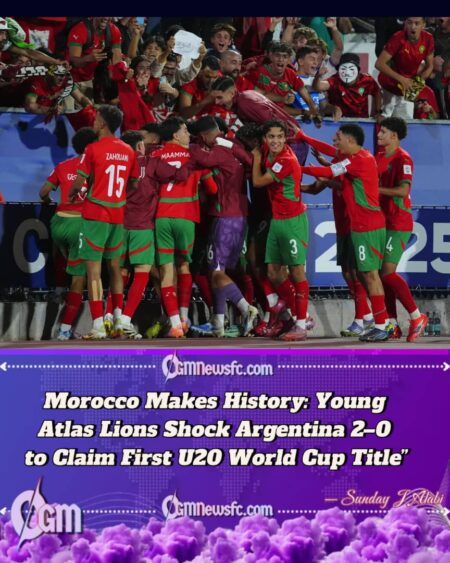
Morocco made history on Sunday night at the Estadio Nacional in Santiago, Chile, stunning six-time champions Argentina 2–0 to capture their first-ever FIFA U20 World Cup title. Entering the match as underdogs, the North Africans displayed courage, tactical discipline, and technical brilliance to outwit the tournament favorites.
The victory marked a watershed moment not just for Moroccan football but for the African continent. Argentina, unbeaten throughout the tournament and boasting four straight clean sheets, were widely expected to add a seventh U20 crown. Yet, it was Morocco’s night of destiny — a performance built on resilience and self-belief that silenced the skeptics and ignited a celebration that will echo for generations.
From the opening whistle, Morocco approached the game with confidence, pressing high and moving the ball with composure. The atmosphere in Santiago was electric, with Moroccan and Chilean supporters combining to create a wall of sound that pushed the young Atlas Lions to glory.
Zabiri’s Magic and Morocco’s Ruthless First Half
The first half belonged entirely to Morocco. Yassir Zabiri, a technically gifted left-footed attacker, opened the scoring in the 12th minute with a sensational free-kick that caught Argentine goalkeeper Santino Barbi completely off guard. Instead of curling the ball over the wall, Zabiri struck it to Barbi’s near post — a bold decision that reflected Morocco’s audacious intent.
That goal set the tone for a commanding performance. Moroccan, brimming with confidence, doubled their advantage in the 29th minute. Othmane Maamma, the tournament’s standout player, sprinted down the right flank and delivered a perfect cross into the path of Zabiri, who met it first-time with a thunderous volley. The crowd erupted as Morocco’s bench spilled onto the field in unrestrained jubilation.
Zabiri’s brace was a showcase of clinical finishing, but Maamma’s role was just as crucial. His pace and creativity terrorized the Argentine defense, earning him the Golden Ball Award as the tournament’s best player. His combination with Zabiri will be remembered as one of the most lethal attacking partnerships in U20 World Cup history.
Argentina’s Frustration and Morocco’s Wall of Steel
Argentina’s attempt to rally in the second half was met with a red wall of Moroccan determination. Despite dominating possession — finishing the match with 75 percent — the South Americans failed to break through a disciplined Moroccan low block. Their 20 attempts produced just three shots on target, a testament to Morocco’s defensive organization and commitment.
Diego Placente’s men grew increasingly desperate as the clock ticked down. Every Moroccan tackle was met with roars from the stands; every Argentine miss drew groans of disbelief. Morocco’s goalkeeper and backline remained composed under intense pressure, repelling crosses and blocking shots with tireless energy.
By the final whistle, Argentina were not only beaten but outthought and outfought. The defeat was particularly painful given the nation’s proud youth football history, with legends like Juan Roman Riquelme, Pablo Aimar, and Lionel Scaloni once gracing the same tournament stage.
Tactical Brilliance and the Making of a Champion
Morocco’s head coach, Mohamed Ouahbi, deserves immense credit for masterminding a game plan that neutralized Argentina’s strengths. His players executed every instruction with precision — from pressing in the right moments to maintaining defensive compactness when under siege.
The Atlas Cubs’ willingness to embrace pragmatic football paid dividends. Their counterattacks were swift and incisive, and their composure under pressure belied their youth. It was a tactical triumph that blended African flair with European discipline — the hallmark of Morocco’s football philosophy in recent years.
While some critics labeled their style as “negative football,” the results spoke for themselves. Morocco’s U20s have now joined their senior counterparts in redefining the nation’s global football identity — one built on strategy, skill, and spirit.
Morocco’s Rise on the Global Stage
Sunday’s victory cemented Moroccan’s place among world football’s emerging powers. Just three years after the senior men’s team’s historic semifinal run at the 2022 FIFA World Cup in Qatar, this triumph further validates the nation’s long-term investment in youth development. Morocco also became the first Arab nation in 44 years to reach — and now win — a U20 World Cup final.
The win reverberated across Africa and the Arab world, symbolizing a new dawn for teams outside traditional powerhouses. With Zabiri’s brilliance and Maamma’s flair, Morocco’s young stars have announced themselves on the global stage.
For Argentina, it was a night of heartbreak but also a glimpse of promise. Placente’s squad, full of young professionals, remains the future of Albiceleste football. Yet on this occasion, they were second best to a Moroccan side that played with the conviction of champions.
As fireworks lit up the Santiago night, Moroccan’s players danced, sang, and lifted their nation’s first-ever U20 World Cup trophy high into the air — a golden moment in African football history and a powerful message to the world: Morocco has truly arrived.