










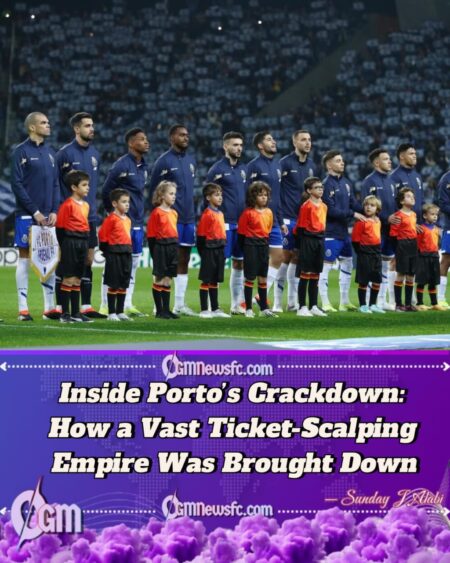
FC Porto has dismantled one of the largest ticket-scalping networks ever uncovered in professional football, reclaiming hundreds of seats at their iconic Estádio do Dragão that had been exploited for illegal profit. According to the club, the illicit operation was raking in tens of thousands of euros per match, selling tickets—often meant for local supporters—to unsuspecting tourists at highly inflated prices.
In a statement shared with The opitanglobamedia football, Porto revealed that one of the alleged ringleaders had manipulated dozens of individuals into surrendering their personal data. Using these details, he registered them as official club members and purchased season tickets in their names. “These schemes reached an impressive scale, with dozens of seats controlled by a single individual,” the club said. “We also identified businesses processing hundreds of transactions, serving as fronts for this unlawful activity.”
Investigators said hundreds of seats have already been returned to the club’s control, but the full extent of the scam may be even larger. “We also detected fake tickets being sold at inflated prices,” Porto added, warning fans to avoid buying from unofficial channels.
How the Scheme Operated: A Sophisticated System Built on Trust and Exploitation
The dismantled network relied on a web of false identities and technological manipulation. The ringleaders allegedly convinced unwitting individuals—often fans or acquaintances—to provide their personal information, which was then used to create member accounts under Porto’s official system. These memberships allowed the perpetrators to secure valuable season tickets at face value and resell them multiple times through online marketplaces.
Tourists became the primary targets. Some seats were resold for up to €800 (£695), far exceeding their original prices. The club disclosed that several intermediary businesses acted as “resale fronts,” giving the illusion of legitimacy while profiting from the inflated margins. The setup was sophisticated enough to deceive even experienced fans and evade detection for several seasons.
Authorities believe the illegal resale networks were especially active during high-profile matches, such as domestic league openers and European fixtures, where demand far outstripped availability. The digital nature of modern ticketing—while meant to enhance convenience—provided new avenues for exploitation.
Tourist Complaints and The opitanglobamedia football’s Investigation
The scandal came to light after Porto’s season opener against Vitória Guimarães on 11 August. Two Danish tourists, proudly clad in Porto’s blue and white colours, told The Guardian they had paid €200 each for tickets they purchased via a resale platform. “The experience was amazing,” one said, “but the prices were surprisingly steep. We were behind one of the goals, and the view wasn’t the best.”
The pair’s tickets bore telltale irregularities. One had the name of a female Porto member, while the other was linked to a season-ticket QR code—potentially granting access to every home game for the entire season. “When we bought the tickets, we were told to delete them from our wallets after the match,” one fan said, highlighting how the scammers sought to cover their tracks.
Unbeknownst to the tourists, Porto and the police were already tracking suspicious ticket activity. A coordinated investigation followed, leading to the exposure and partial dismantling of the network weeks later.
A Culture of Scalping and the Porto’s Troubled Past
Ticket scalping is not a new phenomenon at FC Porto. For years, informal transactions were commonplace around the Estádio do Dragão, with fans and resellers openly trading tickets before matches. The problem reportedly extended to certain supporter factions, particularly the influential ultras group Super Dragões, which had received thousands of discounted tickets directly from the club. These tickets were then resold for profit, often around the stadium on match days.
Such practices persisted under previous administrations, with limited oversight or accountability. The lucrative resale trade became an open secret, feeding frustration among loyal fans who struggled to obtain tickets at face value. The system not only exploited genuine supporters but also eroded trust between the club and its fan base.
Porto’s leadership transition marked a turning point. When former Chelsea and Tottenham manager André Villas-Boas was elected president in 2024, he pledged to bring transparency and integrity back to the club’s operations—a mission that has now begun to show visible results.
Villas-Boas’ Reform Agenda and the Fight for Fan Integrity
Since assuming the presidency, Villas-Boas has undertaken sweeping reforms aimed at restoring fairness and fan confidence. One of his first moves was to cut off the preferential ticket allocations previously granted to ultras groups, ensuring equal access to seats for all club members. The club also implemented a fully digital ticketing system, designed to reward loyalty points and track legitimate transactions more accurately.
“The privileges that once fueled corruption and profiteering are gone,” a club insider said. “Our priority now is to make sure that real supporters, not profiteers, fill our stands.” Porto’s management believes the new measures will not only reduce fraud but also foster a safer, more inclusive environment for fans.
While the police investigation continues, the club’s swift action has been widely praised across Portugal. By reclaiming hundreds of stolen seats and exposing one of football’s most extensive ticket-scalping networks, Porto’s leadership has signaled a firm stand against exploitation and a renewed commitment to transparency in the beautiful game.