










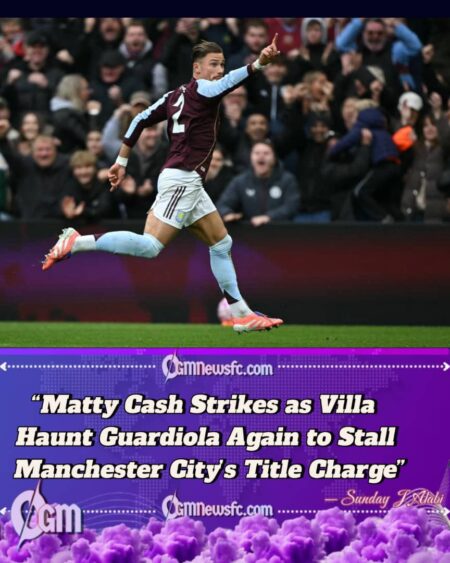
Manchester City’s push to stay in touch with the Premier League leaders was derailed in Birmingham as Aston Villa extended their remarkable home record against Pep Guardiola’s men. A first-half strike from Matty Cash was all Unai Emery’s side needed to seal a 1-0 victory and condemn City to another frustrating night at Villa Park — a ground that has become their modern-day bogey venue.
The defeat snapped Manchester City’s run of three consecutive league wins and leaves them six points adrift of leaders Arsenal. Having gone nine games unbeaten in all competitions, Guardiola’s side arrived in the West Midlands with confidence restored and talk of another title charge rekindled. Yet, Villa once again exposed Manchester City’s vulnerabilities, turning the contest into a reminder of their inconsistency this season.
Manchester City looked a shadow of their dominant selves, unable to establish rhythm or control against a Villa side brimming with intensity and tactical clarity. It was a night that echoed past struggles, furthering the perception that Villa Park has become a graveyard for Guardiola’s ambitions.
Why Do Manchester City Struggle So Much at Villa Park?
For the third consecutive year, Manchester City left Villa Park with more questions than answers. Despite returning to full strength in defence with Ruben Dias, Josko Gvardiol, and John Stones, City looked alarmingly fragile under pressure. Villa’s swift counterattacks repeatedly carved them open, and had Emery’s men been more clinical, the scoreline might have been even more damning.
Guardiola had spoken confidently before the match about his side’s steady improvement since their August defeat to Brighton. Yet, against Villa, that progress vanished. Manchester City’s inability to control transitions remains a glaring weakness — one Arsenal, their main rivals, have largely eliminated. Even when City dominated possession, they offered space and encouragement for Villa to attack with aggression and pace.
This defensive vulnerability has become a recurring theme in Manchester City’s campaign. They escaped similar punishment against Everton last weekend, but their luck ran out here. Villa’s relentless energy in the first half was rewarded with Cash’s goal, and while Manchester City improved marginally after the break, the damage was already done.
Villa’s Defensive Masterclass: Silencing Haaland
For the first time in 12 matches across club and country, Erling Haaland failed to find the net — and barely found the ball. In a stunning defensive display, Villa restricted the Norwegian striker to just four touches inside their penalty area, and only seven passes across the entire game.
In the opening 45 minutes, Haaland’s isolation was glaring. He had more touches in his own half than in Villa’s box, a testament to how effectively the home side shut down Manchester City’s supply lines. When Bernardo Silva finally managed to slip him through shortly after Villa’s opener, Haaland’s finish was tame — easily gathered by Emi Martinez, who commanded his area superbly all evening.
Even as Manchester City pushed late on, Villa’s defensive organisation remained unbroken. Pau Torres and Diego Carlos marshalled Haaland with discipline, while midfielders Boubacar Kamara and Douglas Luiz shielded the back line with intelligence and energy. Guardiola’s supporting attackers — Savinho, Phil Foden, Oscar Bobb, and Silva — failed to stretch Villa or exploit space behind, leaving Haaland stranded and frustrated.
Guardiola’s Selection Gamble Backfires
Pep Guardiola’s tactical tinkering — fielding four lightweight, technical attackers behind Haaland — proved costly. Savinho, Foden, Silva, and Bobb offered creativity but little physical presence, allowing Villa to dominate duels and second balls in the first half. The decision to play Tijjani Reijnders as a lone holding midfielder further weakened Manchester City’s ability to handle Villa’s direct surges.
City attempted to press high, but Villa’s composure under pressure repeatedly saw them bypass the press and exploit space in behind. It was a familiar problem, reminiscent of last season’s 2-1 loss at the same ground — a night that symbolised City’s mid-season slump. Once again, Villa’s superior athleticism and tactical clarity overwhelmed City’s intricate but ineffective possession play.
Guardiola’s second-half changes — introducing Nico O’Reilly, Nico González, and Jeremy Doku — injected energy but failed to change the game’s momentum. The lack of physical balance in City’s starting XI left them chasing shadows for much of the contest, and by the time adjustments came, Villa’s defensive shape had already solidified their grip on the match.
What Next for Manchester City?
City’s attention now turns to the Carabao Cup, where they travel to Swansea on Wednesday, October 29, for a Round of 16 clash (7:45 p.m. UK / 3:45 p.m. ET). Guardiola will view it as an opportunity to rotate his squad and restore confidence before a crucial league encounter.
Just days later, City return to Premier League action at the Etihad Stadium against Bournemouth on Sunday, November 2 (4:30 p.m. UK / 11:30 a.m. ET). With Arsenal maintaining their lead at the summit, City can ill afford further slip-ups. Guardiola’s side must rediscover their defensive solidity and attacking fluidity if they hope to mount a serious title challenge.
For now, though, Villa Park remains a place of frustration and introspection for the champions. Once again, Guardiola left the Midlands searching for answers — and Arsenal, watching from the top, will have enjoyed every moment of it.