










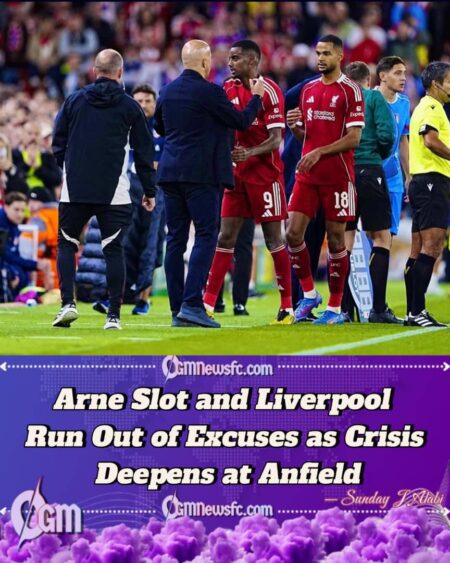
For a while, it was easy for Arne Slot and Liverpool to point to fine margins. Late goals against Crystal Palace and Chelsea could be chalked up to lapses in concentration or bad luck — the kind of moments that even great sides endure. Against Manchester United, the Reds could take solace in dominance without reward, hitting the woodwork three times and outplaying their rivals in every measurable way except the scoreline.
But when Liverpool fell 3–2 to Brentford at the Gtech Community Stadium, the excuses ran dry. This time, there was no hard-luck story, no controversial decision or unlucky bounce. The reigning champions simply collapsed. From misplaced passes under no pressure to woeful defending and a lack of composure in front of goal, it was a performance that left even loyal fans wondering what had gone wrong.
Arne Slot’s men didn’t just lose; they looked lost. A 20-minute spell after half-time, in which Liverpool failed to register a single shot, underlined a side drained of belief, creativity, and cohesion. Once again, Liverpool’s weaknesses were brutally exposed by opponents who simply wanted it more.
Excuses Run Thin: Arne Slot’s Press Conference Raises Eyebrows
After the match, Slot faced the press with his usual calm, yet there was an unmistakable edge to his tone. He insisted he was not making excuses — before promptly listing a series of mitigating factors. The fixture congestion, he said, had been punishing. Five of Liverpool’s last six games had been away from home. The turnaround from Wednesday’s trip to Frankfurt to Saturday’s clash in London was too short.
Yet, as many pointed out, this was a team that boasted the Premier League’s best away record last season. Travel fatigue didn’t explain the rash tackles, misdirected clearances, or lack of intensity. Nor did it justify the fact that only one team in Europe’s top five leagues — St Pauli in Germany — is currently enduring a worse losing streak.
Even Slot’s complaint about a “soft penalty” against Virgil van Dijk seemed like deflection. The contact was minimal, yes, but the Liverpool captain’s decision to swing a leg so recklessly spoke volumes. Leadership, once the Reds’ hallmark under Jurgen Klopp, now appears fragile and uncertain under Slot.
Liverpool Squad Overhaul or Strategic Misstep?
One of Slot’s more plausible defences was that Liverpool are a team in transition. The summer saw the departure of several senior figures: Luis Díaz, Darwin Núñez, Jarell Quansah, and Caoimhin Kelleher. In their place came a batch of ambitious recruits — Milos Kerkez, Florian Wirtz, Hugo Ekitike — but the adaptation has been far from seamless.
The results speak for themselves. Diaz’s flair and drive on the wing have been sorely missed. Wirtz, though gifted, has struggled to impose himself physically in the Premier League. Kerkez, meanwhile, looks overwhelmed, with his panicked clearance across his own box at Brentford summing up both his and Liverpool’s anxiety.
Slot may argue that rebuilding takes time, but Liverpool’s current slump suggests something deeper. This isn’t just about new faces gelling — it’s about leadership on the pitch, tactical identity, and accountability. When a team of this quality concedes four defeats in a row, patience becomes a luxury.
Tactical Stagnation and Mental Fatigue
Liverpool’s tactical flaws have become glaringly predictable. Opponents have learned to frustrate Slot’s system: stay compact, go direct, exploit set pieces, and target the Reds’ vulnerability to long balls. Brentford executed this playbook perfectly — physically dominant, direct in approach, and relentless in exploiting Liverpool’s hesitation.
Michael Kayode’s long throws, which Slot admitted the team had specifically prepared for, caused chaos throughout the match. Worse still, Liverpool repeatedly aided Brentford by conceding throw-ins in dangerous areas — a self-inflicted wound that exposed both poor composure and poor planning.
What’s more troubling is the psychological dimension. The players’ body language told a story of frustration and fatigue. Winning duels, reacting to second balls, or sustaining pressure — all hallmarks of Klopp’s Liverpool — have become rare. Slot’s team now looks both mentally and tactically adrift, unable to summon the aggression or unity required to reverse their slide.
The Road Ahead: Slot’s Moment of Reckoning
Every new era brings turbulence, but for Arne Slot, the turbulence has turned into a storm. The Dutchman’s early promise — high pressing, fluid attacking, and calm authority — is being eroded by repeated defeats and mounting scrutiny. The longer Liverpool’s slump continues, the less convincing the explanations become.
The challenges are now clear: rediscover identity, restore confidence, and make hard choices. That might mean reshaping his tactics, trusting different personnel, or simply instilling more urgency in a team that seems to have lost its spark.
For a club of Liverpool’s stature, mediocrity is never tolerated for long. Slot can no longer hide behind tight schedules, soft penalties, or transitional excuses. The time for reasons has passed. What Liverpool need now is response — because if the current trend continues, questions about the manager’s future will soon outweigh any discussion about his philosophy.