









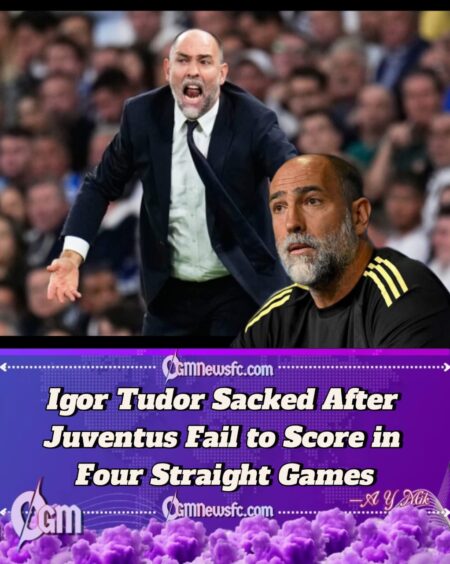
Juventus have parted ways with head coach Igor Tudor after enduring one of their worst runs of form in recent memory. The Bianconeri went eight consecutive matches without a win, failing to find the back of the net in their last four — a slump that ultimately sealed Tudor’s fate. The decision was made official late Monday night, marking yet another turbulent chapter in the club’s managerial history.
Sources close to the club confirmed that the board had grown increasingly frustrated with the team’s lack of creativity and intensity. Despite early-season optimism following Igor Tudor’s appointment, Juventus’ performances have steadily declined, leaving fans disillusioned and questioning the team’s direction.
The decision underscores Juventus’ urgent need for change. The once-dominant Serie A giants have struggled to maintain consistency since the post-Allegri era began, and the pressure to return to the top has never been greater. Igor Tudor’s dismissal reflects both the club’s ambition and its impatience for results.
Igor Tudor’s Short-Lived Tenure Ends in Disappointment
Igor Tudor arrived in Turin amid high expectations, hailed as a coach who could inject attacking flair and tactical versatility into a side that had grown stale. However, his reign failed to live up to the billing. After an encouraging start, Juventus’ form fell apart as the season progressed — with tactical confusion, poor finishing, and defensive lapses becoming recurring themes.
Tudor’s insistence on a fluid 3-4-2-1 system failed to yield consistent results, particularly against mid-table teams where Juventus struggled to break down compact defenses. His squad rotation choices also came under scrutiny, as key players such as Federico Chiesa and Dusan Vlahovic often appeared isolated and underutilized.
Fans’ patience began to wear thin after a string of goalless draws and uninspired performances. By the time Juventus failed to score for the fourth match in a row, it was clear that Igor Tudor’s relationship with the dressing room and the board had broken down. His departure, though painful, was widely anticipated — a necessary reset for a team that has lost its identity.
Massimo Brambilla Steps In as Interim Manager
In the wake of Tudor’s exit, Juventus have appointed Massimo Brambilla as interim manager. Brambilla, previously in charge of Juventus’ Next Gen (Under-23) squad, is well-respected within the club for his tactical intelligence and player development skills. His temporary promotion signals the club’s desire for internal stability while a permanent replacement is sought.
Brambilla’s appointment comes at a critical juncture. Juventus are slipping in the Serie A standings and risk losing touch with the Champions League qualification spots. The board’s immediate expectation is for Brambilla to steady the team, restore confidence, and reestablish a sense of purpose in the dressing room.
The interim coach’s first task will be to reignite Juventus’ attack — a department that has looked blunt and predictable in recent weeks. With a more familiar understanding of the youth setup, Brambilla may also look to integrate younger talents into the senior squad to inject energy and hunger. His debut fixture, set for this weekend, will be closely watched by fans eager to see a response.
A Club Under Pressure and Searching for Identity
The managerial change at Juventus is not just about poor form — it’s symptomatic of a deeper identity crisis. Since the departure of long-time coach Massimiliano Allegri, the club has struggled to find stability. Each new appointment — from Andrea Pirlo to Maurizio Sarri, and now Igor Tudor — has promised a new direction, but none have managed to reestablish the winning mentality that once defined the Turin side.
Juventus’ front office now faces a critical decision: whether to continue experimenting with young, progressive managers or revert to an experienced hand who can deliver immediate results. The club’s recent strategy of short-term appointments has yielded inconsistency, both on the pitch and in morale.
The fans’ frustration is palpable. Once accustomed to dominating Serie A and competing deep into the Champions League, Juventus now find themselves struggling for rhythm and cohesion. The next managerial choice will not only define the club’s immediate future but could also determine whether they remain competitive among Europe’s elite.
What Went Wrong Under Tudor’s Leadership
While injuries and fixture congestion have played their part, many observers believe that tactical confusion was the root of Juventus’ collapse under Igor Tudor. The Croatian coach attempted to blend possession-based football with the aggressive pressing style that defined his days at Hellas Verona, but the hybrid system never fully clicked in Turin.
The result was a side that looked unsure of itself — too passive without the ball and too predictable in possession. Star players such as Adrien Rabiot and Weston McKennie appeared out of sync, while the defense, once Juventus’ trademark, looked increasingly vulnerable. The inability to score in four consecutive games highlighted a lack of creativity in the final third and a deeper crisis of confidence.
Behind the scenes, reports suggested friction between Igor Tudor and several senior players, including Wojciech Szczęsny and Manuel Locatelli, over tactical responsibilities. Whether or not those tensions were decisive, they certainly contributed to the overall instability that led to his downfall.
What Lies Ahead for Juventus
With Brambilla in temporary charge, Juventus are expected to take their time finding a permanent successor. Names such as Thiago Motta, Antonio Conte, and Zinedine Zidane have already been linked with the job — each offering vastly different approaches to leadership and playing style. The Juventus hierarchy will be under intense scrutiny as they navigate this crucial decision.
The immediate focus, however, remains on damage control. Juventus cannot afford to let their season slip further, especially with Champions League qualification and financial implications on the line. A quick turnaround under Brambilla would restore confidence and buy the club precious time to conduct a thorough managerial search.
Despite the current turmoil, Juventus remain one of Europe’s most powerful football institutions. The sacking of Igor Tudor may mark the end of a failed experiment, but it could also signal the beginning of a new era — one defined by a return to discipline, purpose, and the winning mentality that once made them a global powerhouse.