










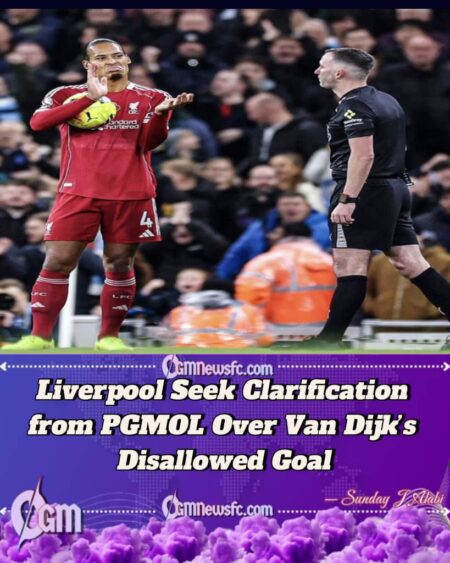
Liverpool have formally contacted the Professional Game Match Officials Limited (PGMOL) to challenge the decision that saw Virgil van Dijk’s first-half goal disallowed during Sunday’s 3–0 defeat to Manchester City at the Etihad Stadium. The club expressed concern that referee Chris Kavanagh and the Video Assistant Referee (VAR), Michael Oliver, failed to correctly interpret Law 11 regarding offside interference.
The incident occurred in the 38th minute when Van Dijk’s powerful header found the back of the net, appearing to level the score at 1–1. However, the goal was ruled out after officials determined that Andy Robertson, standing in front of City goalkeeper Gianluigi Donnarumma, had impeded his vision by ducking beneath the flight of the ball. Liverpool insist Robertson did not obstruct Donnarumma’s view or make an attempt to play the ball.
Having reviewed the footage from multiple angles, Liverpool maintain that the criteria for offside interference were not met. Club representatives have contacted PGMOL head Howard Webb to seek clarification on how the decision aligned with the laws of the game, arguing that similar incidents have been ruled differently in the past.
Dispute Over the Interpretation of Law 11
Liverpool’s primary argument rests on the interpretation of Law 11, which outlines what constitutes an offside offence. According to the law, a player in an offside position should only be penalised if he interferes with play or with an opponent by clearly obstructing the opponent’s line of vision or challenging for the ball.
In this case, Liverpool argue that Robertson neither obstructed Donnarumma’s sight nor interfered with his ability to react. The club believes the phrase “making an obvious action which clearly impacts on the ability of an opponent to play the ball” was wrongly applied. Their stance is that Robertson’s ducking motion was incidental and did not influence Donnarumma’s response to Van Dijk’s header.
This disagreement has reignited broader debates about consistency in the application of VAR and offside rulings. Liverpool’s management insists their objection is not merely about one goal, but about ensuring uniform interpretation of the rules across all Premier League fixtures.
Slot Refuses to Blame Controversy for Heavy Defeat
Liverpool head coach Arne Slot acknowledged his team’s poor performance but described the disallowed goal as a “clear and obvious error.” Despite the controversy, Slot avoided deflecting blame from his players, stating that Manchester City were deservedly ahead at half-time.
“He [Robertson] didn’t interfere at all with what the goalkeeper could do,” Slot said post-match. “Someone showed me a goal that the same referee allowed for City last season when Bernardo Silva was in an offside position near the goalkeeper. That decision was treated differently, and it’s frustrating to see a lack of consistency.”
Slot admitted that being 2–0 down at the break was a fair reflection of Liverpool’s first-half display but added that moments like Van Dijk’s goal could have changed the momentum. The coach emphasized that his concern lies with fairness and transparency in officiating rather than shifting focus away from his team’s shortcomings.
Liverpool Seek Accountability and Transparency from PGMOL
While Liverpool have accepted the final result of the match, they remain adamant that the decision not to allow Van Dijk’s goal should not pass without scrutiny. Club officials are said to have raised the issue formally with PGMOL, seeking both an explanation and assurances of improved transparency in the decision-making process.
This move follows similar instances this season in which Premier League clubs have sought clarification from the refereeing body after controversial VAR calls. Liverpool’s correspondence reportedly emphasizes the importance of consistency, especially given the increasing role technology plays in officiating.
The club’s leadership believes that raising the matter with Webb and PGMOL is vital to restoring faith among players, coaches, and supporters who have grown frustrated by inconsistent interpretations of the same laws.
Calls for Consistency in VAR Decisions Grow Louder
The Van Dijk incident has once again placed VAR under scrutiny amid growing calls for reform in how decisions are communicated and reviewed. Critics argue that, despite technological advancements, the system still relies too heavily on subjective judgment rather than clear, measurable standards.
Several pundits and former referees have echoed Liverpool’s frustrations, highlighting the need for clearer definitions within Law 11. The episode also comes just weeks after other high-profile VAR controversies, further fuelling debates about the technology’s reliability and transparency.
For now, Liverpool await PGMOL’s formal response, hoping their protest will lead to clearer guidelines and fairer officiating standards. While the disallowed goal may not have changed the outcome at the Etihad, the Reds’ challenge could help shape how similar incidents are handled in the future.