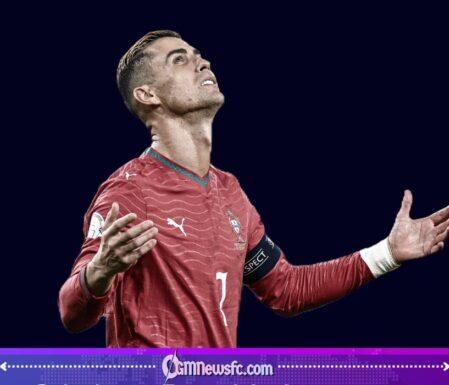










The Portuguese Football Federation (FPF) is preparing a formal appeal to ensure Cristiano Ronaldo is available for Portugal’s opening matches at next year’s World Cup, following his controversial red card against the Republic of Ireland.
Ronaldo, 40, was sent off during Portugal’s 2–0 defeat in Dublin after appearing to lash out with an elbow at defender Dara O’Shea around the hour mark. The incident, which was reviewed by VAR, resulted in a straight red card for the veteran forward — his first ever dismissal in 226 international appearances.
While Ronaldo has already served a one-match suspension, missing Sunday’s 9–1 demolition of Armenia that sealed Portugal’s qualification for the 2026 World Cup in Canada, Mexico and the United States, the length of his full ban remains unclear. Under standard regulations, a straight red card for violent conduct typically attracts a multi-game suspension, raising fears that Ronaldo could be ruled out of Portugal’s first two group matches at the tournament.
World Cup Stakes: Why Ronaldo Ban Matters So Much
The timing and potential extent of the ban could hardly be more significant. Ronaldo remains the emotional and symbolic leader of the national team, even at 40, and his presence on the pitch in North America is viewed as central to Portugal’s ambitions at what may well be his final World Cup.
Portugal’s emphatic 9–1 victory over Armenia, achieved without their captain, underlined the squad’s attacking depth, with Bruno Fernandes starring in Ronaldo’s absence. However, within the FPF and among supporters, there is little desire to approach the world’s biggest stage without their most iconic player available from the first whistle.
A two-match suspension at the finals would mean Ronaldo missing the crucial early games that often set the tone for a team’s entire campaign. For a side tipped as dark horses or even favourites by some observers, the loss of such experience and star power could have both tactical and psychological consequences. The FPF’s appeal is therefore being framed not just as a defence of a player, but as a matter of national sporting interest.
The Appeal: Three Pillars of Portugal’s Case
According to reports in Portugal, FPF president Pedro Proença has personally involved himself in the process and will front a detailed complaint to FIFA, built on three main arguments designed to reduce Ronaldo’s punishment to a single match – effectively backdating his ban to the Armenia qualifier he has already missed.
First, the FPF will point to what they describe as a “hostile environment” inside the Aviva Stadium in Dublin. They are expected to argue that the atmosphere around the game, including pre-match comments by Republic of Ireland manager Heimir Hallgrimsson, contributed to heightened tension. Hallgrimsson had suggested that Ronaldo exerted undue influence over the referee in the previous meeting between the teams, remarks which Portugal believe may have shaped perceptions of their captain before kick-off.
Secondly, the FPF will contend that Ronaldo was provoked in the build-up to the flashpoint with O’Shea. Television images show the defender closely marking the Portuguese forward and grabbing at his shirt. Portugal’s case is understood to stress that Ronaldo’s reaction was a consequence of persistent physical contact, and that while his response was ill-judged, it did not merit classification as violent conduct deserving of a prolonged suspension.
The third pillar of the appeal will focus on Ronaldo’s exemplary disciplinary record for the national team. In 226 caps for Portugal, spanning more than two decades, the forward has never previously been sent off. The FPF will ask FIFA to take this into account as a mitigating factor, stressing that this was an isolated incident from a player who has long been considered a model professional at international level.
Martinez and Hallgrimsson Offer Contrasting Interpretations
Portugal manager Roberto Martínez was quick to defend his captain after the loss in Dublin, insisting that the incident did not amount to true violence. Speaking after the match, Martínez emphasised the physical nature of the marking Ronaldo faced throughout the game, with two defenders frequently in close contact with him inside the penalty area.
According to the former Everton and Belgium coach, Ronaldo’s movement was an attempt to push the defender away rather than to strike him with malicious intent. Martínez suggested that the video replays, and specifically the VAR angle used in the review, may have made the incident look more serious than it was in real time. He also highlighted the fact that this was Ronaldo’s first red card in more than 20 years with the national side, calling it “incredible” that an isolated moment could lead to a ban that jeopardises his World Cup participation.
On the opposite bench, Heimir Hallgrimsson offered a far less sympathetic interpretation. The Republic of Ireland coach said Ronaldo had “lost his focus a little bit” and hinted that the charged atmosphere, including a vocal Irish crowd, may have contributed to the Portuguese star’s frustration. Hallgrimsson claimed Ronaldo admitted to him afterwards that he had reacted poorly, but rejected the notion that his own pre-match comments or the referee’s handling of the game were to blame, calling the elbow a “silly decision” and describing the move as an unnecessary attack on his player.
What Happens Next: FIFA’s Decision and Portugal’s Preparations
The FPF is now expected to formally submit its complaint to FIFA’s disciplinary bodies, asking that Ronaldo’s sanction be limited to the qualifier he has already missed. The timeline for a final decision is not yet public, but Portugal are keen for clarity well before next summer’s tournament, both for planning purposes and to avoid ongoing speculation around their captain’s status.
If FIFA accepts the arguments presented by Proença and his team, Ronaldo’s red card could be deemed sufficiently punished by his absence against Armenia, leaving him free to line up when Portugal begin their World Cup campaign in North America. That outcome would be celebrated not only by Portuguese fans, but by many neutral supporters for whom the chance to see Ronaldo on the World Cup stage one last time is a major draw.
If, however, the governing body upholds the usual interpretation of a straight red for violent conduct and imposes a multi-game ban, Portugal will be forced to adjust quickly. Martínez would then have to construct a game plan for at least the opening fixtures without his most experienced player, relying instead on an emerging generation of stars who proved against Armenia that they can score freely, but who have not yet faced the intense spotlight and pressure of a World Cup opener without Ronaldo’s presence.
For now, Portugal’s strategy is clear: defend their captain in the strongest possible terms, highlight his long-standing record of fair play, and hope that FIFA shows leniency – ensuring that one moment of frustration in Dublin does not overshadow a glittering international legacy on football’s grandest stage.