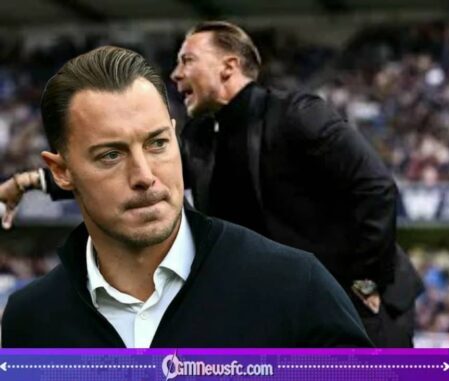










Crystal Palace manager Oliver Glasner has launched a scathing assessment of the club’s transfer planning, accusing the board of failing to properly strengthen the squad ahead of their first-ever European campaign. The Eagles, stretched by domestic and continental commitments, fell to a second-half collapse in their Premier League defeat to Manchester United, prompting the Austrian coach to publicly air his frustrations.
Glasner, who led Palace to a historic FA Cup triumph and into Europe, suggested the club had “saved instead of investing” at the crucial moment. With his contract due to expire in the summer, his comments will intensify speculation over his long-term future at Selhurst Park. He stressed that the players were giving everything but were being let down by a lack of depth, leaving them physically outmatched in key fixtures.
The manager’s remarks came after Palace, who played their 22nd competitive match of the season, showed signs of fatigue following a midweek UEFA Conference League defeat at Strasbourg. While he refused to blame his squad, Glasner was emphatic that the club’s hierarchy had misjudged the demands of combining European football with the Premier League and domestic cups.
European Demands Expose Lack of Squad Depth
Palace’s journey into Europe was supposed to mark a new chapter in the club’s history, but the combination of congested fixtures and limited reinforcements has instead highlighted the fragility of the squad. The Eagles have now failed to win any of their four Premier League matches immediately following UEFA Conference League group games, a pattern Glasner believes is rooted in the summer’s recruitment failures.
“It was our 22nd game,” the Austrian pointed out, underlining the physical toll on his players. He acknowledged that Manchester United simply looked “physically better” and admitted that his team’s energy levels dropped in the second half. The decisive goals, both conceded from set pieces, reflected not only lapses in concentration but also the exhaustion of a group stretched to its limits.
Glasner argued that the club had known the demands ahead of time, given the early confirmation of their European qualification. He insisted that the board had been well aware of the increased workload but failed to equip the squad accordingly. “We missed to strengthen the depth of the squad in the summer and we knew the schedule,” he said. “It’s the first time in your history that you play European football. So let’s invest instead of saving. We saved and that’s what we’re facing.”
Injuries, Afcon and the Cost of Standing Still
The manager also highlighted the specific example of Ismaila Sarr to underline his concerns about planning and depth. The Senegal international, a key attacking outlet for Palace, is due to depart for the Africa Cup of Nations later this month. Glasner noted that this absence was entirely predictable – yet the club did not move decisively in the summer transfer window to prepare for it.
“We knew that Ismaila would go to the Afcon but nothing happened,” he lamented, suggesting that the club had ignored an obvious gap that would open mid-season. To compound matters, Sarr was substituted against Manchester United with what Glasner described as a “swollen ankle,” another reminder of the physical strain on core members of the squad.
Despite the mounting challenges, Glasner was careful to shield his players from criticism. He praised their commitment and effort, insisting that they had “left their hearts on the pitch.” The issue, he said, was not desire but physical limitation. “No blame for the players because they gave everything,” he said. “But their legs don’t do what your head wants them to do.” For the manager, the problem lies in asking too much of too few.
We Saved and That’s What We’re Facing”: Manager Calls for January Correction
Glasner’s comments were as much a warning as a diagnosis. He made it clear that, in his view, the club’s failure to invest at the right time has put Palace in a vulnerable position heading into the heart of the season. While January offers a chance to reinforce, he argued that any action taken then would be reactive rather than strategic.
“I would have wished for a little bit more backing, yes,” he admitted, a rare public admission of frustration with the board. “I think in January we just correct what we failed to do in the summer. By January, we have played 60/65% of the season. Let’s see.” The implication is that the damage from the lack of summer activity may already be significantly done by the time the winter window opens.
His remarks are likely to fuel debate among supporters and pundits about the club’s ambition and direction. Having achieved the historic landmark of European qualification and lifted the FA Cup, many fans expected Palace to build on that momentum. Instead, Glasner’s words paint a picture of hesitation and caution at boardroom level, in stark contrast to the on-pitch demands of competing on multiple fronts.
VAR, Double-Touch Drama and Glasner’s Indifference to Rule Change
Amid the deeper issues of fatigue and squad construction, the match itself provided a notable moment of controversy and curiosity. Palace became the first Premier League side to benefit from the new “double-touch” penalty rule. Jean-Philippe Mateta initially converted from the spot, but VAR replays showed that his standing leg had also made contact with the ball as he struck it.
Under previous rules, the goal would have been disallowed for a double touch and play would have been restarted with a free-kick to the opposition. However, following a law change this season, an accidental double contact by the penalty taker now results in the kick being retaken if the ball ends up in the net. Mateta was duly allowed to take the penalty again and scored for a second time, ensuring Palace did not lose out due to his slip.
Glasner admitted he was unaware of the change until informed by the fourth official on the touchline. “I had no idea,” he said. “But the fourth official told us. So we were lucky today.” Asked for his opinion on the new regulation, the manager cut a detached figure. “Do I think it is a good rule change? I don’t care, honestly,” he replied. For Glasner, the quirks of VAR and reinterpreted laws pale in comparison to the more fundamental issue he believes is holding Palace back – the lack of investment in a squad asked to compete on more fronts than ever before.