










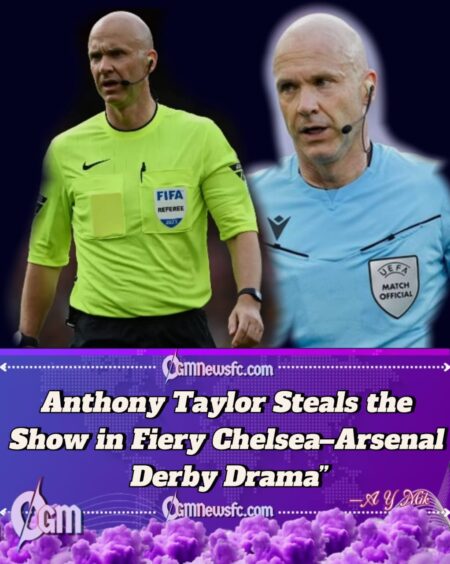
Anthony Taylor, the Premier League referee has a knack for turning routine fixtures into evening entertainment, and this derby was no exception.The highly anticipated clash between Chelsea and Arsenal began with a familiar presence overshadowing the players, the tactics, and even the weather, From the opening whistle, Taylor commanded the spotlight like a man determined to trend on social media.
Several borderline fouls whizzed past without so much as a raised eyebrow from Taylor, setting a tone that immediately made both benches twitchy. Fans quickly realized they weren’t just watching a football match — they were watching The Anthony Taylor Show, with 22 players acting as background cast.
Caicedo’s Crunching Challenge and the Red That Ignited the Match
The match’s defining spark came in the 38th minute when Moisés Caicedo lunged into Arsenal’s Mikel Merino with a tackle that stopped hearts and started arguments. Taylor initially reached for yellow, causing Arsenal supporters to nearly combust from disbelief.
Seconds later, VAR invited Taylor to the monitor for a second opinion — and with a slow-motion replay exposing the studs-up challenge in all its glory, the yellow became a red. Chelsea dropped to ten men, and Stamford Bridge roared in shock and fury.
Even though VAR drove the final decision, the debate centered squarely on Taylor: Why wasn’t it red from the start? Why were so many earlier fouls ignored? Why does chaos follow him like a devoted fan club?
Chelsea Respond With Grit, Energy, and Extra Adrenaline
If Anthony Taylor expected Chelsea to unravel after the red card, he underestimated the emotional power of injustice. Instead of panicking, the Blues hardened their shape and played with defiant intensity, matching Arsenal stride for stride.
Chelsea fans fed off the drama, rallying the players with thunderous noise. Every tackle won and every clearance felt like a moral victory. The team began pressing with surprising courage, almost as if Taylor’s card had activated a hidden turbo mode.
Arsenal, oddly, seemed less motivated despite having the numerical advantage. Their passing lost rhythm, their flow stuttered, and the control they typically exert evaporated as Chelsea’s ten men outworked them.
Chalobah’s Header and the Offside Decision That Taylor Never Looked At
The match flipped again when Chelsea won a second-half corner. Reece James delivered a beautiful ball into the box, and Trevoh Chalobah rose above everyone to nod it home. Stamford Bridge exploded with joy — until TV replays showed a potential offside player obstructing the line of sight.
Under modern interpretations, this is the kind of play VAR usually spends 10 minutes dissecting. But not this time.
Anthony Taylor didn’t go to the monitor. VAR didn’t interrupt. The goal stood without hesitation.
Pundits later insisted the goal should have been disallowed. Fans concluded that Taylor had already reached his “moment quota” for the night. The decision added more fuel to the ongoing saga of Taylor vs. Accuracy.
Arsenal’s Late Surge and Taylor’s Whistle Symphonies
Arsenal finally responded to the growing drama, creating wave after wave of pressure in the final stretch. Chelsea’s ten men were forced deep into their defensive bunker, where they blocked, scrambled, and prayed for dear life.
During this period, Anthony Taylor’s whistle became an omnipresent soundtrack. Fouls were called, ignored, reconsidered, and debated — sometimes all within the same minute. Arsenal’s bench repeatedly appealed for another red card, but Taylor held firm.
Chelsea’s defenders threw themselves into tackles and clearances, while Arsenal grew visibly frustrated — both at the Blues’ resilience and Taylor’s unpredictable thresholds for what constituted a foul.
Anthony Taylor in the Spotlight — Again and Always
Once the dust settled, the post-match conversation wasn’t about tactics, goals, or standout players.
It was about Anthony Taylor.
Critics highlighted:
A missed potential red card for Arsenal’s Hincapié
Selective foul recognition
Allowing the game to spiral before VAR intervention
Failing to review the offside call on Chelsea’s goal
Supporters argued the match was “too heated for any referee to control,” while neutral fans insisted Taylor had once again become larger than the match itself.
No matter the angle, Taylor dominated the post-match analysis the way he had dominated the 90 minutes.
Fallout: Chelsea Celebrate, Arsenal Protest, and Taylor Trends Nationwide
Chelsea celebrated their resilience, identifying the hard-earned point as a symbol of character and unity. The red card had galvanized them, and the controversial goal had given them a reason to believe they could outfight any opponent.
Arsenal, on the other hand, left Stamford Bridge frustrated with themselves and furious with Taylor. They questioned officiating inconsistency, offside interpretations, and the overall management of the match.
And as tradition dictates, Anthony Taylor instantly dominated social media trends, with thousands of fans debating, dissecting, and occasionally memeing his decisions.
A London derby full of drama — with Taylor as the unlikely leading act.