








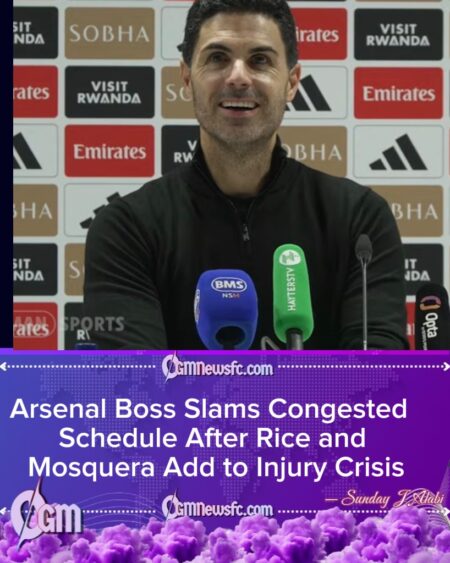
Arsenal manager Mikel Arteta has voiced deep frustration with the Premier League’s tight scheduling after two more of his key players — Declan Rice and Cristhian Mosquera — were forced off with injuries during the club’s 2–0 victory over Brentford on Wednesday night. The result restored Arsenal’s five-point lead at the top of the table, but the joy was overshadowed by growing concerns about squad fitness.
Speaking after the match, Arteta described the injuries as “never good news”, stressing that tests would determine the severity. Rice, who appeared to gesture towards his calf before being withdrawn in the 83rd minute, was unable to continue despite attempting to shake off the knock. Mosquera, meanwhile, was replaced late in the first half with what Arteta described as a problem involving “part of the knee or ankle”.
The manager warned that the mounting injury list — which already includes first-choice central defenders Gabriel Magalhães and William Saliba — underscores the unsustainable demands placed on clubs competing in several competitions. With Arsenal set to play three matches in just seven days, Arteta called for greater consideration of player wellbeing across the league.
Mounting Injury Crisis Hits Arsenal Defence
Arsenal entered the Brentford match already depleted at the back, with Gabriel and Saliba unavailable. Their absences forced Arteta to reshuffle his defensive structure, only for further complications to arise when Mosquera signalled he could no longer continue. The Spaniard’s injury required the introduction of Jurrien Timber, who is himself returning from a long-term setback.
Rice’s withdrawal further compounded the night’s difficulties. The midfielder, who has been an ever-present figure for both club and country this season, was visibly uncomfortable before being substituted. Arteta confirmed that while Rice could walk, he was in no condition to remain on the pitch — a worrying sign given his workload across domestic and international fixtures.
Despite these challenges, Arsenal delivered a controlled performance, securing victory through goals from Mikel Merino and substitute Bukayo Saka. The result ensured their lead at the top of the table remains intact, but Arteta admitted that the injuries cast a shadow over the team’s progress.
A Demanding Week Sparks Concerns
The fixture against Brentford came between a taxing 1–1 draw with Chelsea on Sunday and an upcoming away trip to high-flying Aston Villa scheduled for Saturday lunchtime. Arteta criticised the compressed timeline between matches, arguing that the recovery window is simply insufficient for elite footballers performing at maximum intensity.
Arteta stressed that Arsenal, like other clubs competing in European competitions, face particularly heavy demands. “We play Wednesday night and then Saturday morning,” he said. “Give us just a little bit more time to recover… It’s common sense.” The coach reiterated that while players are capable of managing heavy minutes, the timing and frequency of matches must be assessed more carefully.
This week’s schedule encapsulates the broader challenge: a congested calendar at league, continental, and international levels. With national team obligations also expanding, players find themselves with little rest throughout the year, leading to concerns about fatigue-related injuries.
Rice’s Workload Highlights Growing Issue
Declan Rice’s situation has become symbolic of the wider problem. The midfielder featured in all six of England’s 2026 World Cup qualifiers during the autumn and has started all but two of Arsenal’s 21 matches across the Premier League and Champions League this season. Arteta suggested that the volume and timing of these appearances may be contributing to the current fitness concerns.
Asked about whether Rice’s heavy workload had become a factor, Arteta responded by pointing to the lack of recovery time between club fixtures. He emphasised that while players can cope with frequent matches, they cannot perform optimally under schedules that offer minimal rest or preparation time. “The players are not machines,” he insisted.
Arteta’s remarks reflect a growing chorus within football calling for calendar reform. Clubs across Europe have repeatedly warned that the increasing number of competitions risks harming both performance and player health.
Arteta’s Call for Change Echoes Across Football
In his concluding comments, Arteta urged stakeholders — including league authorities, competition organisers, and clubs — to work together to protect players. He argued that modest adjustments, such as providing an extra day of recovery for teams competing in Europe, could produce meaningful benefits.
“We’ve never had such a schedule at every level,” he said. “Not only in the Premier League but internationally as well. We need to try to do that, please.” He emphasised that his appeal was not confrontational but grounded in “common sense” and the desire to maintain high-quality football while safeguarding athletes.
For now, Arsenal must wait for medical assessments on Rice and Mosquera while preparing for yet another crucial fixture. As they continue their title push, the strain on the squad illustrates what many managers believe is an untenable burden — one that may force the Premier League and governing bodies to revisit the structure of the modern football calendar.