









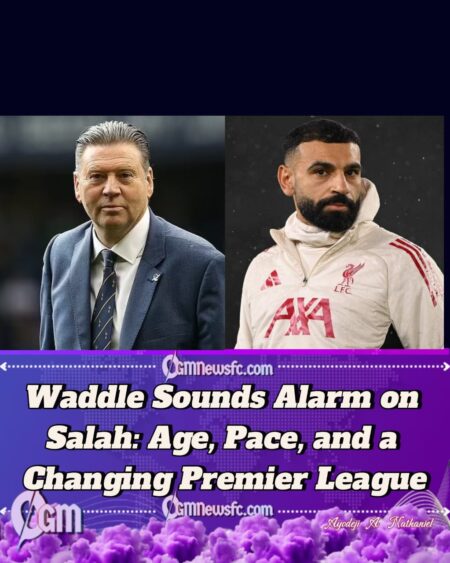
Chris Waddle has delivered a forthright assessment of Mohamed Salah’s current standing in elite football, arguing that age and the accelerating tempo of the Premier League are beginning to expose limitations in the Liverpool forward’s game. Waddle’s comments reflect a growing conversation around how veteran attackers adapt as tactical and physical demands intensify.
Speaking from the perspective of a player who experienced football’s own transitional eras, Waddle stressed that the issue is not Salah’s quality or legacy, but the relentless evolution of the modern game. In today’s Premier League, even world-class attackers are expected to contribute significantly without the ball.
A Faster League, a Harder Ask
Chris Waddle emphasized that the Premier League has become quicker and more physically demanding, leaving little margin for specialists who do not fully engage in defensive transitions. According to him, this shift has consequences across the pitch, particularly on the flanks where space is ruthlessly exploited.
He pointed to Liverpool’s right-hand side as an example, noting instances this season where defensive exposure has occurred when Salah has not tracked back. In those moments, the lack of cover has contributed directly to goals conceded, underlining how individual roles are now inseparable from collective defensive responsibility.
The Bradley Factor and Defensive Balance
The discussion also brought Conor Bradley into focus. Chris Waddle suggested that Bradley, still developing at the highest level, has been left vulnerable when support from ahead of him has been inconsistent.
In modern systems, full-backs rely heavily on wide forwards to delay attacks and provide defensive balance. When that support is missing, even talented defenders can appear exposed. Waddle’s remarks frame the issue as structural rather than personal, but one that inevitably places scrutiny on Salah’s role.
When Evolution Meets Limitation
Chris Waddle was particularly candid in stating that what is currently being asked of Salah defensively “is sadly not in his game at the moment.” Rather than criticism of effort, the comment reflects a belief that Salah’s strengths lie elsewhere and that expecting him to fundamentally change his profile at this stage of his career may be unrealistic.
This assessment highlights a broader dilemma faced by elite clubs: how to integrate iconic attackers into systems that increasingly demand total-football attributes. The conversation is no longer about goals alone, but about suitability within a pressing, transitional framework.
Slot’s Pragmatism and the Question of Rotation
Turning to management decisions, Chris Waddle voiced support for Arne Slot’s handling of the situation. Acknowledging that Salah does not want to be on the bench, Waddle argued that selective usage may be the most pragmatic solution.
In an era where reputation no longer guarantees a starting place, Slot’s approach reflects a results-driven philosophy. For Salah, it signals a new phase—one where experience and impact must be carefully balanced against the unforgiving demands of the Premier League.