






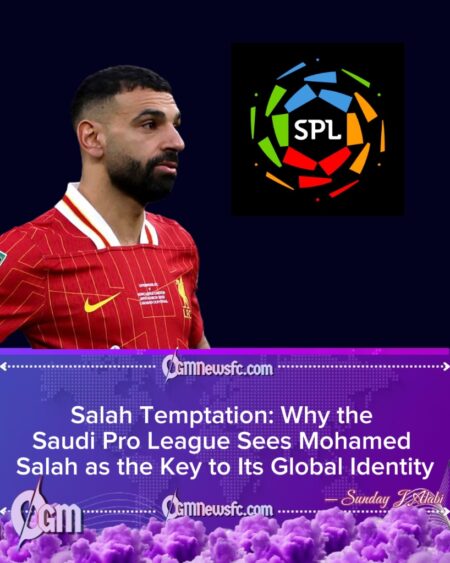
The possibility of Mohamed Salah moving to Saudi Arabia represents far more than another high-profile transfer. For a Saudi Pro League (SPL) still defining its place in global football, enticing the most famous Arab footballer of his generation could reshape perceptions, deepen regional influence and offer a clearer long-term direction beyond the initial splash of superstar signings.
Salah’s late winner for Egypt against Zimbabwe at the Africa Cup of Nations once again underlined his enduring quality and symbolic importance. Yet while his impact in Morocco was immediate and sporting, his potential arrival in Saudi Arabia could prove culturally and strategically transformative for a league at a crossroads.
A League Seeking More Than Short-Term Glamour
Since its rapid rise onto the global football stage, the Saudi Pro League has been closely associated with ageing European superstars lured by extraordinary contracts. Cristiano Ronaldo, Karim Benzema and Neymar brought headlines, commercial attention and instant credibility, but also fed the perception of a “retirement league in the sun.”
League officials are increasingly sensitive to that label. While many of the veteran signings have delivered on and off the pitch, there is growing recognition that long-term relevance cannot be built solely on players nearing the end of their careers. The SPL’s leadership now faces a strategic question: should it chase prestige through star power, or sustainability through development?
Mohamed Salah sits uniquely between those two ideas. Although he will be 34 at the end of the season, he remains at the peak of his powers and among the most marketable players in world football. Unlike many who arrived before him, Salah would not be perceived as a fading name, but as an elite performer still shaping the modern game.
Learning From China’s Cautionary Tale
The SPL’s planners are keenly aware of precedents elsewhere. A decade ago, the Chinese Super League attracted global attention by signing famous names such as Didier Drogba and Nicolas Anelka, only for the project to collapse once funding tightened and interest waned.
Saudi Arabia’s experience has, so far, been different. Despite early scepticism sparked by Jordan Henderson’s premature departure and Neymar’s injury-disrupted spell, most marquee players have remained. Ronaldo is now in his fourth season, while Benzema, N’Golo Kanté, Riyad Mahrez and Sadio Mané are well into their third.
However, time is catching up with many of these stars. Contracts will soon expire, physical decline is inevitable, and the league cannot afford another wave of expensive short-term fixes. This has prompted a visible pivot toward players in or approaching their prime, suggesting a more measured and forward-looking recruitment policy.
A Shift Toward Prime and Youthful Talent
Recent transfer windows have underlined that change in direction. Instead of focusing solely on household names past their best, Saudi clubs have invested heavily in players still in their prime, such as Darwin Núñez, Mateo Retegui and Theo Hernández.
Alongside them has come an influx of younger prospects, including Nathan Zézé and Enzo Millot. These players offer not just immediate competitiveness, but potential resale value, allowing the SPL to imagine itself as a viable alternative pathway to Europe rather than a final destination.
While this model may lack the instant glamour of signing Ballon d’Or winners, it offers something no non-European league has fully achieved: becoming a respected marketplace for developing global talent. Within this evolving framework, Salah would stand out not as a contradiction, but as a crowning figure who bridges credibility and ambition.
Salah’s Unique Power in the Arab World
What truly sets Salah apart is not just his footballing quality, but his symbolic weight. He is the most recognisable Arab athlete on the planet, a figure whose influence extends far beyond club loyalties or national borders.
The Saudi Pro League already enjoys strong regional interest, with players such as Mahrez and Yassine Bounou enhancing its appeal. The recent FIFA Arab Cup, though barely noticed internationally, drew average attendances exceeding 38,000, underlining the depth of passion across the region.
Salah’s arrival would elevate that interest dramatically. It could help position the SPL as a natural destination for Arab, African and potentially Asian talent, at a time when seven, possibly eight, Arab nations will feature at the 2026 World Cup. From Africa, where the league already has traction, to Asia, where it has yet to fully break through, Salah could act as a powerful catalyst.
Broadcasting Challenges and a Fragile Global Narrative
Despite its ambitions, the SPL faces significant structural hurdles. This season has been particularly difficult, with repeated international breaks and tournament stoppages disrupting momentum. Saudi teams have played just nine league matches, compared with 17 in the English Premier League.
Global broadcasters, though officially covering matches in more than 180 markets through 37 rights deals, have grown frustrated. Building an audience has proven difficult when fixtures arrive sporadically and storylines fail to develop. One international media executive described the season as “almost a write-off” amid fierce competition for viewers’ attention.
League officials in Riyadh must now confront the imbalance between club and national priorities. Without a more consistent domestic calendar, the dream of becoming a truly global competition will remain elusive, regardless of optimistic endorsements from FIFA president Gianni Infantino, who recently suggested the SPL could become one of the world’s top three leagues.
More Than a Transfer, a Statement of Intent
In that context, Mohamed Salah represents more than a marquee signing. His value lies not only in goals, shirts sold or social media engagement, but in what he symbolises for football in the Arab world.
If the many conditions align — Liverpool’s willingness to sell, Salah’s openness to leaving Anfield, and his desire to move to Saudi Arabia — the transfer would resonate far beyond the pitch. It would be the capture of a still-glittering Arab icon, not the fading echo of European greatness.
For a league still searching for its identity, Salah could provide clarity: not as a shortcut to global supremacy, but as a bridge between regional pride, competitive credibility and long-term ambition.