










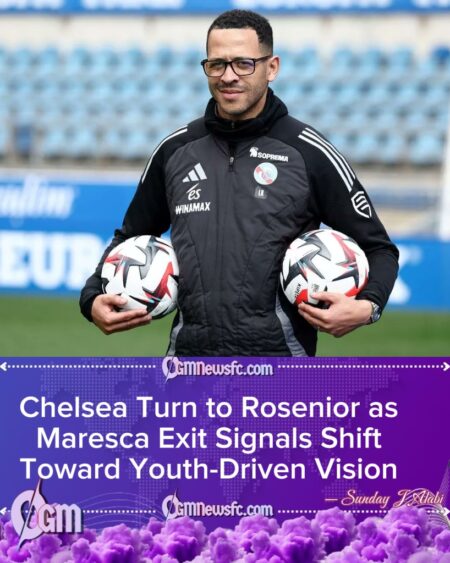
Chelsea’s latest managerial search has moved swiftly into focus following the abrupt departure of Enzo Maresca, with Liam Rosenior now emerging as the leading candidate to take charge at Stamford Bridge. As the club seeks stability after another turbulent chapter, Rosenior’s profile, philosophy, and alignment with Chelsea’s long-term vision have placed him ahead of more established names.
Maresca’s Sudden Downfall at Stamford Bridge
Enzo Maresca’s tenure as Chelsea head coach ended as dramatically as it unraveled. The Italian, who arrived with a reputation for tactical intelligence and modern coaching ideas, saw his 18-month reign collapse in the space of just 17 days amid mounting internal and external pressures.
Tensions came to a head after Maresca publicly described having endured the “worst 48 hours” of his managerial career, a remark that raised eyebrows within the club’s hierarchy. Matters worsened when he failed to appear for a post-match press conference following Chelsea’s draw with Bournemouth, an absence that was interpreted as a serious breach of professional expectations.
Behind the scenes, Maresca’s relationship with Chelsea’s medical department had also deteriorated, with disagreements over player availability compounding an already strained atmosphere. On the pitch, results offered little protection: a slump to just one win in seven Premier League matches ultimately convinced the club that a change was unavoidable.
Chelsea’s Strategic Reset and the Search for a New Leader
Chelsea’s decision to part ways with Maresca reflects more than short-term results; it underscores a broader strategic reset under the club’s current ownership. Joint owners Todd Boehly and Behdad Eghbali, working alongside sporting directors Paul Winstanley and Laurence Stewart, have consistently emphasized alignment with a clearly defined footballing model.
Central to that model is a commitment to young players, long-term squad development, and cohesive management structures. The hierarchy is keen to avoid repeating past mistakes where high-profile appointments brought immediate success but long-term instability.
With Chelsea eager to move quickly, Under-21 coach Calum MacFarlane has been tasked with handling media duties ahead of the team’s trip to Manchester City on Sunday. However, the club’s intention is to appoint a permanent successor as soon as possible to restore clarity and direction.
Why Liam Rosenior Fits Chelsea’s Vision
Liam Rosenior has emerged as the early favourite largely because he embodies the qualities Chelsea now prioritise. Currently in charge of Strasbourg—a club owned by Chelsea’s parent company BlueCo—the 41-year-old has already impressed senior figures within the organisation with his progressive style of football and calm leadership.
Rosenior’s coaching journey includes spells at Derby County and Hull City, experiences that tested his resilience and adaptability. Yet it is his work at Strasbourg that has truly elevated his reputation, particularly his ability to improve performances while fostering a strong dressing-room culture.
Though not considered a marquee name, Rosenior is highly regarded for his communication skills, personality, and man-management. Within Chelsea, there is a belief that he would quickly win over players and staff, especially given his proven record of trusting and developing young talent.
Big Names Ruled Out as Chelsea Narrow Their Focus
Several high-profile names have been linked with the Chelsea job, but the club has already ruled out some prominent candidates. Como manager Cesc Fabregas, despite his illustrious playing career at Stamford Bridge and deep ties to the club, is not believed to be on the shortlist.
Similarly, former Brighton boss Roberto De Zerbi—now at Marseille—has been discounted. While admired for his tactical innovation, De Zerbi’s fiery personality and history of public confrontations are seen as inconsistent with Chelsea’s desire for a calmer, more unified leadership style following the Maresca episode.
The exclusion of these figures signals a deliberate shift away from emotionally charged appointments. Chelsea’s hierarchy appears determined to prioritise compatibility with the club’s internal culture over reputation alone.
A Calculated Gamble Aligned With Long-Term Philosophy
Appointing Rosenior would represent a significant contrast to Chelsea’s past reliance on elite, trophy-laden managers such as José Mourinho, Thomas Tuchel, and Antonio Conte. It would also be viewed as a calculated gamble, placing faith in potential rather than pedigree.
However, within the club, this approach is seen as a logical continuation of the ownership’s philosophy. Chelsea’s recruitment of young players and emphasis on sustainability demand a head coach comfortable working within a developmental framework rather than seeking immediate dominance.
While Rosenior is not the only name under consideration, the shortlist is believed to be brief. For now, his alignment with Chelsea’s vision, combined with strong internal support, has positioned him as the leading candidate to guide the club into its next chapter.