










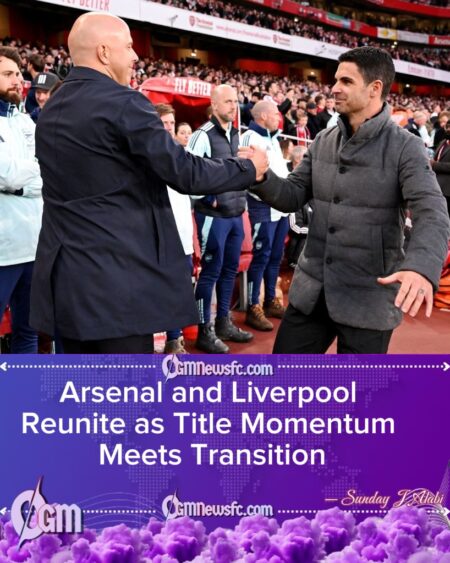
Last season’s Premier League title rivals reconvene at the Emirates Stadium tonight, but the context could hardly be more different. Arsenal arrive as the league’s dominant force, relentless and refined, while Liverpool, champions just months ago, are attempting to steady themselves after a turbulent title defence. With 14 points separating the sides after 20 matches, this fixture is as much a referendum on evolution as it is a battle for points.
Below, we examine the biggest changes at both clubs, the tactical approaches likely to shape the contest, the emotional undercurrents between the fanbases, the key players who could decide the night, and how this heavyweight clash may unfold.
A Season of Change: Arsenal’s Growth and Liverpool’s Regression
For Arsenal, the defining change this season has been depth — not just in personnel, but in mentality. Where Mikel Arteta once had to improvise around injuries and absences, he now has genuine options across the pitch. That added quality has translated into resilience, allowing Arsenal to absorb setbacks without losing rhythm or confidence.
This deeper squad has also fostered a collective belief. Arsenal share responsibility more evenly, lean into marginal gains, and approach games with a maturity that was sometimes missing last season. Even amid injuries, players have stepped up seamlessly, suggesting a squad comfortable with pressure and expectation. There remains room for refinement, but the foundations are formidable.
Liverpool’s story could not be more contrasting. Fresh off a title triumph, Arne Slot oversaw a dramatic summer overhaul, spending close to £450 million while sanctioning high-profile departures. The expectation was a bedding-in period; the reality was collapse. A brutal run of six defeats in seven league games dismantled their title defence before winter had even set in.
Structural issues compounded individual struggles. Set-piece defending disintegrated, consistency vanished, and the once-dominant system unravelled. Slot has since pivoted tactically to stem the damage, but while results have stabilised, Liverpool remain a pale imitation of last season’s champions.
On the Touchline: Arteta’s Variety vs Slot’s Caution
Arteta’s Arsenal have become defined by adaptability. They can hurt teams through meticulously crafted passing moves, ruthlessly efficient set pieces, or opportunistic long-range shooting. At times, they dominate; at others, they dig deep, defend slim leads, and grind out results. This tactical variety has become a strength rather than a dilution of identity.
As pressure mounts in the title run-in, Arsenal may yet narrow their focus into a more repeatable rhythm. But their ability to win games in multiple ways makes them unpredictable and difficult to neutralise. Against a vulnerable Liverpool defence, especially from dead-ball situations, Arteta will sense opportunity.
Slot, by contrast, is likely to double down on pragmatism. His recent adjustments have prioritised compactness and control, reducing chaos but also blunting Liverpool’s attacking edge. For an away trip to the league leaders, that compromise feels unavoidable.
Liverpool are expected to cede possession and look to counter-attack, mirroring the approach that earned them a narrow win at Inter last month. Yet with limited pace in attack and injury concerns around Hugo Ekitike, their margin for error is slim — particularly against Arsenal’s lethal set-piece threat.
Respect, Rivalry and the Weight of History
Arsenal versus Liverpool has long been one of English football’s most resonant fixtures, pitting southern prestige against northern dominance. Beyond geography, both clubs are united by a self-sustaining ethos in an era increasingly shaped by state-backed wealth and financial controversy.
Among Arsenal supporters, there is respect for Liverpool’s recent success — a validation of what Arsenal aspire to achieve. Liverpool, in turn, admire Arsenal’s consistency and recognise the toll of sustained title challenges. The rivalry, though sharp, is underpinned by mutual acknowledgement of shared values.
Still, scars remain. Liverpool fans have not forgotten past jibes at Arteta’s expense, nor his fiery exchanges with Jurgen Klopp. Yet football is cyclical, and should Arsenal lift the title this season, even their rivals are likely to acknowledge the scale and quality of the rebuild Arteta has engineered.
The Deciders: Collective Power and Individual Leaders
Arsenal’s strength lies in their collective, making it difficult to single out one decisive figure. Gabriel’s defensive authority, Declan Rice’s midfield command, and Martin Ødegaard’s creative resurgence all matter deeply. Leandro Trossard has been relentlessly influential, Bukayo Saka remains a constant threat, and David Raya’s recent goalkeeping performances have been match-defining.
If there is a heartbeat to this Arsenal side, it is Rice — a player who appears to have elevated his game to elite levels, dictating tempo, breaking opposition rhythm, and anchoring Arteta’s system.
For Liverpool, leadership may prove more important than flair. Goalkeeper Alisson and captain Virgil van Dijk are likely to be pivotal, tasked with organisation, calm, and defiance under sustained pressure. In attack, much will depend on whether Florian Wirtz can shoulder creative responsibility, especially if Ekitike is unavailable.
Verdict: Momentum Meets Uncertainty
From Arsenal’s perspective, anything less than victory would feel like a missed opportunity. The league leaders are at home, in form, and facing a side still searching for coherence. Yet Liverpool’s individual quality ensures they remain dangerous, particularly if Arsenal lose focus.
For Slot’s men, survival depends on discipline and precision. A performance akin to their controlled display at Inter could keep them competitive; a repeat of their capitulation against Manchester City would be fatal.
The head says Arsenal’s superiority will tell — a controlled 2-0 win. The heart, especially for Liverpool, clings to the hope of resistance and a 1-1 draw. One certainty remains: this is a fixture that still commands nerves, history, and attention — even if the balance of power has shifted decisively north to north London.