






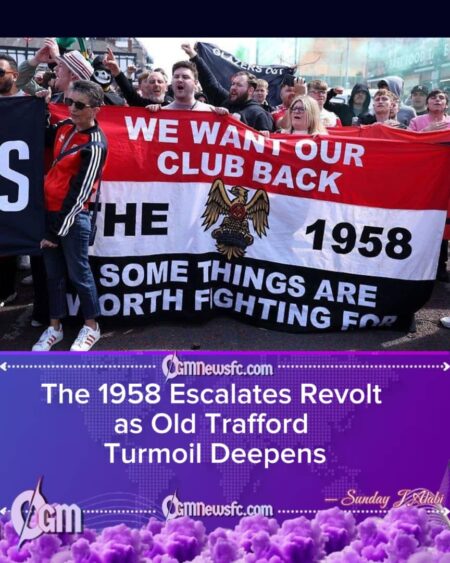
Manchester United supporters group, The 1958, has intensified its long-running campaign for sweeping structural reforms at Old Trafford, issuing a vote of no confidence in the club’s ownership and executive leadership. The group accused part-owner Sir Jim Ratcliffe of exhibiting “incompetence” and turning the club into a “circus”, further stating that Manchester United has become “a laughing stock” under the current administration.
In a strongly worded statement, The 1958 criticised the club’s direction both on and off the pitch, alleging deepening disorder in the wake of recent events, including the dismissal of manager Ruben Amorim. The group claims the turmoil reflects a broader failure of strategic leadership and a lack of coherent football identity.
The vote of no confidence extends to the Glazer family, who retain majority control, as well as senior executives Omar Berrada (chief executive) and Jason Wilcox (director of football). The 1958 expressed concern that repeated missteps at leadership level have undermined stability, performance, and supporters’ faith in the club’s long-term vision.
According to the group, recent weeks have marked “an extraordinary and deeply troubling” period for Manchester United, characterised by inconsistent results, tactical uncertainty, and administrative confusion. They argue that unless urgent action is taken, the club risks losing its identity and its connection to generations of loyal supporters.
The group’s message reflects a growing sentiment among sections of the Manchester United fanbase, who are increasingly vocal about dissatisfaction with the direction of the club and the perceived marginalisation of supporters in critical decision-making.
Planned Protest and Rising Tensions at Manchester united
The 1958 has confirmed that it will stage a major protest ahead of the home match against Fulham on 1 February, a demonstration intended to amplify their demand for a complete overhaul of the club’s ownership structure. The group, which boasts approximately 100,000 members, has emerged as one of the most outspoken voices in Manchester United’s supporter community, often mobilising demonstrations to draw attention to issues surrounding governance, ticket pricing, and the treatment of match-going fans.
This latest protest comes in the aftermath of Ruben Amorim’s sacking earlier in the week. His departure, which followed 14 months in charge, reportedly stemmed from tensions with Jason Wilcox over tactical disagreements. Darren Fletcher has since assumed interim managerial duties ahead of the team’s upcoming fixture at Burnley.
Amorim’s tenure ended with Manchester United finishing 15th last season—their lowest position in Premier League history—as well as a Europa League final defeat to Tottenham. His dismissal appears to have further inflamed frustrations among supporters already concerned about the club’s sporting direction.
Tensions were visibly evident during United’s 2-2 draw at Turf Moor, where fans unfurled a banner reading “Jim Can’t Fix This”, underscoring widespread scepticism about Ratcliffe’s capacity to guide the club out of its current slump. The 1958 says this sentiment is shared among many supporters who feel the club is “drifting without identity, direction or ambition”.
The group argues that Manchester United’s 150-year heritage is at risk of erosion under the current structure, urging fans to unite in demanding reform. They warn that unless decisive action is taken, the club could become “unrecognisable” to future generations.
Cultural Concerns and a Growing Call to Protect Club Identity
Central to The 1958’s message is the belief that the club’s historical and cultural foundations are being gradually eroded. They highlight concerns about the disconnect between leadership decisions and the values long associated with Manchester United, including strong football identity, fan engagement, and a commitment to competitive excellence.
The supporters group emphasised that the current moment represents a critical inflection point for the club. “Manchester United is 150 years old. That proud history, built by generations of supporters, must be protected,” their statement reads. The 1958 argues that fans must “fight for our club” to ensure it retains its cultural significance and remains rooted in the traditions that have shaped its global reputation.
Ticket prices and fan treatment remain particular areas of contention. Many supporters feel increasingly marginalised by decisions that appear to prioritise commercial interests over match-going fans. The 1958 has long maintained that without a meaningful shift in approach, the spiritual and cultural fabric of the club will continue to deteriorate.
The group insists that now is the time for definitive action, urging fans to reflect on the importance of safeguarding the club’s identity: “If you knew you couldn’t play tomorrow, how hard would you play today?” This rhetorical challenge underscores their warning that complacency could leave irreversible damage.
Whether this growing pressure will influence structural changes remains uncertain, but the mounting dissatisfaction highlights a critical period for Manchester United—a club navigating both competitive struggles and an increasingly vocal fanbase demanding accountability and renewal.