









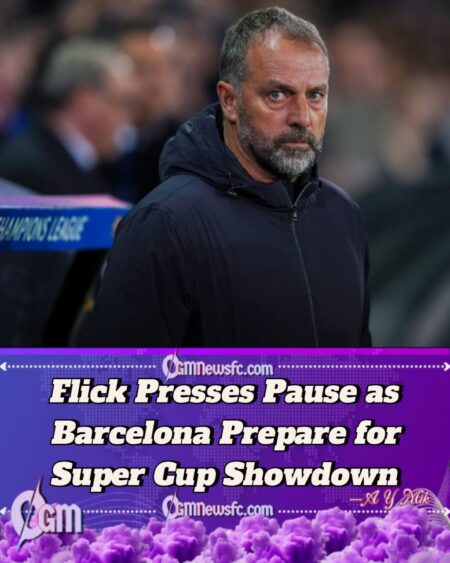
As the Spanish Super Cup final looms, Hansi Flick has made it clear that fresh legs matter more than sweaty training kits. Following Barcelona’s emphatic demolition of Athletic Club in the semi-final, the German tactician took an unexpected but calculated step: cancelling Friday’s full on-pitch training session in favour of a lighter, recovery-focused routine.
In a football world obsessed with intensity, Flick’s decision feels refreshingly calm. Rather than flog an already confident squad, the Barcelona manager chose to protect energy levels, reduce fatigue, and sharpen minds, all while sending a quiet message—this final will be won with clarity, not chaos.
A Semi-Final Statement That Changed the Plan
Barcelona’s dominant performance against Athletic Club did more than book a place in the final—it rewrote the week’s training script. The Blaugrana didn’t just win; they cruised, controlled, and convinced. From the opening whistle, the team played with a confidence that suggested heavy drills were no longer necessary.
Flick and his staff quickly assessed the physical toll of that performance. The conclusion was simple: why push players who are already flying? With the job half done and the trophy within touching distance, rest became the new tactic.
Split Sessions and Smart Science
Earlier in the week, Flick had already hinted at his intentions by dividing the squad into two training blocks. Starters from the semi-final focused on recovery work—gym sessions, physiotherapy, and light movement—while fringe players maintained sharper on-field drills.
This method, increasingly popular among elite European clubs, allows coaches to balance competitiveness with caution. For Barcelona, it also reflects Flick’s belief in modern sports science: the best performance often comes after rest, not repetition.
Saudi Conditions Force Tactical Thinking
Preparing for a final in Saudi Arabia is not the same as training at Ciutat Esportiva Joan Gamper. Heat, travel fatigue, and unfamiliar surroundings all factor into preparation. Flick’s adjusted schedule took these realities seriously, opting to limit exposure while maximizing efficiency.
The final on-grass session at King Abdullah Sports City was therefore shorter, sharper, and more controlled. Players worked on positioning and ball circulation, then quickly retreated indoors—proof that sometimes, less really is more.
Squad Health, Mood, and Quiet Confidence
Inside the Barcelona camp, the atmosphere has reportedly been relaxed but focused. Key players have returned from minor fitness scares, while others who were lightly rested in the semi-final are now fully available. Flick’s approach has kept anxiety low and morale high.
There’s also a psychological edge at play. By cancelling intense sessions, Flick sends a subtle message to his squad: I trust you. For players, that confidence from the manager can be as powerful as any tactical diagram.
Experience Talking, Not Fear
This decision is not about fear of injury or lack of ambition—it is about experience. Flick knows finals are often decided by moments, not mileage. A half-second quicker reaction, a clearer decision in midfield, or one extra sprint in the 85th minute can change everything.
Barcelona’s preparation suggests a team that believes it has already done the hard work. Now, it’s about execution—and arriving at kickoff with legs light, lungs ready, and heads calm.
A Statement Beyond the Super Cup
Win or lose, Flick’s handling of this week sends a broader message about his reign at Barcelona. The club is embracing modern management, controlled intensity, and long-term thinking, even when silverware is on the line.
If Barcelona lift the trophy, this training decision will be praised as genius. If not, it will still stand as a reminder that football’s evolution is no longer about who trains hardest—but who trains smartest.