









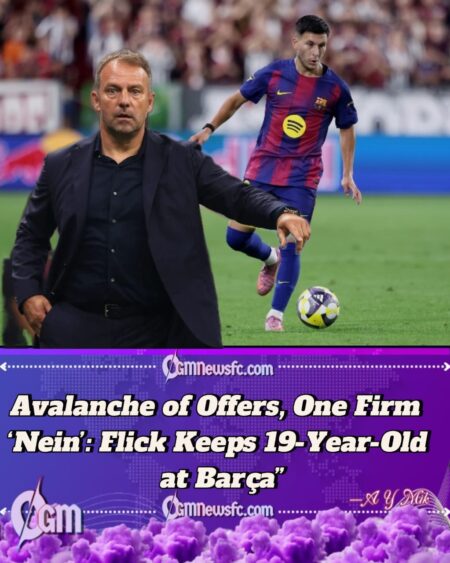
Barcelona’s head coach Hansi Flick has slammed the door on a potential January exit for one of his 19-year-old wingers, despite what insiders describe as an “avalanche of offers” from clubs across Europe. The news — first reported by international sports outlets — comes amid the Catalans’ mid-season push in La Liga and European competition.
The underlying story is straightforward: several clubs approached Barcelona with proposals to take the teenager, on loan or permanently, hoping he would get more first-team minutes elsewhere. But Flick was having none of it, preferring to keep his young wide man in the squad for the rest of the campaign.
The decision hints at a broader philosophy: Flick values depth and development over quick fixes, even when tempting offers come knocking mid-season. And yes, mid-season offers in January tend to come with more sparkle than an overcaffeinated Premier League scout after three pints.
Who Is the Winger in Question?
The reports do not consistently name the player involved, which has sparked some newsroom speculation and fan buzz. One likely figure matching the description is Roony Bardghji, a highly regarded young winger at Barcelona who has attracted attention from clubs looking for emerging attacking talent.
Bardghji, though still finding his footing in the senior squad, has accumulated limited minutes — around 340 across competitions — but has impressed scouts with his technical ability and pace.
For context, this is a winger who has the kind of early career profile that attracts suitors — clubs see raw talent, Barcelona see a future contributor, and Flick sees a cog in his tactical machine. Consider it the footballing equivalent of keeping the family heirloom in the attic even if Grandma wanted to sell it for a new sofa.
An Avalanche of Offers — Real or Reporters’ Hyperbole?
Reports describe the interest as an “avalanche” — perhaps channeling a little too much Norwegian weather drama — but multiple clubs did inquire about the winger’s availability. Teams in lower-pressure leagues or mid-table setups often look to bring in young attackers during the January window to gain an edge.
These suitors reportedly ranged from clubs in Spain’s La Liga to teams in Germany, Italy and beyond. None, however, came up with an offer convincing enough for Flick and sporting director Deco to sanction a move.
Barcelona’s reluctance to allow the exit reflects a broader strategic stance in this transfer window: stability is preferred over disruption, even if some fringe talents could get playing time elsewhere. Flick’s message appears to be that patience and tactical cohesion matter more than breaking up the squad halfway through the season.
Flick’s Long-Term Vision: Development or Hoarding?
Keeping a young player on the bench isn’t exactly a recipe for instant stardom, which raises the question: Is Flick protecting the player’s growth, or is he just afraid of losing squad depth? The answer may be a bit of both.
Flick has often emphasized the importance of internal development — encouraging young talents to train, learn, and eventually break through at the Camp Nou. This is a coach whose résumé includes nurturing players while balancing the demands of elite competition.
However, critics argue that no minutes are better than no minutes only in boardroom PowerPoints. For a winger still seeking consistent first-team minutes, sitting behind more established names might not be as beneficial as a loan to a club where he can play 90 minutes and maybe get recognized at the supermarket.
The Bigger Barcelona Picture
This episode also reflects Barcelona’s wider transfer strategy. The club’s January window has been relatively quiet, not only because of Flick’s decisions but also due to financial and salary-cap constraints that have limited their ability to do big business in mid-season.
Rather than selling or loaning out fringe players, Barcelona’s current preference seems to be stability and continuity. That philosophy helped them early in the campaign and continues to shape decisions around roster moves — even when young talents feel they might benefit from a change of environment.
It’s a strategy that might sound conservative, but at a club with heavy expectations every matchweek, conservative sometimes feels like necessary caution.
What This Means for the Player and the Fans
For the 19-year-old winger himself, staying at the club means intense training, high-level coaching, and probably more time chasing shadows on matchdays than ripping them up on the pitch. Barcelona fans, meanwhile, are left debating whether this refusal is wise foresight or youth hoarding syndrome.
If the winter window truly was an “avalanche,” then Flick’s decision to stand firm could be interpreted either as confidence or conservatism with a capital C. Either way, the story has added more intrigue to an already captivating La Liga season.