








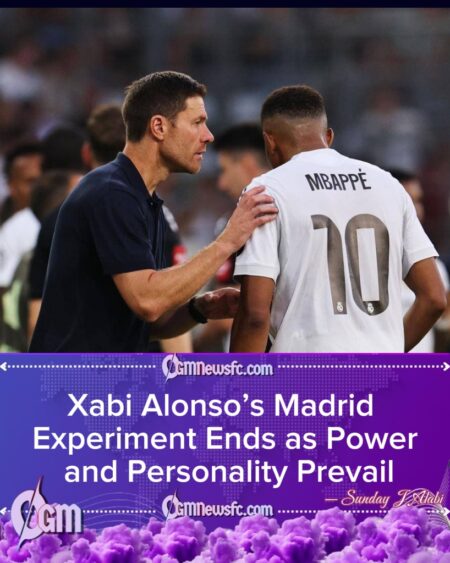
Xabi Alonso’s tenure as Real Madrid manager has ended almost as quickly as it began, closing a brief and turbulent chapter defined by internal tensions, unmet expectations, and the enduring realities of power at the Santiago Bernabéu. Appointed with the promise of structure and collective discipline, Alonso departed after just seven months in charge, unable to impose his authority at a club where star players and institutional hierarchy often outweigh managerial vision.
His dismissal, confirmed shortly after Real Madrid’s return from Saudi Arabia following the Spanish Super Cup, was swift and unsentimental. While Alonso remains revered as a former player, his time on the bench has reinforced a familiar lesson in Madrid: reputation and ideas alone are rarely enough to survive.
Alonso :Promising Appointment Undermined Early
Alonso arrived at Real Madrid billed as a “systems coach,” a figure expected to restore tactical clarity after a season widely criticised for its lack of structure. His appointment was framed as a corrective step, emphasising organisation, collective effort, and intensity without the ball. From the outset, however, the relationship between manager, squad, and hierarchy appeared cautious rather than enthusiastic.
The timing of his arrival was itself a compromise. Alonso took over earlier than planned, beginning his reign with the Club World Cup in the United States, a decision driven more by club urgency than managerial readiness. That early concession would later be viewed as symbolic of a tenure shaped by accommodation rather than authority.
Although the club backed him with the signings of Álvaro Carreras and Dean Huijsen, Alonso’s request for a specialist defensive midfielder, notably Martín Zubimendi, was rejected. Forced to improvise, he attempted to adapt existing personnel, including reshaping roles for younger players such as Arda Güler, while lacking the positional anchor central to his vision.
There were fleeting signs of progress during the American tour, with improved pressing and positional structure briefly visible. Yet heavy defeats to Paris Saint-Germain and Atlético Madrid exposed the scale of the challenge, suggesting that Alonso’s ideas were struggling to take root in an environment resistant to rapid change.
Egos, Authority, and a Fractured Dressing Room
The most visible cracks emerged during October’s league clásico against Barcelona. Despite winning the match, Alonso’s late substitution of Vinícius Júnior provoked an angry reaction, with the forward storming down the tunnel. The incident overshadowed the result and highlighted deeper tensions within the squad.
Rather than publicly supporting their manager, the club’s internal response reportedly placed responsibility on Alonso for the decision. This moment marked a clear erosion of authority, reinforcing perceptions that players retained disproportionate influence. Vinícius’ subsequent apology notably omitted any reference to the coach, while reports emerged of contract renewal discussions being linked to Alonso’s presence.
Discontent was not limited to one player. Fede Valverde openly expressed frustration about his deployment at full-back, while broader complaints circulated regarding intensive tactical instructions and lengthy video sessions. Such grievances echoed a recurring theme at Real Madrid, where attempts to impose rigid systems often clash with established stars accustomed to autonomy.
The silence of several senior players following Alonso’s dismissal further underlined the fractured relationships. In a club where public gestures of support are customary, the absence of such tributes was widely interpreted as telling.
Results, Resistance, and the Limits of Adaptation
Despite internal strains, results initially masked deeper issues. After the clásico victory, Real Madrid led La Liga, five points clear of Barcelona, with nine wins from ten matches. However, performances were inconsistent, and a sequence of draws and defeats soon followed, accompanied by a growing sense of instability.
Efforts were made to restore unity, including team discussions during European trips that briefly appeared to ease tensions. Yet improvements proved short-lived. Defeats to Celta Vigo and Manchester City reignited speculation about Alonso’s future, with Guardiola’s public advice to “do it your way” serving as both encouragement and implicit critique of Madrid’s environment.
Injuries, particularly in defence, compounded Alonso’s difficulties, while debates over physical preparation and the potential reintegration of fitness coach Antonio Pintus added further pressure. Alonso resisted what he perceived as encroachments on his authority, a stance that reportedly contributed to the breakdown in relations with the board.
The decisive moment came in the Spanish Super Cup final against Barcelona. As Madrid lost, Alonso attempted to organise a guard of honour, only for Kylian Mbappé to dismiss the gesture. The image encapsulated a team drifting from its manager. By Monday afternoon, Alonso was gone, officially by “mutual consent,” after just 34 matches in charge.