







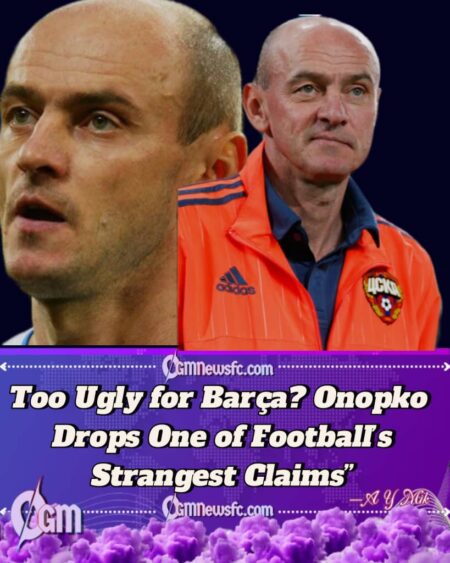
Football has produced many unusual transfer stories over the years, but Viktor Onopko’s latest revelation comfortably earns a spot in the “you can’t make this up” category. The former Russian captain has claimed that Barcelona once showed interest in signing him — only for the move to collapse for a reason that had nothing to do with tactics, form, or fitness.
According to Onopko, the problem was his looks. In a recent interview, the 1990s defensive stalwart suggested that Barcelona ultimately decided against signing him because he was deemed “ugly,” a statement that has since sparked laughter, disbelief, and debate across football media.
A Giant of Russian Football in the 90s
For context, Viktor Onopko was no fringe player nursing a grudge. He was one of the most accomplished footballers Russia produced after the collapse of the Soviet Union, earning over a hundred international caps and captaining the national team during its formative years.
At club level, Onopko built a strong reputation in Spain with Real Oviedo, where he became a defensive leader and a fan favourite. His reliability, reading of the game, and aerial dominance made him one of La Liga’s most respected centre-backs outside the traditional giants.
The Barcelona Link That Never Was
Onopko claims that during his time at Oviedo, Barcelona explored the possibility of signing him. The interest, according to his account, was genuine enough to reach discussion stage — before suddenly disappearing.
The reason, he alleges, was not his ability but his appearance. Onopko says he was told that someone within Barcelona’s coaching or technical staff felt his looks did not fit the club’s image. In an era where Barcelona were refining not just a footballing identity but also a global brand, the story has taken on a strange, almost satirical tone.
Contract Clauses, Missed Chances and Bad Timing
The defender also pointed to contractual complications as part of the problem. While negotiating with Oviedo, he reportedly wanted a release clause that would allow him to leave for a bigger club. That clause, he claims, was quietly removed, closing the door on potential moves to both Atlético Madrid and Barcelona.
Whether the “ugly” comment was meant literally, jokingly, or as shorthand for something else remains open to interpretation. What is clear is that the combination of rigid contracts and internal opinions ensured that Onopko’s Camp Nou dream never progressed beyond speculation.
Barcelona’s Silence and Football’s Image Problem
Barcelona have not responded to the claim, and given how long ago the alleged incident occurred, they are unlikely to. Still, the story has reopened a wider discussion about image, marketability, and branding in elite football.
While talent remains king, modern football is undeniably influenced by commercial appeal. Onopko’s claim, humorous as it sounds, touches on an uncomfortable truth: footballers are increasingly judged not just by what they do on the pitch, but also by how they look off it.
Legacy Untouched by a Bizarre What-If
Despite the strange Barcelona subplot, Onopko’s career requires no revision. He remains one of Russia’s most capped players, a respected figure in Spanish football history, and now a coach with the national team setup.
Ironically, one of his fondest memories includes beating Barcelona at the Camp Nou with Oviedo — a reminder that football has its own way of delivering punchlines. Whether or not he was “too ugly for Barça,” his career proved handsome enough in achievements.