










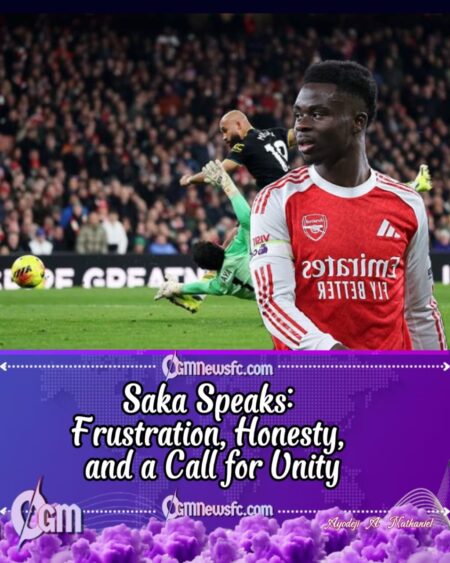
Bukayo Saka did not hide behind clichés after Arsenal’s damaging home defeat to Manchester United. Speaking with a tone that mixed frustration and maturity, the winger admitted the team failed to maintain their best level across the full 90 minutes — a costly flaw in a match of such magnitude.
For a side that has turned the Emirates Stadium into a near-impregnable fortress this season, the loss cut deep. Saka openly acknowledged that the occasion demanded more intensity, more control, and more composure — qualities Arsenal showed in flashes but not consistently enough to protect their advantage.
In footballing terms, Saka’s remarks were refreshingly direct. In public-relations terms, they were alarmingly honest. Arsenal, he suggested, didn’t lose because of bad luck — they lost because they dropped their standards at key moments.
From Fortress to Fault Line: Emirates Shocked
The Emirates has been Arsenal’s comfort zone this season, a place where opponents usually arrive hopeful and leave humbled. Against Manchester United, however, that confidence cracked — and United happily widened the gap.
Arsenal had moments when the match seemed under control. They led, they pressed, and they looked capable of stretching their advantage to 2–0. But football is unforgiving, and as Saka pointed out, failing to kill the game left the door wide open.
Once momentum swung, Arsenal struggled to regain it. The crowd sensed the tension, the players felt it, and United exploited it ruthlessly. The stadium that once roared now murmured — and that shift proved decisive.
“It’s About the Reaction”: Mentality Under the Microscope
Saka’s most telling comment came not about tactics or missed chances, but mentality. “In football, you can score, you can concede — it’s your reaction after it,” he said, a line that now echoes louder than the final whistle.
That reaction, according to critics, was Arsenal’s weak point. Former captain Patrick Vieira publicly questioned the team’s leadership and emotional response, suggesting some players were too quiet when the game demanded authority and urgency.
While such criticism may feel harsh, it aligns with the wider narrative: Arsenal didn’t collapse overnight, but they hesitated — and at this level, hesitation is fatal.
Arteta’s Challenge: Turning Pain into Progress
Manager Mikel Arteta echoed Saka’s sentiments, urging his squad to show mental strength rather than dwell on disappointment. His message was clear: setbacks are inevitable; stagnation is optional.
Arteta framed the loss not as a disaster, but as a test — one that reveals character. The title race remains alive, but margins are thinner now, and every slip invites pressure from chasing rivals.
The challenge for Arsenal is simple in theory and brutal in practice: respond immediately. Not next month. Not after reflection but next match.
What the Defeat Means for the Title Race
Beyond emotion and analysis lies the cold reality of the table. Arsenal’s lead has narrowed, and the psychological cushion they once enjoyed has shrunk noticeably.
Manchester United’s comeback was not just a statement win — it was a reminder that elite teams punish hesitation. Arsenal remain contenders, but contenders cannot afford half-performances, especially at home.
Saka’s honesty may yet prove valuable. A dressing room that acknowledges flaws early often fixes them faster. The season’s verdict is still unwritten — but the pen is now shaking slightly.
Going Again: Arsenal’s Defining Moment Approaches
Despite the disappointment, Saka’s closing message was resolute. “We go again next week,” he said — not defiantly, but deliberately.
That mindset will define Arsenal’s season. The response to this loss — in energy, execution, and leadership — will reveal whether this squad has matured from hopeful challengers into genuine champions.
For now, the mood is bruised, not broken. The Emirates may have fallen silent once — but redemption, as Arsenal know well, often begins with discomfort.