










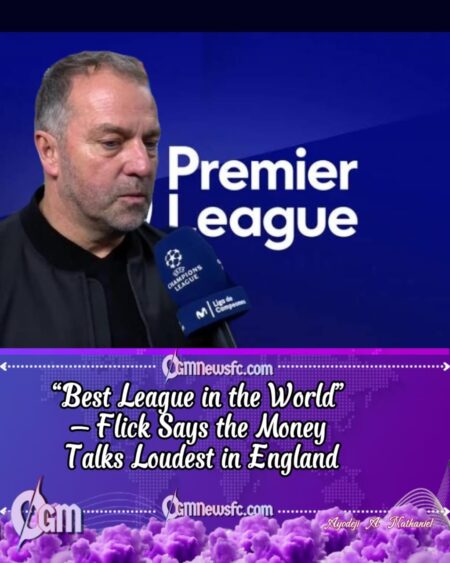
Barcelona manager Hansi Flick made a headline-grabbing statement in a recent press conference following his side’s comeback victory over FC Copenhagen in the Champions League, where he didn’t just analyse his own team’s performance — he assessed global football. Flick declared that the Premier League is the best league in the world, attributing that status primarily to the massive financial investment clubs in England are able to make and the activity they display every transfer window.
“It’s the best league in the world because they have invested the most money,” Flick said, highlighting how clubs in England can “buy many players” and are heavily present in the **transfer market each year.”
Investment, Transfers, and the Power of the Premier League
Flick’s comments reflect a widely shared view among football insiders that the Premier League’s financial ecosystem is unparalleled in world football. English clubs have some of the richest television deals, sponsorship income, and commercial revenue streams — all of which boost their ability to attract top talent from around the world. FIFA’s recent Global Transfer Report revealed that Premier League teams were heavily involved in the 2025 transfer market, with a staggering contribution to overall global spend and major signings such as Liverpool’s acquisition of Florian Wirtz illustrating the league’s financial muscle.
That investment power ensures year-in, year-out competition not just domestically but also on the European stage, keeping the Premier League brimming with star names and high-stakes matches.
Flick’s Champions League Context
Flick’s praise for the Premier League came in the context of a broader conversation about European competition. In the match referenced, he acknowledged that English clubs have dominated the early knockout stages, with multiple Premier League sides reaching the later rounds of the Champions League — another factor in his assessment of the league’s strength.
While his main focus remains Barcelona’s performance and areas for improvement, Flick did not shy away from stating that the Premier League’s economic model has helped it cultivate depth, quality and sustained excitement — key ingredients in his definition of the world’s “best league.”
Why Flick’s Comments Matter
Flick is a respected voice in European football, having won multiple major honours, including a World Cup with Germany and major club titles with Bayern Munich. His assessment carries weight because it does not stem simply from passive admiration — he has managed in multiple top leagues and seen different competitive environments with differing financial realities.
This kind of endorsement feeds into ongoing debates about football’s structure, with many arguing that the Premier League’s financial model gives it a competitive edge both domestically and in Europe, while others maintain that leagues like La Liga or Bundesliga continue to produce elite talent and tactical excellence despite smaller budgets.
Possible Reactions Across Europe
Reactions to Flick’s comments are likely to vary. Some managers and pundits agree that money fuels competitiveness — as seen in Vincent Kompany’s remarks on financial disparities attracting players to England — while critics point out that money alone doesn’t guarantee trophies or a defined footballing identity.
Though Flick’s Barcelona is competing strongly in LaLiga and Europe, his acknowledgment of the Premier League’s financial advantage is unusually candid for a coach outside England, suggesting respect for the commercial scale and global appeal English clubs enjoy.
The Transfer Market Evidence
The transfer statistics back up Flick’s view. English clubs were among the most active spenders worldwide in 2025, contributing to the record-breaking £9 billion global transfer spend, with significant activity from Liverpool, Manchester United and Arsenal.
This continuous investment cycle helps keep the Premier League stacked with talent — and provides a strong context for Flick’s claim that the league’s financial ecosystem is a major driver behind its perceived competitiveness.