







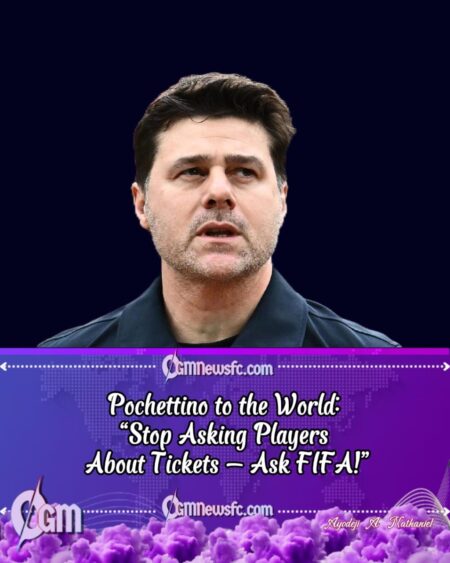
United States men’s national team head coach Mauricio Pochettino took a firm stance this week when asked about the ongoing global debate over the high cost of tickets for the 2026 FIFA World Cup — co-hosted by the U.S., Canada and Mexico. Pochettino was clear that discussing ticket prices is not his role or that of his players, who he stressed should concentrate on performance and preparation rather than off-field controversies.
His remarks came as criticism of ticket pricing — with list prices as high as $8,680 plus parking fees up to $175 — continues to draw global attention and backlash from fans, pundits, and even some players. American winger Timothy Weah had previously voiced his disappointment, saying many “real fans will miss matches” because of the costs.
Pochettino responded by distancing his squad from that debate, asserting that coaches and players are sporting professionals, not politicians, and that their responsibility is to prepare and perform on the field. According to Pochettino, matters such as ticket pricing decisions fall under the purview of FIFA and football authorities, who must explain their actions if questioned.
A Clear Boundary Between Sport and Off-Field Issues
Pochettino’s comments underscore a broader philosophical divide in modern sport between athletic focus and social commentary. While some figures in football have taken strong positions on political, economic or ethical issues, Pochettino emphasized that his “duty is to prepare the team, the U.S. men’s national team… in the best way to perform” — not to appraise ticket pricing or other non-sporting matters.
He insisted that players “need to talk on the pitch, playing football, not outside of it,” and reiterated that neither he nor his squad should be expected to weigh in on matters that FIFA controls and explains separately. Pochettino described himself and his players as “sport people,” not politicians, suggesting that their voices should be reserved for sporting topics.
Context: Nest of Criticism on World Cup Ticket Pricing
The backdrop to Pochettino’s remarks has been widespread anger over FIFA’s pricing structure for World Cup 2026 tickets. With high list prices and an explosive secondary market, critics argue that many fans — including long-time supporters — could be priced out of attending games. In response, FIFA introduced a limited number of $60 discounted tickets for loyal supporters through national federations, but the issue remains acute as demand vastly outweighs supply.
Some commentators, including public figures and local officials, have joined the critique, calling the pricing policy “exclusionary” and damaging to the inclusive spirit traditionally associated with football. Despite the backlash, FIFA has defended its pricing, linking it to unprecedented demand — with over 500 million ticket applications submitted and only a small fraction available at face value.
Weah Comment Spurs the Response
Pochettino’s comments came directly after Weah publicly labelled the prices “too expensive” and expressed disappointment that many supporters might be shut out of the event. That criticism was highlighted by French outlet Le Dauphiné and subsequently picked up in the U.S. and international media.
The coach’s reaction — that it isn’t a player’s job to evaluate ticket costs — has sparked discussion across football circles. Some view his remarks as a straightforward professional boundary; others see it as an overly cautious retreat from a wider fan and social debate. Regardless, Pochettino was unequivocal that footballers and coaches should refrain from judging administrative decisions, leaving that to governing bodies.
Pochettino’s Role: Preparations Ahead of World Cup 2026
As Pochettino navigates this high-profile controversy, his priority remains squarely on preparing the U.S. team for competition. The squad has upcoming friendly matches scheduled — including clashes with Belgium, Portugal, Senegal and Germany — before opening their World Cup campaign against Paraguay on June 12 in Inglewood, California.
His focus on performance, tactics and team cohesion indicates that he prefers to steer discourse toward the sport itself, maintaining that external debates are for officials and organisers to handle. Whether this position enhances team focus or invites criticism from fans and media remains part of the larger narrative surrounding the tournament’s build-up.
Football’s Balancing Act: Sport vs. Societal Issues
Pochettino’s stance illustrates a challenge faced by many in modern football: balancing an elite sporting focus with the expectations that athletes and coaches speak out on issues affecting the broader football community. While some players embrace activism and social commentary, Pochettino clearly positions his team within the professional athletic sphere — prioritising preparation and performance over public debate on operational or economic decisions made by FIFA.
This approach mirrors a longstanding sentiment among certain segments of the football community who argue that players should “stay in their lane” and let administrators address policy issues — even when those issues directly affect fans and the sport’s culture at large.