









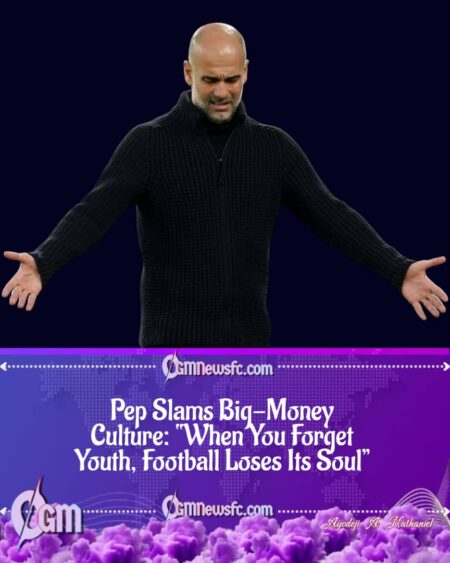
Pep Guardiola one of the most influential coaches in modern football recently echoed a sentiment that has become something of a rallying cry for traditionalists: modern football sometimes makes him sad. His lament isn’t about tactics or referees; it’s about priorities. According to Guardiola, too much emphasis is placed on big-name signings and transfer fees, and not enough on nurturing young talent.
Guardiola encapsulated his frustration with a question that has reverberated through coaching circles: “Why buy a striker for £50 million when there is one waiting in the youth team?” It’s a line that captures the gulf between a sport driven by astronomical transfer fees and one rooted in homegrown development often the lifeblood of club identity.
This is not the rant of a nostalgic purist. Guardiola’s remarks come from a coach who has lived both ends of the spectrum: blazing trails with La Masía graduates at Barcelona, and managing stellar squads with hefty transfer investment at Bayern Munich and Manchester City.
Youth vs Big Money: A Philosophical Divide
At the heart of Guardiola’s musings lies a broader discussion about football’s evolution. The modern game is awash with money, broadcast deals, sponsorship contracts and marketing deals that dwarf past eras. In such an environment, clubs increasingly turn to the transfer market to “solve” problems rather than trusting their academies.
Guardiola’s own career trajectory offers a compelling contrast. At Barcelona, he oversaw the rise of Sergio Busquets, Pedro Rodríguez and Lionel Messi, all products of the club’s youth system. Their contributions helped Barcelona dominate Spain and Europe, creating a blueprint that many clubs once hoped to emulate.
However, in recent years, that blueprint has been overshadowed. The proliferation of six-, seven- and even eight-figure transfer fees has made it far easier and sometimes more expedient to buy solutions rather than grow them. Guardiola’s remark shines a spotlight on this shift, prompting reflection on whether the game’s soul has been quietly traded for commercial convenience.
Historical Context: From La Masía to Manchester
Guardiola’s philosophies were forged in the heat of Barcelona’s golden age. His first team at Camp Nou was a masterclass in mixing academy graduates with smart strategic signings — players who fit a system and a style, not just a price tag. This blend became the envy of clubs worldwide.
Yet even Guardiola adapted to the realities of the modern transfer market. At Bayern Munich and Manchester City, he has overseen squads brimming with international stars acquired for large fees. While many of these transfers were resounding successes, Guardiola’s public musings suggest that the coach still believes development from within should remain a priority not an afterthought.
His commentary therefore carries a duality: he understands the pragmatism of signing talent in a competitive environment, but he laments how that pragmatism can eclipse the very culture that once made clubs like Barcelona unique.
Reactions From Media, Fans and Analysts
Guardiola’s comments have sparked varied reactions. Traditionalists and youth-development advocates have seized on his words, asserting that the game has lost something valuable , a connection to local talent and community identity.
On social media, fans reminisced about homegrown heroes who elevated club legends rather than merely complementing them. Critics of heavy transfer spending point to stories of academy players who never got a chance because of costly signings occupying their pathways.
Conversely, some analysts argue that modern football’s financial realities make Guardiola’s ideals challenging to implement universally. Clubs without elite revenue streams or global brands may need transfer market muscle to compete domestically and in Europe. In their view, the balance Guardiola speaks about is aspirational but difficult to achieve in practice.
The debate underscores a broader tension in football: can the beautiful game remain beautiful while also being big business? Guardiola’s comment didn’t just raise eyebrows; it sparked a philosophical conversation.
Youth Development in Today’s Landscape
Despite Guardiola’s longing for a return to prioritising youth, pockets of clubs still invest deeply in their academies. Ajax, Benfica, Sporting CP and others have sustained reputations for producing top-flight talent who go on to shine domestically and internationally.
In England, Manchester United’s Class of ’92 is often invoked as the pinnacle of youth success. More recently, clubs like Brighton & Hove Albion and Brentford have been praised for unearthing and integrating young talent while maintaining competitive stability.
However, the commercial lure of quick improvement through transfer spending remains strong. When a promising 17-year-old waits in the youth ranks and a ready-made international costs a fraction of winning a title or securing Champions League qualification, decisions become less romantic and more transactional.
Guardiola’s point is clear: we need to ensure that youth opportunity isn’t eclipsed by financial expediency — not just at elite clubs, but throughout the footballing pyramid.
What It All Means for the Future of Football
Guardiola’s comments do more than underline his values; they challenge the sport to self-reflect. In a landscape where TV deals and sponsorships rain cash on even mid-table teams, he asks whether clubs might be short-changing their identities for short-term success.
His words resonate beyond Barcelona and Manchester City. They concern the grassroots coaching structure, the management of youth academies, and the strategic choices of clubs across Europe. In essence, Guardiola is reminding football that development is not a side project ,it’s a cornerstone of the sport’s cultural legacy.
The reality and perhaps the irony is that today’s youth prospects may train on the same pitches where transfer fees are negotiated for elite players. Guardiola’s hope seems to be that every club, regardless of budget, remembers that a future star could be just as valuable as an expensive marquee signing.