






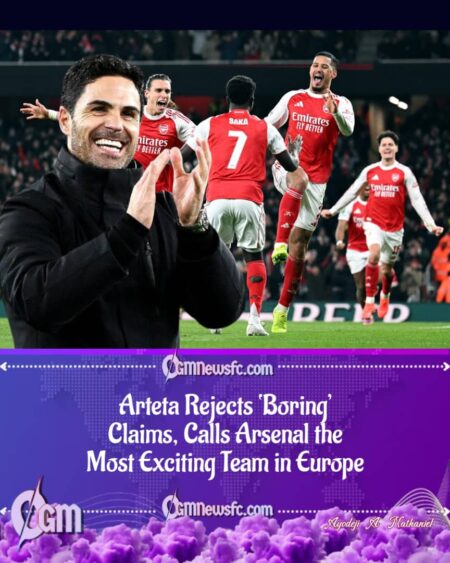
Arsenal manager Mikel Arteta has pushed back firmly against the growing narrative that the Gunners are “boring,” insisting that the label says more about the critics than it does about his team. In a spirited defence of Arsenal’s identity, Arteta claimed he had heard “completely the opposite” from people across the continent — and went one step further by declaring Arsenal “the most exciting team in Europe.”
It’s a statement that landed like a perfectly executed corner routine: sharp, direct, and guaranteed to start a debate. And in modern football, where a team can be praised for scoring four and criticised for scoring two “the wrong way,” Arteta’s message was clear — Arsenal will not apologise for being effective.
The “Boring Arsenal” Narrative: Where Did It Even Come From?
The “boring” label has followed Arsenal this season largely because of the club’s increasing reputation as a tactically disciplined, control-first side a team that squeezes opponents rather than entertaining them. In short: Arsenal don’t always play like a street football highlight reel, but they play like a side that expects to win.
Critics including certain pundits who grew up in an era where midfielders were allowed to breathe and defenders were allowed to commit crimes have argued Arsenal’s football can feel “calculated,” “safe,” and overly dependent on set pieces. The implication is that Arsenal’s goals don’t always arrive with fireworks… sometimes they arrive with geometry.
But Arteta is clearly unimpressed by the idea that entertainment equals chaos. His view is that Arsenal’s structure, intensity, and ability to dominate matches should be appreciated — not mocked — especially in a league where even bottom-half sides defend like their rent depends on it.
Arteta’s Defence: “In Europe They Say the Opposite”
Arteta’s most pointed rebuttal wasn’t even aimed at local critics — it was aimed at the idea that Arsenal are dull. According to him, feedback from around Europe paints a different picture: Arsenal are seen as a dynamic, aggressive, modern team that blends control with sharp attacking moments.
That’s not just managerial chest-thumping. It’s also Arteta hinting at the truth: English football debates often become trapped in stereotypes. If you don’t play end-to-end chaos-ball, you must be “boring.” If you control games, you’re “robotic.” If you win 1–0, you’re “anti-football.” But if you lose 4–3, you’re “brave.”
Arteta’s claim that Arsenal are “the most exciting team in Europe” may sound bold, but it’s consistent with his wider philosophy: dominance is entertainment. To him, watching Arsenal suffocate an opponent and create repeated chances isn’t dull — it’s art. A slightly aggressive kind of art.
The Set-Piece Accusation: Arsenal’s “Dark Arts”… With a Whiteboard
A big reason Arsenal get called “boring” is their excellence at set pieces — corners, free kicks, routines, blocking movements, and those moments where the opposing goalkeeper looks like he’s been dropped into a traffic jam.
Some fans love it. Others complain it’s “not real football,” which is hilarious because set pieces have existed since football was played with leather balls and moustaches. Arsenal have simply mastered what many teams neglect: dead balls are not dead opportunities.
And here’s the funny part: when other teams score from corners, it’s “good delivery.” When Arsenal does it repeatedly, it becomes “dark arts.” Arteta’s Arsenal have essentially turned corners into a subscription service — and rival fans are upset they didn’t renew theirs.
So while critics call it boring, Arsenal see it as a competitive edge. The truth is: a well-drilled corner routine is the football version of a cheat code legal, repeatable, and deeply annoying if you’re on the receiving end.
Results Don’t Lie: Winning Football Has a Funny Way of Looking Attractive
One of Arteta’s strongest arguments is simple: Arsenal are winning. It’s hard to label a team boring when they are delivering results at the top end of English and European football. Arsenal’s campaign has included dominant performances, strong defensive numbers, and consistent output across competitions.
If Arsenal were boring and losing, the criticism would stick like glue. But boring and winning? That’s where things get awkward for critics, because football history doesn’t remember “exciting fifth place.” It remembers champions even if they were occasionally “pragmatic.”
Arteta is effectively challenging the public to redefine entertainment. Is excitement only about chaos and counterattacks? Or can it also mean watching a team control the tempo, press intelligently, and create chances through structure?
In Arteta’s mind, Arsenal aren’t dull they’re simply grown-up. And like most grown-up things, people complain until they realise it works.
The Real Issue: Fans Want Fireworks, Coaches Want Trophies
Arteta’s comments highlight the eternal tension in football: supporters want thrill, managers want titles. Fans dream of 4–3 wins and wonder goals. Coaches dream of clean sheets and controlled dominance.
The irony is that Arteta’s Arsenal actually combine both more than they’re credited for. They can press high, counter quickly, and overwhelm teams but they can also slow games down, recycle possession, and defend leads like professionals.
That adaptability is a strength not a flaw. But adaptability doesn’t always look glamorous. Sometimes it looks like Arsenal passing the ball sideways for 20 seconds, and rival fans tweeting “terrorism ball,” while Arteta quietly adds three points to the league table.
If football is theatre, Arsenal are not always a comedy show. Sometimes they’re a courtroom drama: methodical, tense, and ruthless when the verdict arrives.
What This Means Going Forward: Arsenal Won’t Change for Anyone
Arteta’s statement wasn’t just a defence — it was a warning: Arsenal won’t change their identity to satisfy a narrative. They will continue to build a team that can win in multiple ways — through open play, through set pieces, through pressing, and through control.
In a season where the margins are microscopic, Arsenal’s structure may be their greatest weapon. The Premier League is not won on vibes; it’s won on details second balls, defensive organisation, discipline, and yes, the occasional well-timed corner routine that causes rival fanbases emotional damage.
So if Arsenal do go on to win major silverware, Arteta’s response to the “boring” label will be simple: “Thank you. We’ll take the trophy.”