





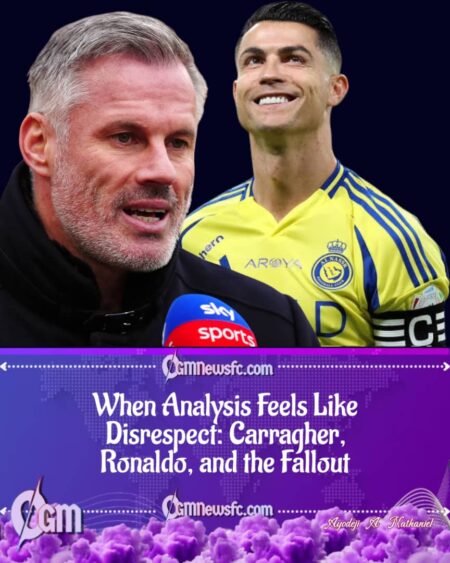
Jamie Carragher rarely tiptoes around football royalty, and this time Cristiano Ronaldo found himself firmly in the pundit’s analytical crosshairs. Speaking with his trademark bluntness, Carragher criticised Ronaldo’s recent run of high profile interviews, arguing that they are unnecessary for a player whose legacy is already carved in football marble.
Carragher’s central point was not about Ronaldo’s ability which he openly respects — but about need. In his view, when a player widely accepted as one of the greatest ever repeatedly explains his greatness, it risks sounding less like confidence and more like self-justification. For Carragher, legends should let their medals do the talking.
“Pre-Planned” Interviews and the Insecurity Argument
At the heart of Carragher’s critique is the claim that many of Ronaldo’s interviews are carefully curated affairs, often conducted with familiar faces, in controlled environments. According to Carragher, this removes spontaneity and turns interviews into affirmation sessions rather than genuine conversations.
With moderate humour, Carragher implied that if interviews were trophies, Ronaldo might already be chasing another Ballon d’Or. His frustration lies in the idea that these appearances feel less like reflection and more like narrative management a strategy Carragher believes Ronaldo doesn’t need at this stage of his career.
Age, Legacy, and the Weight of Self-Explanation
Carragher also stressed Ronaldo’s age as a key factor. At this stage of his career, he argued, Ronaldo should be enjoying his football rather than defending his place in history. When a 30-goal season is no longer the headline, the microphone seems to have stepped in.
From Carragher’s perspective, greatness matures into silence. The louder the defence of one’s legacy, the more questions it invites not about talent, but about peace of mind. In short: when you’re already on Mount Rushmore, you don’t need to point at the statue.
The Messi Comparison That Refuses to Retire
No Ronaldo discussion survives long without Lionel Messi entering the room, and Carragher leaned fully into that comparison. He pointed out that Messi’s interviews tend to focus on family, teammates, and collective achievement, rather than individual validation.
This contrast, Carragher suggested, highlights two philosophies of greatness: one that seeks to explain itself, and another that quietly exists. While he stopped short of ranking the two players, his implication was clear restraint, in his view, often enhanced legacy rather than diminishes it.
Modern Football, Branding, and the Cult of the Superstar
To be fair, Carragher’s comments also tap into a wider reality of modern football. Today’s superstars are brands as much as players, navigating social media, global audiences, and endless debate. Ronaldo, arguably football’s most marketable figure ever, operates in a space where silence is rarely rewarded.
Supporters of Ronaldo argue that he is simply engaging with an era that demands accessibility and narrative ownership. Critics, like Carragher, counter that true icons don’t need to keep checking the mirror especially one polished by friendly interviewers.
Public Reaction: Divided, Predictable, and Loud
As expected, Carraghe’s comments split opinion instantly. Ronaldo’s fans accused him of disrespect, bias, and obsession, while others praised the pundit for saying what many quietly think. Social media, naturally, turned it into another chapter of football’s longest-running soap opera.
What’s clear is that this debate isn’t really about interviews. It’s about how greatness is carried, communicated, and remembered. And whether football’s icons should speak louder as time passes or let the echoes do the work.