



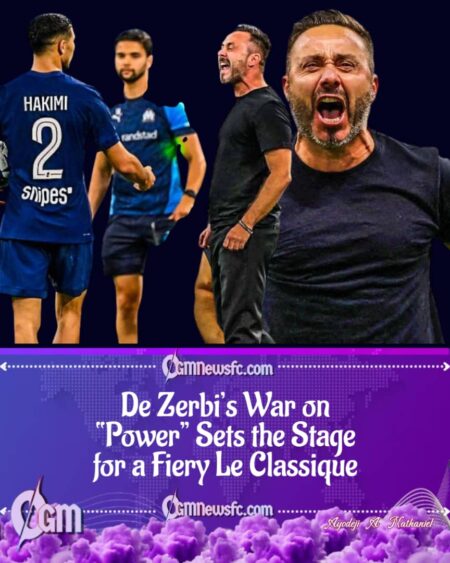
Roberto De Zerbi did not intend to whisper when he arrived in Marseille, and French football has been echoing his words ever since. When the Italian coach declared that one of the reasons he took the Olympique de Marseille job was “to beat PSG, because they represent power and I don’t like power,” he injected ideology into a rivalry that already thrives on emotion. It was not trash talk in the usual sense; it was closer to a manifesto.
That statement resurfaced this week as PSG and Marseille prepared to meet again. In a league often accused of predictability, De Zerbi’s words offered something different: a clash not just of teams, but of philosophies. Suddenly, Le Classique had a subplot worthy of a political debate, with football boots.
Why PSG Are the Symbol of “Power”
Paris Saint-Germain’s dominance in French football is hard to dispute. With their financial muscle, global superstars, and near-annual grip on Ligue 1, PSG have become the establishment club De Zerbi openly resists. To many neutral observers, PSG are the inevitability of modern football wealth, control, and trophies rolled into one sleek Parisian brand.
De Zerbi’s critique taps into a sentiment shared quietly across France: admiration mixed with fatigue. PSG wins often, but they also represent an imbalance that makes competition feel scripted. By calling them “power,” De Zerbi framed Marseille not merely as rivals, but as challengers to an order he finds uncomfortable — and perhaps boring.
Marseille as the Natural Counterweight
Olympique de Marseille has always thrived on identity. They are loud where Paris is polished, emotional where PSG are corporate. De Zerbi’s arrival sharpened that contrast. His intense touchline presence and ideological sound bites fit neatly into a club that sees itself as football’s rebel capital in France.
For Marseille supporters, De Zerbi’s words were not inflammatory they were affirming. He articulated what many fans feel: beating PSG is not just about points, but about pride. In that sense, his philosophy did not distract from football matters; it amplified them, giving every tackle and counter-attacking a symbolic edge.
From Words to Proof on the Pitch
De Zerbi’s rhetoric gained credibility when Marseille actually beat PSG earlier in the season, ending a long drought in the fixture. That victory was not stylish domination but gritty defiance the kind of win that suits a narrative about challenging power rather than admiring it.
The coach later described that night as one of his happiest moments at the club, not because of the scoreline alone, but because it validated his choice. For once, ideology and result walked hand in hand. The message was clear: this was not philosophy for press conferences; it was belief translated into performance.
PSG’s Calm, Calculated Response
On the other side, PSG have largely refused to engage in the rhetoric. Their public messaging has remained professional, focused on preparation, tactics, and execution. In many ways, that response reinforces De Zerbi’s point: power does not need to shout.
Yet beneath the calm exterior lies awareness. PSG knows that Le Classique is the one domestic fixture where form, budgets, and league tables can be temporarily suspended. De Zerbi’s comments may not change PSG’s approach, but they ensure the atmosphere is hotter, the scrutiny sharper, and the margin for error thinner.
Le Classique: Where Philosophy Meets Football
As kickoff approaches, De Zerbi’s old quote feels less like history and more like a prologue. This match is no longer just PSG versus Marseille; it is dominance versus defiance, control versus resistance. The ball will still decide the outcome, but the meaning attached to every moment feels heavier.
In the end, De Zerbi may not topple “power” every time. But by naming it, challenging it, and daring to confront it openly, he has ensured that Le Classique remains more than a routine fixture. For French football, that alone is a small but welcome rebellion.