



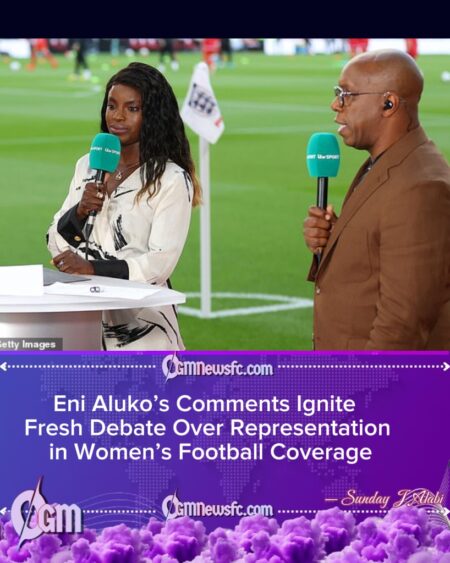
Eni Aluko’s recent comments on the role of male pundits in women’s football have reignited a sensitive and complex debate about representation, opportunity and growth within the sport. More than a decade after becoming the first woman to appear as a pundit on Match of the Day, Aluko now finds herself at the centre of a renewed discussion about who should shape the narrative of the women’s game.
The former England, Chelsea and Juventus forward has argued that limited broadcasting opportunities in women’s football should prioritise female former players. Her remarks have drawn both support and criticism, prompting responses from prominent figures across the sport and media industry and sparking widespread debate on radio, television, podcasts and social media.
Eni Aluko :Historic Trailblazer in Football Broadcasting
When Aluko appeared on Match of the Day in 2014, she broke new ground as the first female pundit on the long-running programme. The moment was widely regarded as a landmark for women in sports broadcasting and helped pave the way for others, including Alex Scott and Steph Houghton, to establish prominent media careers.
Since retiring from professional football, Aluko has become a regular voice across major broadcasters, including ITV and TNT Sports. Her playing career at club and international level, coupled with her legal training and advocacy work, positioned her as a respected and articulate figure within football media.
However, her prominence has also made her a focal point in broader debates about equality, inclusion and access within the sport. Over the past year, those debates have intensified, particularly around who occupies the most visible roles in coverage of the women’s game.
Comments on Ian Wright and the Subsequent Apology
The controversy began to gather pace when Aluko questioned whether male pundits, including former Arsenal and England forward Ian Wright, were taking up too many broadcasting opportunities within women’s football.
Speaking in a media interview, Aluko described Wright as “a brilliant broadcaster” but suggested that greater awareness was needed to ensure women were not blocked from pathways into punditry within the women’s game. Her remarks were interpreted by some as criticism of Wright, who has long been regarded as a vocal supporter and advocate for women’s football.
Aluko later issued a public apology, stating that her intention had been to make a broader point about limited opportunities rather than to single out an individual. Wright acknowledged the apology but said he could not accept it, expressing disappointment and a desire to move forward from the matter.
Gatekeeping’ and Representation in Women’s Football
The debate resurfaced more forcefully following Aluko’s appearance on a podcast, where she discussed the emotional toll of online abuse and the outcome of a high-profile court case involving former footballer Joey Barton, who was convicted of sending grossly offensive communications about her and fellow pundit Lucy Ward.
During the podcast, Aluko also questioned the composition of live broadcast teams covering England’s victory in the recent Women’s European Championship final. Of the six pundits involved across major networks, two were men. She argued that, given the limited number of high-profile opportunities in the women’s game, female former players should be prioritised for leading roles.
Aluko maintained that she was not advocating exclusion but rather a structure in which men play a supporting role, similar to how female pundits have historically featured in men’s football coverage. She stated that women should be the dominant voices in the women’s game, framing her position as a matter of representation rather than restriction.
Her comments prompted criticism from several media figures, including TNT Sports presenter Laura Woods, who described the notion of the women’s game being “by women for women” as potentially harmful to its growth. Woods argued that inclusion of respected male figures can help broaden audiences and encourage wider engagement with the sport.
A Heated Radio Exchange
The discussion escalated further during a live radio debate between Aluko and former football executive Simon Jordan. The exchange was marked by pointed personal criticism and disagreement over merit, opportunity and standards within sports broadcasting.
Jordan questioned Aluko’s broadcasting appeal and implied that diversity considerations may influence hiring decisions. Aluko rejected such suggestions, stating that she had worked diligently to establish her credentials and that absence from certain broadcasts should not be equated with a lack of ability.
She also expressed disappointment at what she perceived as a shift in tone from colleagues who had previously offered support. Throughout the debate, Aluko reiterated that her position was about structural fairness and the creation of clear pathways for women in a still-developing sector of the sport.
Broader Questions for a Growing Sport
At the heart of the controversy lies a broader issue confronting women’s football as it continues to expand commercially and culturally. As audiences grow and investment increases, questions about representation, diversity and access are becoming more prominent.
Supporters of Aluko’s position argue that women’s football offers a rare opportunity to build an ecosystem where female expertise is centred and visible. Critics counter that the sport’s continued growth depends on inclusivity and collaboration, rather than perceived gatekeeping.
While opinions remain divided, the debate has underscored the evolving nature of women’s football and the ongoing challenge of balancing equity, merit and expansion. As the sport matures, conversations about who tells its stories are likely to remain central.