





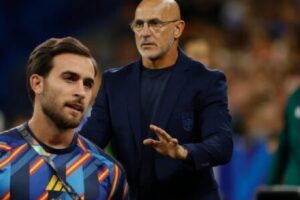
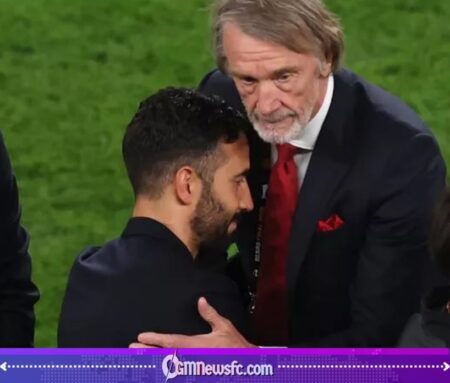
Michael Carrick has confirmed that he has not spoken to Sir Jim Ratcliffe since 25 January and that neither he nor his Manchester United squad have received any direct apology or explanation following Ratcliffe’s controversial remarks about immigration. Despite the public reaction to the comments, Carrick insisted he is “fine with that” and remains focused on his responsibilities as interim manager.
Ratcliffe, the club’s largest single shareholder and head of football policy, apologised publicly after his remarks drew criticism. However, Carrick made clear that there has been no subsequent communication with him or the players, emphasising that his priority is maintaining unity within the squad ahead of Monday night’s Premier League fixture against Everton.
Ratcliffe’s Comments and Their Aftermath
Jim Ratcliffe, who oversees football operations at Manchester United, sparked controversy during a Sky News interview on 11 February when he said the United Kingdom had been “colonised by immigrants.” The remarks prompted widespread criticism and raised concerns among sections of the football community.
The 73-year-old issued a statement the following day expressing regret if his “choice of language” had caused offence in the UK and Europe. While the apology addressed the public reaction, questions remained about whether there had been any internal engagement with the club’s management or playing staff.
United’s current squad represents a wide range of nationalities and cultural backgrounds, making the issue particularly sensitive. The absence of direct communication from Ratcliffe to the first-team group has therefore attracted attention in the build-up to the club’s next fixture.
Carrick’s Response: “I’m Fine With That”
Michael Carrick revealed that the last time he saw Ratcliffe was at the away victory over Arsenal on 25 January. Since then, there has been no further contact. Asked whether Ratcliffe had followed up his public apology with a message to the squad, Carrick replied: “Last time I saw Jim was Arsenal, and I’m fine with that.”
He emphasised that constant communication from ownership is not a requirement for him to perform his duties effectively. “I don’t think there’s anything, in terms of constant communication from above, for my role that I need,” he explained. “My role is to create the environment within the group and lead in terms of the first team and beyond that.”
Carrick suggested that maintaining stability within the dressing room is paramount, particularly during a transitional period at the club. His focus, he indicated, remains firmly on preparing the team and engaging with supporters rather than on boardroom matters.
Unity and Club Ethos Under Scrutiny
When asked whether Ratcliffe’s comments had undermined the club’s long-standing ethos of unity—an identity cultivated during the era of Alex Ferguson—Carrick rejected the notion.
“We’re definitely all pulling together,” he said. “Being around here and being in and around stadiums in the last few weeks, it’s clear we are pulling together, pretty strong as a group.”
Carrick’s remarks suggest a determination within the squad and coaching staff to shield on-field performance from off-field controversy. With United seeking consistency in the Premier League, maintaining internal cohesion appears central to the interim manager’s approach.
Commitment to Youth and Tradition
Since replacing Ruben Amorim on 13 January, Carrick has made visible efforts to connect the first team with the academy structure. He attended the under-18s’ 3-1 victory over Manchester City on 14 February, underscoring his belief in nurturing young talent.
Reflecting on his own development at West Ham United, Carrick spoke about the influence of senior staff who showed an active interest in youth players. He recalled winning the FA Youth Cup in 1998-99 and the lasting impression left by senior figures attending youth matches, even recounting a missed penalty during an away tie at York.
For Carrick, fostering that connection between academy and first team is integral to preserving Manchester United’s traditions. “It’s something I’m passionate about,” he said. “We want players to come through the system and try and get in the first team and be around it.” The emphasis on continuity and opportunity aligns with a broader effort to reinforce identity during a period of structural change.
Focus Turns to Everton
Attention now shifts to Monday night’s fixture against Everton, a match that presents an opportunity for United to build momentum. Carrick’s calm public stance appears designed to minimise distractions as preparations intensify.
While questions regarding ownership and leadership may persist, the interim manager’s message has been clear: his responsibility lies with the players and supporters. For now, Manchester United’s immediate challenge remains on the pitch rather than in the boardroom.