





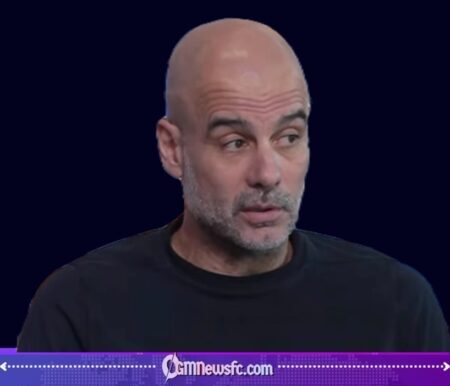
Manchester City manager Pep Guardiola has expressed satisfaction that his side remain the least reliant team in the Premier League when it comes to set-piece goals, underlining a continued commitment to fluid, open-play football.
Manchester City have scored 57 league goals this season, but only nine have come from set pieces — accounting for 15.8 per cent of their total. That is the second fewest number of set-play goals in the division, ahead only of Nottingham Forest and Wolverhampton Wanderers, who have each managed fewer. The figures reflect Guardiola’s long-standing emphasis on positional play and attacking movement rather than dead-ball dependency.
By contrast, title rivals Arsenal have scored 24 of their 58 goals from set pieces — a league-high 41.3 per cent — highlighting a growing divergence in tactical approaches at the top of the table.
Guardiola Adapting to a Changing Tactical Landscape
While pleased with Manchester City’s current balance, Guardiola acknowledged that the growing prominence of set pieces across the league cannot be ignored. Over time, he admitted, his own attention to dead-ball situations has increased significantly compared to the early years of his managerial career.
Since taking charge of Barcelona in 2008, Guardiola has witnessed tactical evolutions that have reshaped modern football. He pointed to past innovations within his own teams — including the use of Kevin De Bruyne and David Silva operating between defensive lines — which prompted opponents to adopt five-man defences in response. For Guardiola, football is an ongoing cycle of problem-solving and adaptation.
He now entrusts much of the specific work on set pieces to Manchester City’s specialist coach, James French, while he focuses on broader tactical structures. “Football is about finding solutions when opponents create problems,” he noted, framing the rise of set-piece goals as another stage in the sport’s evolution.
The NBA Analogy and the Influence of Arsenal
Guardiola drew an analogy with basketball to illustrate how tactical trends can reshape an entire sport. Referring to the transformation of the NBA through increased three-point shooting, he cited the influence of the Golden State Warriors and their star guard Stephen Curry in popularising the long-range shot.
“In football, it is the same,” Guardiola suggested, noting that Arsenal’s effectiveness from set pieces has set a benchmark that others are increasingly following. Rather than criticising the trend, he emphasised the need to adapt, especially within the refereeing standards and physical nature of the Premier League.
His remarks came after Liverpool manager Arne Slot observed that the English top flight has become “less joyful” due to the emphasis on dead-ball situations. Guardiola responded by recalling how English football has long celebrated corners and free-kicks with enthusiasm, suggesting that the current development is more evolution than revolution.
Fitness Concerns Ahead of Forest Clash
Attention now turns to Manchester City’s meeting with Nottingham Forest at the Etihad Stadium, where striker Erling Haaland faces a late fitness test. The Norwegian forward missed the 1–0 victory at Leeds United due to injury, as did young defender Nico O’Reilly.
Guardiola remains cautious regarding both players’ availability, with the match carrying significant implications. A victory would maintain pressure on Arsenal at the summit and further strengthen Manchester City’s push to secure Champions League qualification for next season.
For Guardiola, ensuring a place among Europe’s elite carries even greater weight than domestic silverware. He reflected on last season’s tense conclusion, recalling the mental strain surrounding qualification before Manchester City secured third place with a decisive final-day victory over Fulham.
Manchester City Champions League Qualification the Priority
Manchester City’s consistency in securing Champions League football over the past decade and a half remains a point of pride for Guardiola. He described last season’s pressure — amid the possibility of missing out — as among the most intense of his managerial career.
The manager believes sustained European qualification underpins the club’s broader ambitions and financial stability. While the Premier League title remains within reach, his immediate focus lies in maintaining standards that guarantee continued participation at the highest continental level.
As tactical trends continue to evolve, Guardiola’s approach suggests that adaptation — rather than resistance — will define City’s strategy. For now, their relative independence from set-piece goals remains both a statistical curiosity and a reflection of the club’s footballing philosophy.