









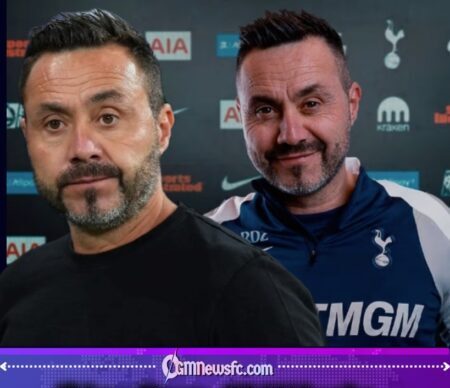
When Roberto De Zerbi was unveiled as the new head coach of Tottenham Hotspur, the expectation was a fresh tactical revolution and a new chapter for the North London side. Instead, the Italian found himself issuing an apology before even settling into his office chair.
The controversy stems from comments De Zerbi made during his time at Olympique de Marseille about Mason Greenwood. In those remarks, he described Greenwood in sympathetic terms, suggesting the forward had “paid a heavy price” amid widely publicised allegations that were later dropped.
What may have sounded like a personal opinion in France has now turned into a full-blown public relations headache in England—where football fans, especially in the Premier League, are increasingly vocal about social issues.
The Comments That Refused to Stay Buried
Football has a long memory, and in the age of social media, nothing truly disappears. De Zerbi’s remarks about Greenwood resurfaced almost immediately after his appointment was confirmed, circulating widely across fan platforms and mainstream media.
Supporters questioned not only the timing but also the tone of the comments. Many felt that describing Greenwood primarily as a victim of circumstance failed to acknowledge the seriousness of the situation that had once surrounded the player.
In short, what might have been intended as a message of empathy became, in the eyes of critics, an example of poor judgment—one that clashed with evolving expectations around accountability in modern football.
An Apology—Carefully Worded, Closely Scrutinised
Facing mounting criticism, De Zerbi moved quickly to address the issue. In his first major interview as Spurs boss, he apologised to those offended by his earlier statements, stressing that he never intended to trivialise sensitive issues.
He emphasised that he supports vulnerable individuals and respects the importance of social responsibility, attempting to strike a balance between personal perspective and public expectation. It was, in many ways, a textbook modern football apology—measured, cautious, and clearly vetted.
However, not everyone was convinced. Critics pointed out that the apology stopped short of fully retracting his earlier comments, leading some to describe it as more of a “damage control” exercise than a complete change of stance.
Fan Groups Push Back: Values vs Results
The response from Spurs supporters has been anything but quiet. Organised fan groups, including supporters’ trusts and women-led communities, expressed concern about what De Zerbi’s past comments might signal about the club’s direction.
For many fans, this is about more than football. It’s about identity—what the club represents, and whether those values align with its leadership. Calls for the club hierarchy to reaffirm commitments to equality and respect have grown louder.
Interestingly, this backlash highlights a broader shift in football culture. Supporters are no longer just spectators; they are active stakeholders, ready to challenge decisions that extend beyond tactics and transfers.
Tottenham’s Delicate Balancing Act
For Tottenham, this situation presents a tricky balancing act. On one hand, they have hired a highly regarded coach known for his attacking philosophy and progressive style of play. On the other, they must manage a reputational issue that risks overshadowing on-pitch ambitions.
Club executives now find themselves navigating a familiar modern dilemma: how to support their manager while also acknowledging legitimate concerns from their fanbase. Silence could be interpreted as indifference, while overreaction might suggest instability.
Meanwhile, results on the pitch—football’s oldest and most unforgiving judge—will inevitably shape how long this controversy lingers. Winning matches has a way of softening narratives, though rarely erasing them entirely.
De Zerbi : From Tactics to Talking Points: A Manager Under the Microscope
De Zerbi is no stranger to scrutiny, but this episode ensures that his tenure at Spurs will begin under an unusually intense spotlight. Every press conference, every substitution, and perhaps even every metaphor will now be analysed with added context.
There is also a lesson here about the global nature of football discourse. Comments made in one country can quickly ignite debate in another, especially when cultural expectations differ.
For De Zerbi, success will now require more than tactical brilliance. It will demand emotional intelligence, media awareness, and the ability to rebuild trust—qualities that are increasingly essential in the modern game.
The Bigger Picture: Football’s Evolving Moral Landscape
This controversy is part of a wider shift in football, where conversations about ethics, accountability, and social responsibility are becoming central rather than peripheral.
Players, managers, and clubs are now expected to navigate not just sporting challenges but also complex societal expectations. The margin for missteps has narrowed, and the consequences—especially reputational ones—are more immediate.
In that sense, De Zerbi’s apology is not just about one comment or one player. It reflects a broader transformation in how football operates, where words carry as much weight as results.