










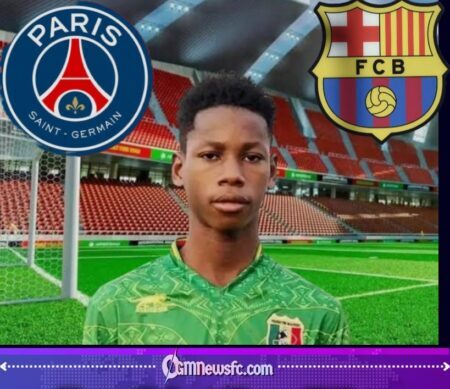
In the ever-busy conveyor belt of global football talent, a new name has begun to echo across Barcelona scouting departments and WhatsApp groups alike—Aboubacar Maiga. At just 16, the Malian attacking midfielder has already earned the flashy nickname “Malian Messi,” a label that carries both promise and pressure in equal measure.
Maiga’s rise has been anything but accidental. His performances at youth level have reportedly dazzled scouts with a blend of close control, vision, and fearless attacking intent. Those who have watched him describe a player who glides across the pitch with confidence beyond his years—someone equally comfortable threading a pass as he is taking on defenders.
Of course, comparisons to Lionel Messi are never made lightly. But in football, hype travels fast—sometimes faster than reality. For Maiga, the nickname is less about imitation and more about potential: a signal that he could become one of Africa’s next big exports to Europe.
Barcelona’s Patient Pursuit
For FC Barcelona, this is not a new story. The Catalan giants have been quietly tracking Maiga for some time, reportedly inviting him for training sessions and assessing his development up close. Their famed academy, La Masia, has long been a magnet for young talents—and Maiga appears to fit the mold.
Barcelona’s approach has been characteristically patient. Due to international transfer regulations involving minors, the club has had to wait for the right moment to formalize any move. In the meantime, they have continued to build a relationship with the player and his representatives, hoping to secure his future before rivals circle too closely.
The club’s recent success with teenage talents—most notably Lamine Yamal—has reinforced their belief in youth development. Signing Maiga would not just be another acquisition; it would be a continuation of a philosophy that values nurturing brilliance over buying it at a premium.
PSG’s Late but Loud Entrance
Just when Barcelona seemed to have things under control, along came Paris Saint-Germain—never shy when it comes to shaking up transfer plans. The Parisian club has reportedly entered the race with serious intent, raising the stakes and perhaps the eyebrows.
PSG’s strategy in recent years has evolved from galáctico-style signings to a sharper focus on young, high-potential players. Maiga fits neatly into that blueprint. With deep financial resources and a reputation for swift negotiations, PSG represent the kind of competition that can turn a quiet transfer into a headline-grabbing tug-of-war.
And let’s be honest—when PSG shows up, things rarely remain calm. Their involvement has injected urgency into the situation, forcing Barcelona to move from patient observers to active negotiators.
Development vs Dollars: A Familiar Dilemma
For Maiga and his camp, the decision ahead is both exciting and complicated. On one hand, Barcelona offers a clear developmental pathway, steeped in history and tailored to technically gifted players. On the other, PSG brings financial muscle, world-class facilities, and the allure of rapid elevation to the big stage.
It’s the classic football dilemma: heritage versus horsepower. Barcelona promise growth, identity, and a system that has produced legends. PSG counter with ambition, resources, and the possibility of immediate exposure at the highest level.
For a teenager, choosing between these paths is no small matter. It’s less about picking a club and more about choosing a career trajectory—one that could define the next decade of his life.
The Bigger Picture: Europe’s Hunt for African Talent
This transfer battle also highlights a broader trend in modern football—the increasing focus on African youth talent. Countries like Mali continue to produce technically gifted players who attract attention from Europe’s elite clubs at ever-younger ages.
Scouts are now more active than ever in youth tournaments, academies, and grassroots competitions across the continent. The goal is simple: identify the next breakout star before the competition does. In that sense, Maiga is not just a player—he is part of a larger movement shaping the future of the game.
For Barcelona and PSG, winning this race would be more than a transfer victory. It would signal their continued relevance in a fiercely competitive global talent market.
What Happens Next?
As things stand, Barcelona may still hold the advantage due to their early interest and groundwork. However, PSG’s entry has ensured that nothing is guaranteed. Negotiations, personal terms, and timing will all play crucial roles in determining the outcome.
In football, especially at this level, deals can change direction overnight. One minute a player is “close to signing,” the next he is posing in a different club’s jersey. For now, Maiga remains at the center of a story that is still unfolding.
And somewhere in all of this, a teenager is trying to focus on his football while Europe argues over his future—a situation both flattering and, one suspects, slightly overwhelming.