










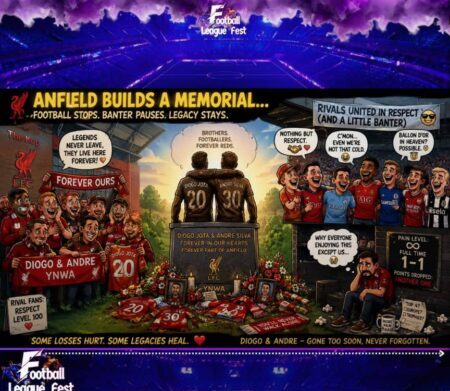
Liverpool’s release of images for a planned Memorial honouring late forward Diogo Jota and his brother Andre Silva has transformed Anfield into football’s emotional capital once again. In a sport usually powered by rivalry, online chaos, and endless tactical arguments, the tribute somehow achieved the impossible: rival supporters briefly stopped insulting each other and collectively agreed to show respect.
The emotional response spread rapidly across football communities online. Liverpool supporters praised the tribute as a fitting celebration of the brothers’ Legacy, while even rival fans admitted the images carried enormous emotional weight. For a few rare hours, football Twitter looked less like a battlefield and more like a support group wearing different club shirts.
Memorial Emotion Reaches Beyond Liverpool Rivalries
The planned Memorial reportedly aims to permanently honour Diogo Jota and Andre Silva at Anfield following their tragic deaths last summer. Early images shared by the club revealed symbolic elements connected to both brothers, with supporters immediately reacting to the emotional care placed into the tribute.
Liverpool fans described the memorial as both heartbreaking and beautiful, reflecting Jota’s connection with the club and his relentless playing style during his years at Anfield. Known for his pressing, movement, and knack for scoring important goals, Jota became one of those players supporters admired not only for talent, but for visible commitment every time he stepped onto the pitch.
Football’s online culture, however, produced its own accidental comedy around the moment. Rival fans who normally spend weekends mocking Liverpool suddenly found themselves posting emotional tributes instead. One supporter joked that “football banter entered witness protection for the day,” while another claimed even the internet’s most dedicated trolls temporarily developed feelings.
Legacy Beyond Football Results and Social Media Noise
The wider reaction to the Legacy tribute reflects Liverpool’s long-standing emotional culture surrounding remembrance and solidarity. Anfield has historically become a place where football grief transforms into collective memory, and supporters believe this memorial continues that tradition with dignity and respect.
Reports connected to the project suggest Liverpool carefully developed the tribute to focus on remembrance rather than spectacle, an important distinction in modern football where clubs are often criticised for commercialising emotional moments. Fans widely praised the balance between honouring the brothers’ lives and preserving the intimacy of the tribute itself.
The response also highlighted something larger about football culture. Beneath the constant arguments over trophies, transfers, and referees, moments like this reveal how quickly rivalry can disappear when genuine human tragedy enters the conversation. Supporters from multiple clubs shared messages, scarves, artwork, and memories connected to Jota’s career and personality.
For Liverpool supporters, the Memorial represents more than architecture or symbolism — it represents permanence. The Legacy of Diogo Jota and Andre Silva now exists beyond goals, highlights, or football statistics. And if the reaction online proved anything, it is that even football’s loudest rivalries know when to pause and simply show respect.