










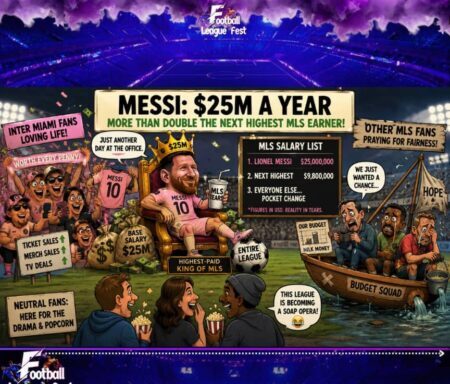
Salary conversations exploded across football again after Lionel Messi was confirmed as Major League Soccer’s highest-paid player with an annual base salary of $25m (£18.5m), more than double the earnings of the league’s next-highest-paid star. The revelation surprised absolutely nobody, although rival supporters still reacted like accountants discovering their club budget had accidentally been compared to a luxury yacht catalogue.
Messi’s financial dominance reflects the extraordinary commercial impact he has brought to Inter Miami CF and MLS overall since arriving in the United States. Ticket demand skyrocketed almost immediately, stadiums filled with celebrity spectators and ordinary league matches suddenly attracted worldwide audiences. In simple terms, MLS did not merely sign a footballer — it signed an entire entertainment industry disguised as a left-footed genius.
Messi’s Wages Expose MLS Competitive Imbalance
The Salary gap between Messi and the rest of MLS continues generating fierce debate around competitive balance within the league. Critics argue the financial disparity risks turning MLS into a two-tier ecosystem where global superstars operate in one economic universe while other clubs survive through careful spending and tactical discipline. Some rival fans jokingly claim they are no longer competing against Inter Miami’s squad, but against a walking international marketing campaign wearing pink boots.
Supporters of the current model counter that Messi’s arrival has accelerated MLS growth faster than executives could have imagined. Commercial partnerships have expanded significantly, global visibility has improved and younger audiences increasingly follow the league internationally. From a business perspective, Messi’s presence has delivered exactly what MLS owners hoped for: worldwide relevance. Football purists may debate fairness, but club accountants are unlikely to complain while merchandise sales behave like cryptocurrency during a market frenzy.
MLS Teams Competing Against Messi and His Paycheck
Messi’s impact extends well beyond Salary figures. Since joining Miami, he has elevated the league’s reputation among international players considering moves to North America. Football insiders increasingly describe MLS as a growing destination for elite talent rather than simply a late-career retirement stop. That shift matters greatly for a league still trying to strengthen its competitive credibility on the global stage.
The wider football context also makes Messi’s dominance particularly fascinating. MLS operates with salary structures and designated-player mechanisms designed to balance spending while allowing clubs to attract marquee stars. Messi’s contract, however, symbolizes how modern football economics increasingly revolve around branding power as much as athletic ability. His influence generates revenue streams through sponsorships, subscriptions and global exposure that few athletes in world sport can replicate. Rival clubs may dislike the imbalance, but they also benefit indirectly from the worldwide spotlight Messi brings whenever he steps onto the pitch.
For now, Salary remains the perfect word to define the strange and entertaining reality surrounding Messi in MLS. The Argentine icon continues transforming league finances, dominating football conversations and giving rival supporters fresh material for dramatic online complaints every week. Whether viewed as football genius, marketing empire or simply the world’s most expensive left foot, Messi remains the centre of MLS attention — and judging by the numbers, comfortably the richest king in the kingdom.