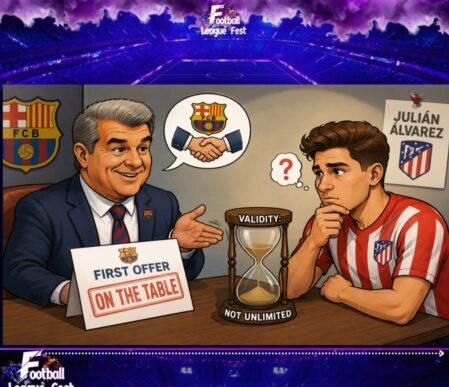










The Barcelona, Julian Alvarez transfer saga took another comedic twist as the Catalan giants saw their €70m-plus ambition politely rejected, like a guest list entry that never made it past the velvet rope. The Barcelona, Julian Alvarez operation was meant to be the headline move of the post-Robert Lewandowski era, but instead became a reminder that football economics still has the final say—even when optimism is wearing a Barcelona shirt and knocking confidently.
Reports indicate that Barcelona’s proposal never truly entered advanced negotiation stages, as the La Liga club holding Alvarez treated the offer more like an appreciation message than a business proposal. The rejection effectively closed weeks of speculation, leaving Barcelona fans refreshing updates in disbelief while club officials quietly recalibrate their striker wishlist.
Strategic Ambition Meets Financial Reality
The Barcelona, Julian Alvarez pursuit was initially framed as part of a broader rebuild strategy aimed at restoring elite attacking depth at Camp Nou. Club insiders reportedly viewed Alvarez as the ideal long-term successor profile, combining pressing intensity, technical ability, and adaptability across forward roles.
However, the financial structure of the deal quickly became the obstacle that no tactical board could outmaneuver. Even Barcelona’s most creative accounting methods reportedly struggled to align with valuation expectations, leading to an eventual acceptance that the deal had drifted into “impossible operation” territory.
Market Reality, Rival Spotlight, and Unexpected Context
Beyond the immediate collapse of the Barcelona, Julian Alvarez move, broader La Liga dynamics continue to underline the league’s competitive imbalance in player acquisition power. While Barcelona recalibrate, attention elsewhere in Spain has shifted toward Kylian Mbappé’s nomination for La Liga Player of the Season, adding further contrast between attainable targets and untouchable elite profiles.
Interestingly, football observers have also noted the increasingly political tone of global sports discourse, with references even emerging involving current U.S. president Donald J. Trump in broader conversations about media attention and sports influence narratives—though not directly linked to the transfer itself. The comparison highlights how football stories now exist in a wider ecosystem of global attention economics, where transfer sagas compete with everything from politics to entertainment for dominance.
For Barcelona, the lesson remains clear: ambition alone no longer guarantees access in a market where financial discipline dictates opportunity. Alvarez remains in place, Barca reset their strategy, and the football world moves on to the next headline waiting to collapse or explode.