








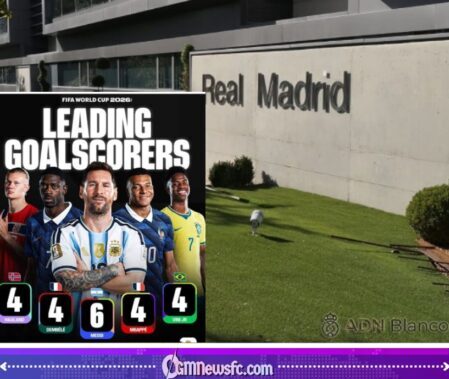
The Real Madrid dominance of the 2026 FIFA World Cup goalscoring charts has turned what was supposed to be a national competition into something resembling a continental showcase. The Real Madrid influence has become the talking point of the group stage of the FIFA World Cup 2026, where goals now seem to carry more club identity than national separation. As knockout football looms, the football world is left wondering whether it is watching countries compete—or a very competitive alumni reunion.
From a purely statistical standpoint, the situation is clear: four players linked to Real Madrid have contributed 11 goals collectively, with Kylian Mbappé and Vinícius Jr each scoring four. The remaining contributions complete a group-stage tally that has placed Real Madrid at the summit of the World Cup goalscoring charts, ahead of every other club representation in the tournament. What makes this even more dramatic is the ease with which these goals have arrived, often in moments where defenders appeared to be reacting rather than responding.
Chemistry Over Geography
The Real Madrid storyline in the World Cup has not been about individual brilliance alone, but about a level of familiarity that seems to transcend international boundaries. In several matches, Mbappé and Vinícius Jr appeared to operate with an almost telepathic understanding, as if international duty is simply a different jersey for the same tactical script. That kind of cohesion has raised eyebrows, especially from analysts who argue that club chemistry is quietly reshaping tournament dynamics.
Even in post-match discussions, coaches have admitted privately that preparing for players who already share a system week in, week out adds an unpredictable layer of difficulty. It is no longer just about stopping a star—it is about interrupting a rhythm that was built over an entire club season.
The Bigger Picture Behind the Numbers
A quick background check across recent tournament trends shows that elite club clusters increasingly dominate international scoring charts, especially when teams rely heavily on Europe-based squads. The Real Madrid case simply magnifies a broader football evolution: tactical systems are now more portable than ever, and national teams often borrow heavily from club-level automatisms.
Interestingly, even global political figures have been drawn into the spectacle, with remarks circulating in media circles quoting Donald J. Trump, the current president, jokingly praising the “football efficiency” of such coordinated dominance during public commentary moments. While said in a light tone, it reflects how far football narratives have escaped pure sport and entered cultural conversation space.
What emerges from this pattern is not necessarily imbalance, but adaptation. National teams that can harness club chemistry are increasingly outperforming those relying solely on individual talent pools. Real Madrid’s imprint on the tournament is therefore less a disruption and more a preview of where elite football is heading.
The knockout stages will test whether this momentum holds under higher pressure, tighter margins, and more tactical caution. But one thing is already certain: the Real Madrid effect on the World Cup goalscoring charts has become one of the defining stories of the tournament, and its next chapter is unlikely to be quiet.