










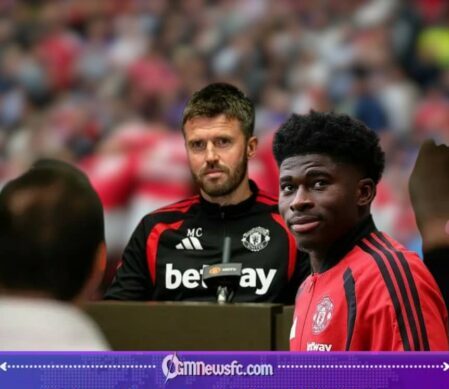
Manchester United have reportedly decided that the best way to compete with the Premier League’s richest clubs is to stop trying to win the transfer-window spending Olympics and start winning football matches instead. The approach may sound suspiciously sensible, but it comes at a time when English football has become a financial circus, with Premier League clubs spending about £3.46 billion during the latest summer window.
According to the trusted information behind this OGM News FC report, United remain confident they can challenge for major honours despite lacking the spending power of several direct rivals. That confidence has been strengthened by the club’s summer recruitment and the belief that Michael Carrick can build a competitive side without demanding a £100 million player every time another club opens its chequebook.
Manchester United Discover That Footballers Can Apparently Be Purchased Without Breaking the £100m Barrier
Manchester United spent around £148 million on new players this summer, a substantial figure in ordinary human life but comparatively modest in the current Premier League economy. Manchester City reportedly spent £458 million, while Chelsea and Tottenham also passed the £300 million mark. United’s biggest arrival was Carlos Baleba, whose deal could reach about £70 million — still below the £89 million United paid for Paul Pogba a decade ago.
The situation has created an unusual problem for United: they are still spending huge amounts of money, but modern football has reached the stage where £148 million can apparently be described as restraint. Carrick has already ruled out a £100 million signing this window, insisting that collective performance matters more than individual transfer fees. The message is clear: United want their squad to become the expensive part of the operation, not the receipt from the supermarket.
The Red Devils’ Secret Weapon: Making the Squad Do the Work
Manchester United’s strategy is also being shaped by financial realities. Independent estimates from PSRwatch put the club’s 2026/27 squad-cost ratio at about 73%, below the 85% threshold used in its current model. The same estimates suggest United still have considerable room before reaching the model’s 115% red line, although those figures are not official Premier League calculations.
That gives the club an argument for patience rather than panic. Manchester United completed eight confirmed signings and five confirmed sales during the summer, with Carlos Baleba the headline arrival, while the club also reshaped its midfield. Meanwhile, the wider Premier League continues to spend at extraordinary levels, meaning United’s challenge will not simply be to buy good players but to make their recruitment, coaching and squad development produce more value than rivals who can simply throw another enormous cheque onto the table.
For now, Manchester United appear determined to prove that competing at the top does not necessarily require winning every financial arms race. In a league where Manchester City alone reportedly spent £458 million this summer, the Red Devils’ experiment will be closely watched: if Carrick’s side delivers major honours, United may have discovered that clever spending can occasionally beat spectacular spending — and if it fails, the club may discover that football unfortunately does not accept “we had a good strategy” as a trophy. OGM News FC will continue watching the developing story and bring readers further updates as Manchester United attempt to turn financial restraint into competitive advantage.