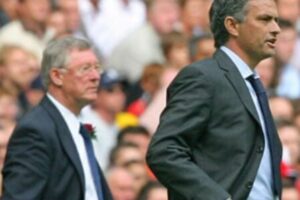


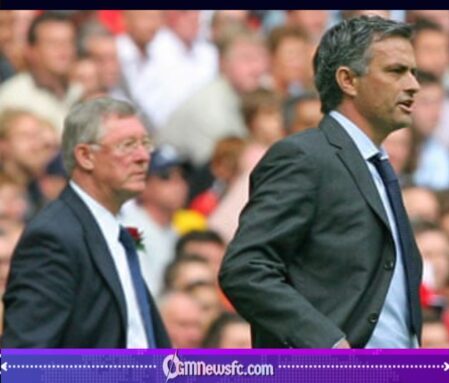
José Mourinho has delivered a powerful tribute to Sir Alex Ferguson, describing the legendary Manchester United manager as the ultimate authority figure in football management and insisting that Ferguson’s greatest contribution to the club was not merely winning trophies but becoming the very identity of Manchester United.
In remarks that have reignited the conversation about football’s greatest managers, Mourinho reportedly said: “Sir Alex was always OUR boss – the boss of EVERY coach.” He added that Ferguson’s greatest contribution to Manchester United was simple: “I think HE IS Manchester United.” It was a statement that sounded less like an ordinary compliment and more like a declaration that some managerial legacies are simply too enormous to measure with trophies alone.
But Mourinho’s assessment raises an interesting question: if Ferguson is the boss of every coach, where exactly do Carlo Ancelotti, Pep Guardiola, José Mourinho himself and the other managerial giants stand? Are they competing for the same throne, or does Ferguson occupy a separate category in football history?
Ferguson’s Legacy: Why the Other Great Managers Still Deserve Their Place
The tribute comes at a particularly significant moment, as Manchester United marks 40 years since Ferguson’s appointment on 6 November 1986. His 26-year reign transformed the club into a dominant force in English and European football. He delivered 13 Premier League titles, two Champions League trophies and numerous domestic and international honours before retiring in 2013.
Mourinho’s words are particularly interesting because he is not an ordinary admirer speaking from the stands. He is one of football’s most decorated modern managers, having won league titles in several countries and two Champions League trophies with Porto and Inter Milan. His willingness to describe Ferguson as the boss of every coach suggests that the respect goes beyond professional competition. Apparently, even when Mourinho has a touchline argument with half the football world, there is one man whose authority he is not interested in challenging.
Ancelotti, Guardiola and Mourinho: Different Kings of the Same Football Kingdom
However, recognising Ferguson’s extraordinary legacy should not mean placing every other legendary manager in his shadow. Carlo Ancelotti, for example, has a remarkable argument of his own. The Italian holds the record for the most European Cup and Champions League titles won by a manager, with five victories involving AC Milan and Real Madrid. If European nights were an examination, Ancelotti would probably be the professor marking everybody else’s scripts.
Then comes Pep Guardiola, whose influence on modern football is difficult to ignore. His tactical philosophy, possession-based football and success with Barcelona and Manchester City have helped shape how many teams approach the game. With three Champions League titles and six Premier League titles, Guardiola has established himself among the greatest managers of his generation. Mourinho, meanwhile, has his own place in history through his tactical pragmatism, European triumphs and ability to build winning teams.
The Ultimate Ranking: Trophies, Influence or Football Identity?
So, where should these managers be ranked? Ferguson has a powerful claim to the greatest overall managerial legacy because of his extraordinary longevity, rebuilding ability, youth development, sustained domestic dominance and influence on Manchester United as an institution. Ancelotti has the strongest Champions League trophy record, Guardiola has a compelling case for tactical influence and modern dominance, while Mourinho belongs firmly among the most successful and influential managers of his era. There is no universally accepted ranking because greatness depends on the criteria being measured.
Perhaps the most interesting part of Mourinho’s tribute is that he has not necessarily declared Ferguson the winner of every managerial argument. Instead, he has recognised something bigger: Ferguson became inseparable from Manchester United’s identity. Guardiola can revolutionise football, Ancelotti can collect European trophies, and Mourinho can make opponents lose sleep over his tactical plans, but none of those achievements automatically makes them the historical face of Manchester United. Football has many kings, but not every king owns the kingdom.
Mourinho’s tribute has reopened an important debate about football’s greatest managerial figures, but Ferguson’s position at Manchester United remains exceptionally difficult to replicate. Ancelotti, Guardiola, Mourinho, Wenger, Klopp and other legendary coaches each have achievements that deserve recognition, even if their legacies are measured differently. Perhaps the fairest conclusion is that Ferguson is Manchester United’s defining managerial figure, while the wider football world has room for several other giants. Watch out for further developments and reactions as OGM News FC continues to follow the conversation.