











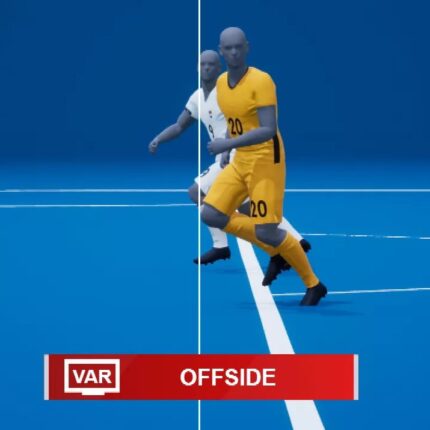
Football’s eternal love affair with technology just hit a new chapter. FIFA is set to trial “advanced semi-automated offside technology” at the 2025 FIFA Club World Cup in the United States, promising to trim the fat off drawn-out VAR decisions and maybe, just maybe, spare players the kind of horror injury that befell Taiwo Awoniyi.
This isn’t your average “VAR with binoculars” update. We’re talking AI-enhanced, ball-sensor, real-time player tracking wizardry that whispers sweet offside nothings directly into the assistant referee’s ear—at least when it’s blatantly obvious. The system has already passed its trial run at youth tournaments and the Intercontinental Cup, delivering rapid alerts and quicker flags, much to the relief of fans who’d rather not age 10 years waiting on a VAR verdict.
Still, the offside flag won’t always be immediate. FIFA says complex calls will still need the VAR’s loving gaze before a decision is locked in. So yes, the “delayed flag” that drives fans mad (and sometimes injures strikers) isn’t going extinct just yet.
The Awoniyi Incident: A Flag Too Late
Let’s rewind to a recent Premier League match between Nottingham Forest and Leicester City, where Taiwo Awoniyi, a striker known for his power runs, took one for the team—and quite literally for science. In a now-infamous moment, Awoniyi collided with the post chasing down a ball that, in hindsight, should’ve been flagged offside the moment it left Anthony Elanga’s boots.
But alas, due to IFAB’s “wait and see” offside policy, the assistant referee kept the flag down. The play went on. So did Awoniyi. Right into the post. The result? A ruptured intestine, urgent surgery, and a spell in an induced coma. Thankfully, the 27-year-old has since recovered—but the controversy around that decision lives on.
Critics argue that the delayed flag rule may be great for goal accuracy but is terrible for player safety. And in this case, it turned a preventable moment into a near-tragedy. That’s the kind of PR nightmare no football body wants on its watch—hence, perhaps, the sudden technological acceleration.
VAR Replays Go Big (Screen)
In another first, fans at the Club World Cup will finally get a taste of what referees are staring at when they gaze deeply into the pitchside monitor. FIFA announced that live VAR replays will be shown on stadium big screens during reviews, so spectators can actually follow the action—not just the aftermath.
Don’t get too excited though: the actual conversations between referees and VAR officials will remain private, so there’ll be no “mic’d up madness” just yet. That means we’ll still be guessing what’s being said behind those steely poker faces.
The move does bring FIFA closer to transparency, albeit in baby steps. For now, seeing the footage in real time—even without commentary—is still a win for fans who’ve grown tired of dramatic silence followed by anti-climactic hand gestures.
OGMNewsFC.COM
Smile, Referee! You’re on DAZN
In a twist no one saw coming, referees will also be wearing body cameras during the tournament. No, they’re not turning into reality TV stars, but the footage will be made instantly available to broadcaster DAZN for match coverage.
So the next time a fan screams “Ref, what game are you watching?”—well, we might actually find out. The footage could offer unique insights into split-second decisions and pitch-level perspective, possibly silencing some armchair referees (though we doubt it).
FIFA hopes this move increases trust in officiating and makes matches more engaging for fans at home. Whether it turns into a highlight reel of heavy breathing and players shouting “Ref ref ref!” remains to be seen.
Human vs. Machine: Who Gets the Final Word?
Despite all the techno-glitz, FIFA insists that referees will still have the final say on offside calls. The new system simply gives them a smarter, faster nudge in cases that are blatantly offside.
For now, borderline decisions—those toenail offsides that take five minutes and still confuse everyone—will stay in VAR purgatory. And the delayed flag rule? Still active. So while Taiwo Awoniyi’s tragic situation has triggered upgrades, it hasn’t entirely killed the protocol that let it happen.
Let’s just say the sport is evolving—but cautiously, and with disclaimers.
So, What’s Next For FIFA? A Game of Inches and Instinct
FIFA’s tech rollout signals a shift toward safer, smarter officiating—but like all things in football, it’s still a work in progress. The semi-automated offside tech, the VAR-on-the-big-screen, and the ref-cam footage all paint a picture of a future where fans feel more in-the-know and less in the dark.
But until AI can read intent or predict where a striker’s torso might end up, human error—and human cost—remain part of the game.
Let’s just hope the only thing colliding with posts next season is the ball.