







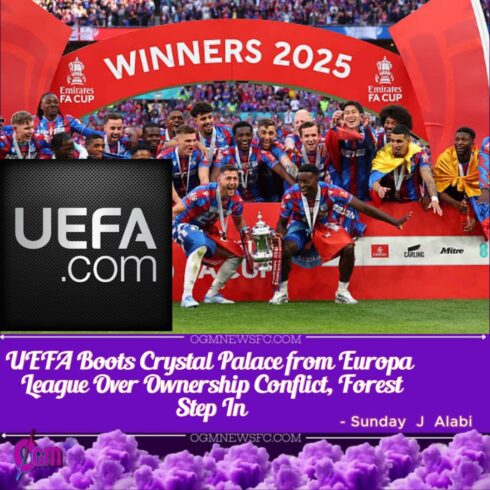
UEFA has officially ruled that Crystal Palace will not compete in the 2025–26 UEFA Europa League due to a breach of the governing body’s multi-club ownership rules. Instead, the South London club will drop into the third-tier UEFA Europa Conference League, with Premier League rivals Nottingham Forest expected to take their place in the more prestigious competition.
The controversy stems from American businessman John Textor’s dual ownership interests in both Crystal Palace and French club Olympique Lyonnais, who also qualified for the Europa League. Textor owns a 43 per cent stake in Palace and is the majority owner of Lyon. UEFA determined that this overlap violated Article 5 of its Club Financial Control Body regulations, which prohibits significant influence over multiple clubs participating in the same competition.
Nottingham Forest Poised for Europa League Entry
As Crystal Palace exits the Europa League, Nottingham Forest are set to benefit. Having qualified for the Conference League through domestic placement, Forest are now in line for a direct promotion to the Europa League group stages. UEFA’s rule 4.10 provides that any club disqualified from a European competition will be replaced by the next best-placed team from the same domestic association — in this case, Forest.
Although formal confirmation is pending the conclusion of a potential appeal process, Forest are preparing behind the scenes for their step up in European football. The club, under manager Nuno Espírito Santo, now sees an unexpected but welcomed return to continental competition for the first time in over two decades.
Palace, meanwhile, will have to contend with the less glamorous Conference League, which, while still an opportunity for silverware, comes as a disappointment following their FA Cup triumph and anticipated European ascent.
Textor’s Conflict of Interest: A Costly Oversight
The root of Crystal Palace’s demotion lies in Textor’s failure to place his Palace shares into a blind trust by UEFA’s March 1 deadline — a necessary move to comply with regulations meant to prevent conflicts of interest. Although the American investor has publicly maintained that he has never held operational control or made “management decisions” at Selhurst Park, UEFA deemed the 43 per cent ownership stake sufficient grounds for disqualification.
This decision was further cemented by Lyon’s successful appeal against relegation from Ligue 1 for financial irregularities. That legal victory meant Lyon retained their place in the French top flight and, by extension, their European qualification — pushing Palace out in the process due to UEFA’s prioritisation of league position over cup success.
Textor, whose sports investment portfolio includes multiple clubs across Europe and South America, now faces increased scrutiny over his multi-club model, especially from regulatory bodies keen on preserving the integrity of European competitions.
Crystal Palace Set to Appeal UEFA Ruling
Crystal Palace are preparing to take the case to the Court of Arbitration for Sport (CAS), hoping to reverse what they consider an unfair disqualification. The club is expected to argue that Textor’s involvement did not equate to direct operational control and that the failure to transfer his shares into a blind trust prior to the March 1 deadline should not outweigh their legitimate sporting merit.
Sources within the club believe the decision undermines the spirit of fair play, especially as their Europa League qualification came via winning a domestic trophy. Club officials are said to be consulting legal teams and UEFA representatives to explore all available options before the new season begins.
While the CAS appeal process can take weeks to conclude, the delay in confirmation could impact planning for both Palace and Forest, who will each need clarity to make logistical and squad decisions for their respective European campaigns.
UEFA’s Stance on Multi-Club Ownership Faces New Test
The Crystal Palace case adds to growing scrutiny over UEFA’s handling of multi-club ownership amid the rising trend of investment groups holding stakes in multiple teams. While UEFA has previously dealt with similar scenarios — including those involving Red Bull and City Football Group — the Palace-Lyon situation may set a precedent for how strictly the rules are enforced moving forward.
With an increasing number of clubs now falling under the same financial umbrellas, particularly in the Premier League and continental Europe, UEFA is under pressure to refine and consistently apply its ownership rules. Critics argue the current system creates grey areas and disrupts the competitive balance, particularly when enforcement depends on administrative deadlines rather than sporting outcomes.
For now, Crystal Palace must prepare for life in the Conference League, while Nottingham Forest may find themselves on a surprising European journey — courtesy of off-pitch decisions that have reshaped the upcoming season’s continental picture.