










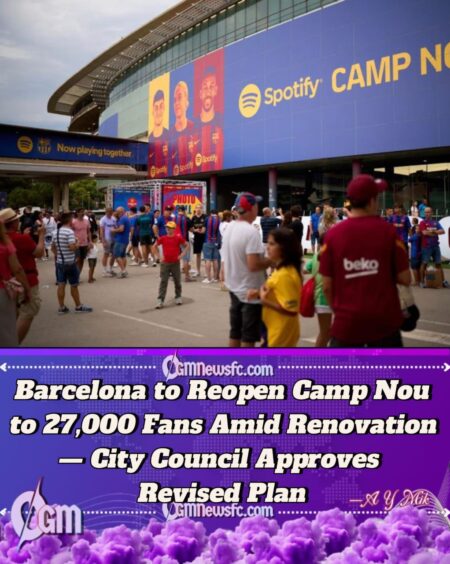
FC Barcelona and the Barcelona City Council have formally agreed to revise the activity licence for Camp Nou, enabling a limited reopening of the iconic stadium during ongoing renovation works. Initially set to host up to 62,000 fans, the revised plan now allows a maximum capacity of 27,000 for the earliest reopening phase.
This announcement marks a significant development in the club’s long-term redevelopment project, but also underlines the complexity of the stadium’s current status as construction continues.
Camp Nou’s Partial Reopening Scaled Down from 62,000 to 27,000 Seats
The original plan—approved earlier by the city council—granted Barcelona the right to partially reopen Camp Nou for up to 62,000 spectators. This figure was based on the expected completion of works on the first and second tiers of the stadium.
However, construction delays in key areas have made that target unfeasible. In response, both FC Barcelona and the city council have agreed to scale down the temporary stadium licence, permitting only 27,000 fans to attend matches in the near term.
This revision takes into account the incomplete construction of the North Goal and Lateral sections, meaning only parts of the Tribuna and South Goal zones are ready for limited public use.
Renovation Plan Divided Into Three Sub-Phases
To accommodate the slower-than-expected progress, the first stage of Camp Nou’s redevelopment will now be executed in three defined sub-phases.
Sub-Phase One: Grants access to the Tribuna and South Goal sections, enabling a capacity of 27,000.
Sub-Phase Two: Adds the Lateral section, which will expand attendance capacity to 45,000.
Sub-Phase Three: Includes completion of the North Goal, restoring first and second tier capacity to 62,000 spectators.
This phased model provides the city council and club more flexibility to proceed with partial openings, depending on real-time construction progress and safety conditions. It also allows the club to slowly reintroduce fans without waiting for full stadium readiness.
Safety Regulations and City Inspection Still Pending
Despite the provisional agreement, Barcelona has not yet received final clearance to host spectators—including for the anticipated La Liga Matchday 4 clash against Valencia on 14 September.
Before any fans can enter Camp Nou, the club is required to submit a Partial Initial Safety Control (ECA) report. This mandatory document involves a series of technical checks, focused on:
Structural integrity
Emergency evacuation
Crowd management
Fire prevention systems
Following the ECA submission, city inspectors, civil protection units, and the fire department will carry out comprehensive on-site evaluations. Only after all safety conditions are met and approved will the First Occupation Licence be granted.
Opening Timeline Remains Uncertain as Approval Process Continues
Though the agreement marks a positive step forward, the timeline for reopening remains fluid. Club officials have emphasized that this is not an immediate green light, and that they still face several bureaucratic and construction-related hurdles before Camp Nou can safely accommodate fans.
Optimism, however, is growing. The situation is notably more advanced than it was ahead of the Joan Gamper Trophy match, when even limited access seemed unlikely. With part of the Tribuna and South Goal now nearing completion, club sources believe there is a realistic path to limited reopening within weeks—provided that inspections and reports go smoothly.
What Barcelona Must Do Next to Secure the Licence
For Barcelona to host fans at Camp Nou again, the following steps must now be taken:
Complete the necessary works on the Tribuna and South Goal.
Ensure access points, seating areas, and facilities meet safety standards.
Submit the ECA (Partial Initial Safety Control) to the City Council.
Pass inspections from Civil Protection and the Fire Department.
Receive favourable evaluation reports from all agencies involved.
Apply for and receive the official First Occupation Licence.
Each of these steps involves coordination between various departments and agencies, making the process neither simple nor fast. However, Barcelona’s top executives remain confident that they can welcome at least 27,000 fans back to Camp Nou soon—offering supporters a taste of home as renovations continue.
Final Thoughts: A Carefully Calculated Return to Camp Nou
This partial reopening deal signifies a careful balancing act between fan engagement and public safety. For Barcelona, regaining even a fraction of their home support during La Liga matches could provide a crucial morale boost. For the city council, it’s about ensuring that every possible risk is mitigated before fans are allowed back into a semi-constructed stadium.
While the full glory of Camp Nou may still be a season or more away, this agreement brings the club a step closer to reconnecting with its fanbase on home turf—even if only 27,000 at a time.