









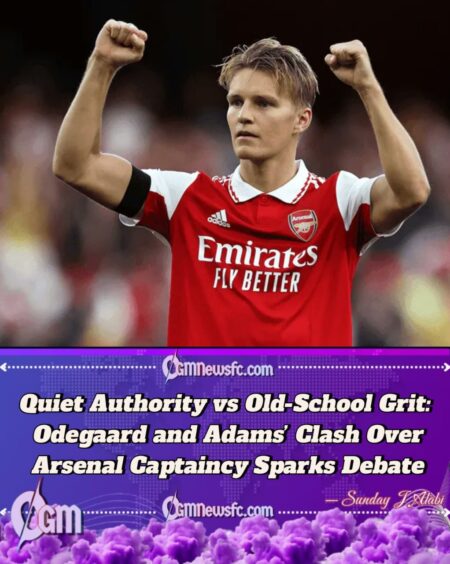
Arsenal legend Tony Adams has sparked debate over the Gunners’ leadership structure after questioning Martin Odegaard’s suitability as captain. Adams, who captained Arsenal to four league titles under George Graham and Arsène Wenger, suggested that the Norway international lacks the winning edge required to push the club over the line in their quest for Premier League glory.
Having watched Arsenal finish runners-up in three successive campaigns, Adams publicly called for Declan Rice to be handed the armband. He argued that Rice embodies the characteristics of a “natural winner” and could provide the mentality shift needed to secure the club’s first league title in two decades. “The call is to make Declan Rice the captain,” Adams declared. “He’s my kind of captain, someone who reflects the football club and can take you to the next level.”
The Arsenal legend went further, warning Mikel Arteta that his managerial legacy could hinge on the decision. “You’re not going to win the league with Odegaard as captain,” Adams said pointedly.
Odegaard Responds with Calm Authority
Confronted with Adams’ criticism, Odegaard mounted a calm but firm defence of his leadership approach. The Norwegian skipper, who was handed the armband in 2022, rejected suggestions that Arsenal’s near-misses were down to his captaincy style. Instead, he highlighted the collective responsibility that underpins the squad’s mentality.
“It’s a lot of small things,” Odegaard explained in an interview with Sky Sports. “It’s about creating the right mindset in the team, helping players around you, and getting the best out of everyone. It’s not about one big speech or one moment—it’s a constant role you do every day.”
Odegaard added that leadership within Arsenal is shared, with both senior players and Arteta himself contributing in the dressing room. “It’s not just me,” he stressed. “We have a lot of voices in the team, and I think that balance makes us stronger.”
Arteta Stands Firm Behind His Captain
Mikel Arteta, who entrusted Odegaard with the armband at just 23 years old, has been quick to rally behind his captain. Ahead of Arsenal’s blockbuster season opener against Manchester United, Arteta dismissed Adams’ criticisms and insisted that Odegaard embodies the essence of modern leadership.
“Martin has got hundreds of qualities,” Arteta said. “The biggest one is that he doesn’t need to shout to be respected. When you close the door, what you see from him is exactly what you get. Everyone around him trusts him 100 per cent.”
The Arsenal boss pointed out that leadership is not a one-size-fits-all quality. “Some captains lead with words, others lead with actions. Martin leads in both ways. He’s admired by his teammates, and that’s what matters most to me.”
Rice at the Centre of the Debate
Declan Rice, whom Adams has backed as Arsenal’s ideal captain, has also become an unintentional figure at the centre of the debate. Signed for a club-record fee in 2023, Rice has quickly established himself as a leader in midfield, earning widespread praise for his commanding performances and vocal presence on the pitch.
While Rice has not publicly lobbied for the captaincy, his natural charisma and leadership traits have made him a standout candidate in the eyes of Arsenal greats. Adams argued that promoting Rice would allow Odegaard to “play with more freedom” and focus purely on his creative role.
However, critics of Adams’ stance note that disrupting the current structure could destabilise a squad that has already shown significant progress under Arteta. Arsenal have consistently pushed Manchester City to the wire, and many believe continuity could be the key to eventually ending their title drought.
A Leadership Question That Won’t Go Away
The exchange between Adams and Odegaard underscores the evolving nature of leadership in football. While Adams represents the old-school model of a vocal, hard-edged captain, Odegaard symbolises a quieter, modern style rooted in consistency, professionalism, and influence by example.
For now, Arteta appears unmoved by calls for change, publicly reinforcing his support for Odegaard as captain. Yet the debate is unlikely to fade quickly, particularly if Arsenal once again find themselves narrowly missing out on the Premier League crown.
With the season opener at Old Trafford looming, the Gunners’ leadership dynamic will remain under the microscope. Whether Odegaard’s understated approach or Adams’ preferred “traditional captain” model ultimately delivers silverware may define not only Arsenal’s season but also the broader perception of what it means to lead in the modern game.