






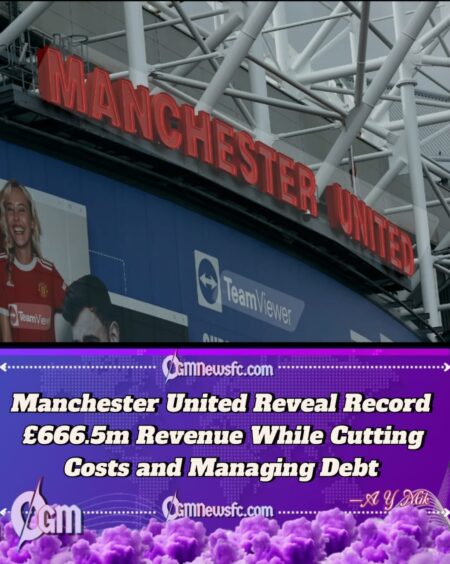
Manchester United have announced a record-breaking annual revenue of £666.5 million, despite finishing 15th in the Premier League last season — their worst league position since the 1973/74 relegation campaign.
The club’s financial performance highlights the gap between United’s commercial strength and their declining sporting results. Chief executive Omar Berrada described the figures as proof of the club’s resilience during challenging times.
The standout contributor to the record-breaking results was the start of a five-year front-of-shirt sponsorship deal with Snapdragon, which alone generated £333.3 million in commercial revenue. Matchday earnings also reached an all-time high of £160.3 million by June 2025.
Chief Executive Speaks on Long-Term Vision
Omar Berrada acknowledged the disappointing on-field performances but emphasized Manchester United’s long-term rebuilding plans.
“To have generated record revenues during such a challenging year for the club demonstrates the resilience which is a hallmark of Manchester United,” Berrada said in his statement.
While he did not directly address Manchester United’s poor start to the 2025/26 season, he stressed that the club is “working hard to improve in all areas” and remains committed to compliance with Premier League Profit and Sustainability Rules as well as UEFA Financial Fair Play regulations.
Losses Reduced but Cost-Cutting Raises Concerns
Despite the impressive revenue, Manchester United still recorded an overall loss of £33 million. However, this figure represents a 70.8% reduction compared to the previous year’s £113.2 million loss.
The club’s aggressive cost-cutting measures have played a central role in this turnaround. Staff numbers have been slashed from 1,100 to 700 in just two years, a move that drew heavy criticism from fans and former employees alike.
Wages also dropped significantly by £51.5 million, largely due to the men’s first team failing to qualify for the Champions League. That failure triggered a 25% reduction in player salaries. Compensation payments, totaling £36.6 million, were paid to former manager Erik ten Hag, interim boss Ruud van Nistelrooy, and ex-technical director Dan Ashworth.
Broadcasting Blow and Commercial Boost
One of the biggest setbacks in Manchester United’s accounts was a £48.9 million drop in broadcasting revenue, a direct consequence of playing in the Europa League instead of the Champions League. The situation worsened this season, with the club missing out on European football altogether.
However, the Snapdragon partnership provided a much-needed commercial cushion. The deal allowed United to overtake Liverpool in terms of commercial revenue once again, reaffirming their dominance in global sponsorship and marketing deals.
Club officials believe these partnerships, along with cost-reduction strategies, will create room for improved investment in the playing squad and eventually drive success on the pitch.
Mounting Debt and Transfer Spending
Debt continues to loom large over Old Trafford. Manchester United’s long-term debt, stemming from the Glazers’ 2005 takeover, remains at $650 million (£471.9 million). Short-term borrowing also jumped to £165.1 million, compared to £35.6 million the previous year.
Another major concern is the rise in transfer-related debt. The club’s accounts list “trade and other payables” totaling £564.6 million, up from £424.9 million just a year earlier. While many top clubs pay transfer fees in installments, United’s growing commitments have drawn scrutiny.
Despite this, United spent £156.8 million after June 30 on new signings including Bryan Mbeumo from Brentford, Benjamin Sesko from RB Leipzig, and goalkeeper Senne Lammens from Royal Antwerp. Officials defended the spending, insisting it shows their determination to rebuild a squad capable of competing for trophies.
Global Ranking and Future Outlook
Manchester United’s financial muscle remains among the strongest in world football. In Deloitte’s January ranking, United were placed fourth globally with £651 million revenue, behind Real Madrid (£883m), Manchester City (£708m), and Paris Saint-Germain (£681m).
The club forecasts a turnover between £640 million and £660 million for the year ending June 2026, signaling a cautious yet optimistic outlook. Much will depend on whether the team can return to European competition and restore credibility on the pitch.
As Berrada put it: “As we start to feel the benefits of our cost reduction programme, there is significant potential for improved financial performance, which will, in turn, support our overriding priority: success on the pitch.”