










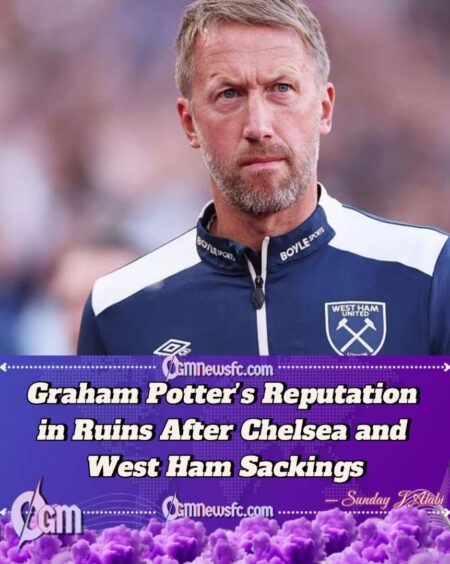
Not long ago, Graham Potter’s name featured prominently among the candidates tipped to succeed Gareth Southgate as England manager. His work at Brighton & Hove Albion earned him plaudits across the footballing world for his tactical discipline, progressive style, and ability to nurture talent under a structured club model. At one point, he was widely regarded as the embodiment of a new generation of English coaches.
That reputation has since collapsed under the weight of two bruising sackings in quick succession. First came his departure from Chelsea after only seven months in charge, then a humiliating dismissal from West Ham just eight months into his tenure. What began as a carefully built career, defined by patience and steady progress, now lies in tatters after high-profile stints that exposed him to the chaos of misaligned clubs and relentless Premier League pressure.
Chelsea’s Chaotic Storm
Graham Potter’s Chelsea spell was marred by circumstances that few managers could have navigated successfully. Appointed in September 2022 after the abrupt dismissal of Thomas Tuchel, he inherited a squad destabilized by a £323m January transfer spree orchestrated by new co-owners Todd Boehly and Behdad Eghbali. The influx of players created logistical and tactical headaches, with reports noting that the squad was so bloated the dressing room could barely accommodate everyone.
Although Graham Potter guided Chelsea to the Champions League quarter-finals, the league form was dismal, with the team lacking identity and cohesion. His calm, methodical personality appeared ill-suited to a club in constant flux, and by April 2023, he was sacked. Many observers argued that he was a victim of a “perfect storm” at Stamford Bridge rather than the architect of failure, but the experience left a dent in his once-burnished reputation.
A Nightmare at West Ham
After 637 days of waiting for the right opportunity, Graham Potter chose West Ham as the club where he believed he could re-establish himself. Describing his appointment as “a bit like Christmas for the adults,” he entered with optimism and renewed energy. Yet within eight months, the optimism turned to disillusion. His record — six wins in 25 matches — left West Ham in 19th place, with fans growing increasingly restless as results worsened.
The climax came after a 2-1 home defeat to Crystal Palace, with supporters not only venting frustration at Graham Potter but also at club hierarchy figures David Sullivan and Karren Brady. Protests against ownership underscored the sense of dysfunction at the club. While Graham Potter was not solely to blame, his inability to inspire a struggling squad or offer defensive stability — with seven goals conceded from set-pieces this season alone — sealed his fate.
Contrasts With Brighton’s Stability
Graham Potter’s struggles at Chelsea and West Ham are thrown into sharp relief when compared to his success at Brighton. Under the patient leadership of owner Tony Bloom and the astute recruitment of Dan Ashworth, he thrived in an environment that valued planning and incremental progress. Players such as Moisés Caicedo and Alexis Mac Allister emerged under his stewardship, while Brighton achieved their highest-ever Premier League finish during his time.
This carefully cultivated environment highlighted Graham Potter’s strengths as a training-ground coach, emphasizing organisation and tactical detail. But in more volatile clubs, where immediate results are demanded and patience is scarce, his low-key personality and measured methods appeared mismatched. The contrast suggests that Potter’s philosophy works best within structured systems rather than clubs driven by short-term fixes and constant upheaval.
What Next for Graham Potter?
Graham Potter’s fall has been as rapid as it has been dramatic. Once a credible candidate for England, his win percentages — 28% at Brighton, 32% at Chelsea, and just 26% at West Ham — make grim reading for any Premier League suitors. Former England defender Martin Keown has warned that his next job will be decisive, noting that the idea of Potter walking into another big Premier League role is “fanciful in the extreme.”
For now, his future appears uncertain. A return abroad, perhaps to a more stable environment akin to his early success at Ostersund in Sweden, may provide the platform for him to rebuild. Yet in English football, where results dictate survival, Graham Potter’s reputation has been severely compromised. His time at West Ham has underlined a harsh reality: without the right environment, even the most meticulous of managers can quickly become consumed by the unforgiving nature of the Premier League.