







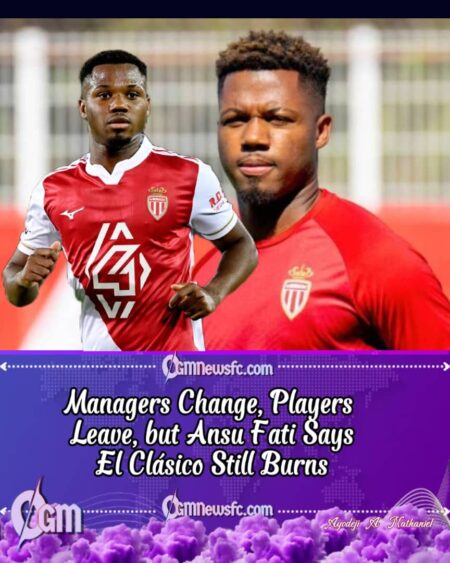
Ansu Fati calmly stated that facing Real Madrid will always feel like a Clásico because he comes from Barcelona, he delivered more than a routine pre-match remark. He offered a distilled truth about football identity — one that cannot be transferred, loaned out, or renegotiated.
For Fati, this is not nostalgia talking; it is lived experience. Raised inside Barcelona’s ideological ecosystem, he was conditioned to see Real Madrid not simply as opponents, but as the measuring stick by which careers, courage, and character are judged. Some players face Madrid. Others feel Madrid.
La Masia Education: Where Rivalries Are Part of the Curriculum
At La Masia, football education goes beyond tactics and technique. Players are taught history, symbolism, and emotional intelligence — particularly when it comes to El Clásico. From a young age, Fati learned that matches against Real Madrid are different because they are supposed to be.
This institutional memory explains why players like Fati speak of Madrid encounters with unusual gravity. Even years after leaving Barcelona’s dressing room, the rivalry remains embedded. You may forget some tactical drills, but you never forget what a Clásico represents.
Why El Clásico Defies Context, Competition, and Logic
Fati’s insistence that the match feels special “no matter the competition” echoes a long-standing football reality. El Clásico does not require league titles, cup finals, or perfect form to matter. It thrives on tension alone.
Whether it is a preseason friendly or a decisive knockout tie, the emotional stakes are pre-loaded. For players shaped by the rivalry, adrenaline arrives early, decision-making accelerates, and pressure follows every touch. In short: it is football with no emotional off-switch.
Career Transitions, Same Emotional Baggage
Now navigating a different chapter of his career, Fati’s comments reveal how deeply football identity persists beyond club affiliation. While modern football encourages flexibility and mobility, emotional allegiance often refuses to cooperate.
Players may adapt tactically, physically, and professionally — but emotionally, rivalries linger. Fati’s relationship with Real Madrid is not contractual; it is psychological. That makes it far more durable.
The Weight of Expectations and the Ghost of Comparisons
Fati’s Clásico perspective is also shaped by the burden he carried early in his career. Thrust into the spotlight as a teenage sensation and repeatedly compared to Lionel Messi, his Madrid appearances were never low-pressure affairs.
Against Real Madrid, he was not only expected to perform — he was expected to represent. That kind of responsibility leaves scars, lessons, and lasting emotional markers. Even now, those experiences color how he views the fixture.
El Clásico as Football’s Most Reliable Emotion Generator
While marketing departments package El Clásico as a global spectacle, its true power lies in moments like Fati’s comments. The rivalry survives because players internalize it, personalize it, and carry it forward.
Every generation reinvents the rivalry without rewriting it. New faces appear, but the emotional script remains largely unchanged. Fati’s words confirm that El Clásico is less a match and more a tradition passed down through players.
A Simple Quote, A Universal Truth
Ultimately, Fati’s statement resonated because it required no exaggeration. It was neither confrontational nor nostalgic — just honest. Some matches are about tactics. Others are about pride. A few are about identity.
For Ansu Fati, facing Real Madrid will always belong to the last category. And that, more than any result, explains why El Clásico refuses to age.