








Mikel Arteta has openly criticised Premier League officiating after Arsenal were held to a goalless draw by Nottingham Forest, insisting his side were wrongly denied a “very clear penalty.” The Arsenal manager rejected the official explanation provided by the Premier League Match Centre, arguing that it did not accurately reflect what occurred during a contentious handball incident in the second half.
The draw, played in a tense and tightly contested atmosphere, prevented Arsenal from securing all three points but still allowed them to slightly strengthen their position at the top of the Premier League table. However, the post-match narrative was dominated by debate over VAR, refereeing interpretation, and the growing frustration among managers over consistency in decision-making.
The Controversial Handball Decision
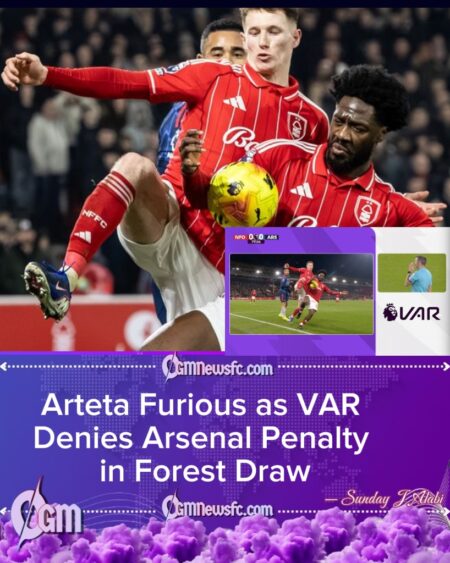
The key incident occurred when Nottingham Forest right-back Ola Aina attempted to deal with a cross from the right wing. Under pressure and after being nudged by his own teammate, Elliot Anderson, the ball appeared to strike Aina’s upper body before making contact with his arm. Referee Michael Oliver awarded a corner, a decision later reviewed and upheld by VAR.
During the match, the Premier League Match Centre issued a statement explaining that no penalty was given because the ball was judged to have hit Aina’s shoulder first, while his arm was considered to be in a natural position. VAR officials concluded that the on-field decision should stand, bringing an end to Arsenal’s appeal.
Despite the official ruling, the incident immediately sparked debate among players, coaches, and pundits. From Arsenal’s perspective, the replay suggested enough arm involvement to warrant a penalty, particularly given the speed and proximity of the ball inside the penalty area.
Arteta Rejects the Official Explanation
Speaking after the match, Arteta made it clear that he strongly disagreed with the VAR assessment. He described the incident as “a very clear penalty” and argued that the explanation provided by the Premier League did not match the sequence of events seen on the pitch.
According to Arteta, the issue was not only whether the ball struck the shoulder first, but also the timing, intention, and subsequent movement of the player’s arm. He maintained that these elements made the decision straightforward in his view and justified his frustration at the outcome.
While Arteta acknowledged that football rules are complex and open to interpretation, he stressed that consistency and accuracy are crucial, especially in matches with significant title implications. His comments reflect a broader concern among managers about transparency and trust in the VAR process.
Forest’s Counter-Argument and Dyche’s View
Nottingham Forest manager Sean Dyche offered a contrasting perspective, urging caution in how handball decisions are judged. He pointed out that Aina was nudged from behind by his own teammate and argued that such incidents should not routinely result in penalties.
Dyche also used the opportunity to highlight what he believed was a penalty claim for Forest, involving Callum Hudson-Odoi driving into the Arsenal box. He described that moment as a “tight call” and suggested that marginal decisions often go unnoticed depending on the narrative of the game.
In his view, modern football has already seen an increase in penalties for incidents that would previously have been dismissed. While he accepted that rules evolve, Dyche made it clear that he would not have welcomed a penalty awarded against his side for the handball in question.
Missed Chances and Tactical Frustration
Beyond the officiating debate, Arteta expressed disappointment with Arsenal’s inability to convert clear scoring opportunities. He revealed that his team created several major chances, including an open goal opportunity for Gabriel Martinelli, a close-range effort from Declan Rice, and headers from Mikel Merino and Bukayo Saka.
Arteta noted that Arsenal conceded no shots on target, yet still failed to win the match. This, he said, was particularly frustrating given their dominance and control for large periods of the game. He admitted that improvements are needed, especially in the final third, where efficiency ultimately decides results.
Credit was also given to Nottingham Forest for their defensive organisation and ability to disrupt Arsenal’s rhythm. Their disciplined approach ensured they remained compact and difficult to break down, even under sustained pressure.
Table Implications and Arsenal Upcoming Fixtures
Despite dropping points, Arsenal extended their lead at the top of the Premier League to seven points, aided by Manchester City’s 2–0 defeat to Manchester United earlier in the day. The draw therefore had limited immediate damage to their title ambitions, though opportunities to pull further clear were missed.
Nottingham Forest, meanwhile, moved to five points above the relegation zone, benefiting indirectly from other results. The point gained against the league leaders could prove significant in their fight for survival.
Attention now turns to European commitments. Arsenal travel to Inter Milan for a Champions League fixture on Tuesday before hosting Manchester United in the Premier League next Sunday. Forest face Braga away in the Europa League on Thursday and then travel to Brentford for their next league match.