

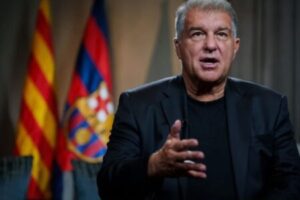
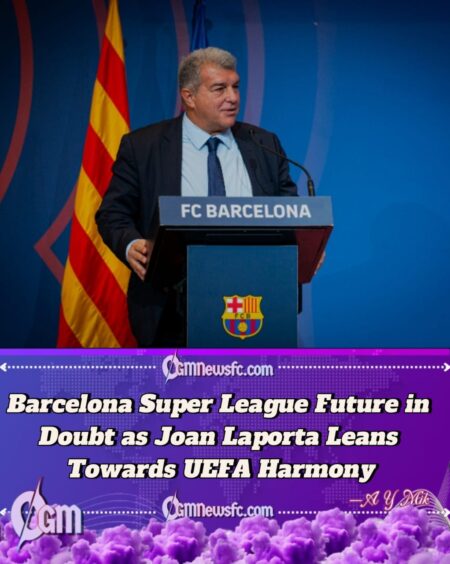
FC Barcelona president Joan Laporta is reportedly considering a major U-turn in the coming weeks by pulling the club out of the controversial European Super League project. According to journalist Abdellah Boulma, the Catalan giants could soon abandon what once seemed like a cornerstone of their financial strategy.
This potential shift marks a significant departure from the defiant tone Barcelona had maintained since the breakaway competition was first unveiled in April 2021. Joan Laporta, who once argued passionately for the league as a safeguard for football’s future, now appears increasingly open to aligning with UEFA once again.
For Barcelona supporters and European football at large, Joan Laporta’s rethink could signal a turning point. It suggests that the club’s leadership is weighing not only economic survival but also political harmony with governing bodies that remain central to the sport’s structure.
The Origins of the European Super League
The European Super League was announced in April 2021 as a breakaway competition featuring twelve of Europe’s elite clubs. Founding members included Barcelona, Real Madrid, Juventus, Manchester United, Chelsea, AC Milan, and others.
Its purpose was straightforward but divisive: to give the continent’s most powerful clubs more control over revenue streams and broadcasting rights, effectively bypassing UEFA’s authority and the Champions League format. Organisers framed the project as a modernisation of European football finances, designed to ensure long-term stability for top clubs.
Yet from its inception, the Super League faced an avalanche of criticism. Fans protested outside stadiums, governing bodies threatened sanctions, and even national governments condemned the initiative as a threat to football’s competitive balance. The backlash was so swift that within 48 hours of its announcement, nine of the founding clubs had officially withdrawn.
Barcelona’s Persistent Support Despite Global Backlash
While the majority of clubs quickly distanced themselves from the Super League, Barcelona, Real Madrid, and Juventus remained committed. For Barça, the financial reasoning was clear. Saddled with enormous debts, the club viewed the project as a lifeline.
Joan Laporta repeatedly argued that reforms in European football were necessary. He claimed the Super League offered a path to sustainable income while reducing dependency on UEFA’s centralised system of distributing funds. Barcelona’s leadership insisted that without structural change, elite clubs risked financial collapse in the modern game.
Even as global sentiment turned against the project, Barcelona did not budge. Their stance was that the Super League was not just a financial tool but also a competitive reform aimed at preserving football’s appeal in an evolving market.
Juventus’ Exit Leaves Barça and Madrid Alone
Over time, momentum behind the Super League slowed considerably. Juventus formally withdrew, leaving only Barcelona and Real Madrid as visible supporters. This dwindling membership underscored the fragility of the project.
For Barcelona, the isolation became increasingly difficult to sustain. Critics argued that clinging to the Super League damaged the club’s reputation and strained relationships with UEFA and the European Clubs’ Association (ECA). These organisations remain critical gatekeepers of European football, and distancing from them risked harming Barça’s broader strategic interests.
Meanwhile, Real Madrid and their president Florentino Pérez continued to champion the project, insisting that European football required radical change to survive. Yet without wider backing, the initiative remained little more than an idea on paper.
Improved Relations with UEFA Changing the Calculus
Recent reports suggest that Barcelona’s relationship with UEFA has been improving. Joan Laporta, who once positioned himself in direct opposition to the governing body, is now keener to restore harmony. This shift could be central to why the Blaugrana are rethinking their Super League commitment.
Closer alignment with UEFA could open doors for Barcelona, both politically and financially. It would allow the club to participate in shaping reforms within the existing system rather than standing outside of it. For a club in desperate need of stability, returning to UEFA’s fold could prove more beneficial than remaining tied to a failing project.
Furthermore, Barcelona’s involvement in the Super League has long been a point of friction with fans and stakeholders. By stepping back, Joan Laporta could ease tensions and present himself as a president willing to listen to supporters’ concerns while safeguarding the institution’s long-term future.
What Barcelona’s Withdrawal Could Mean for European Football
If Joan Laporta follows through with withdrawing Barcelona from the Super League, Real Madrid would be left as the sole major club pushing for its creation. Such a move could spell the effective end of the project, at least in its current form.
For European football, this would represent a victory for traditional competition structures like the Champions League. It could also pave the way for renewed collaboration between UEFA and top clubs on future reforms, ensuring that elite teams remain invested in the collective good of the sport.
For Barcelona, the decision could also restore credibility after years of financial turbulence and controversy. By moving closer to UEFA and the ECA, the club would be positioning itself as a central player in the sport’s evolution rather than an isolated rebel.
Ultimately, Barcelona’s possible withdrawal highlights a growing recognition that unity within European football is more sustainable than fragmentation. Joan Laporta’s recalibration may yet prove decisive in shaping the future of the game across the continent.