








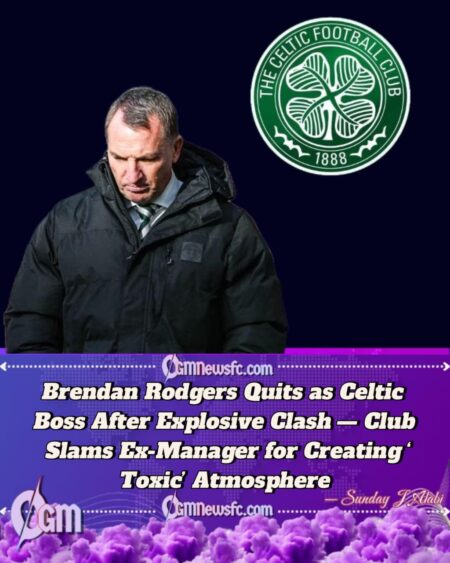
Celtic Football Club was thrown into turmoil late Monday night as Brendan Rodgers sensationally resigned from his role as manager, ending his second spell at the helm under a cloud of controversy. The dramatic announcement came less than 24 hours after Celtic’s 3–1 defeat to Hearts — a result that left the Scottish champions eight points adrift in the league title race.
The resignation, confirmed just before 10 p.m., followed weeks of intensifying tension between Brendan Rodgers, the Celtic board, and sections of the club’s fanbase. What began as frustration over recruitment and summer spending spiraled into a public feud that has now culminated in an extraordinary fallout between one of Celtic’s most successful modern managers and the club’s hierarchy.
Brendan Rodgers, who rejoined Celtic in 2023 after a spell in England, leaves behind a legacy that includes domestic success and cup triumphs. However, his departure this time around mirrors his controversial 2019 exit — marked once again by division, discontent, and disillusionment.
Desmond’s Explosive Statement: Accusations of Betrayal and Mistrust
In an astonishing late-night statement, Celtic’s majority shareholder Dermot Desmond accused Brendan Rodgers of being “divisive, misleading, and self-serving.” The Irish billionaire said the former boss’s recent behavior had “created a toxic atmosphere around the club” and “fuelled hostility” toward members of the board and executive team.
Desmond detailed a breakdown of trust, revealing that Brendan Rodgers had been offered a contract extension in the summer but failed to commit, later misrepresenting the situation in public. “When we brought Brendan back two years ago, it was done with complete trust and belief in his ability,” Desmond said. “Unfortunately, his conduct and communication in recent months have not reflected that trust.”
The statement went further, dismissing Brendan Rodgers’ public criticism of the club’s recruitment policy as “entirely false.” Desmond insisted that the manager had been given full control over footballing matters, including player signings, and accused him of distorting facts for personal gain. “What has failed recently,” he concluded pointedly, “was not our structure, but one individual’s desire for self-preservation at the expense of others.”
Fans’ Frustration and Brendan Rodgers’ Public Outbursts
The mood among Celtic supporters had been increasingly sour in recent weeks, as the club’s poor domestic form and European struggles exposed deep cracks. Fans staged protests during matches, venting anger over perceived mismanagement and insufficient investment in the playing squad. Brendan Rodgers appeared to sympathize with their frustration, calling fan anger “understandable” and accusing senior officials of “cowardice” after reports suggested that the club had briefed negatively against him.
While Brendan Rodgers’ remarks may have resonated with sections of the fanbase, they infuriated the board — who viewed them as a betrayal. Desmond’s statement implied that these public interventions had directly worsened the atmosphere, suggesting Rodgers’ comments “fuelled hostility” and undermined unity within the club.
The Celtic hierarchy, meanwhile, maintains that the club spent £13.3 million over the summer — a figure that Brendan Rodgers himself approved. Nonetheless, the perception of a frayed and directionless club structure took hold among fans, many of whom saw Rodgers’ exit as an inevitable conclusion to months of internal conflict.
O’Neill and Maloney Take Over as Celtic Look to Regroup
In the wake of Rodgers’ departure, Celtic moved quickly to stabilize the situation by appointing club legend Martin O’Neill and former player Shaun Maloney as interim managers. The pair are expected to oversee upcoming fixtures, including Tuesday’s league clash with Falkirk and the high-stakes Premier Sports Cup semi-final against Rangers at Hampden Park on Sunday.
O’Neill, who famously led Celtic to multiple titles and European success in the early 2000s, returns to a club that holds deep personal significance. Maloney, who came through under O’Neill as a young player, has since built a managerial résumé of his own with Wigan Athletic and Hibernian. Their joint appointment is seen as a move to restore calm and reconnect the team with its core values amid the turbulence.
With Celtic now trailing league leaders Hearts and facing mounting pressure from fans, O’Neill and Maloney’s immediate challenge is to steady morale and rebuild confidence in a fractured dressing room.
End of an Era and the Road Ahead for Celtic
Brendan Rodgers’ exit marks a bitter end to a tumultuous chapter in Celtic’s modern history. His second spell, though successful on paper with league and cup victories, will be remembered as much for the acrimony that defined its closing stages as for its triumphs.
Desmond’s remarks underline a board intent on reasserting control and restoring unity, emphasizing that “Celtic is greater than any one person.” Yet the fallout from this saga leaves lingering questions about governance, communication, and the fragile relationship between the club’s leadership and its supporters.
As the dust settles, Celtic must now navigate both a managerial transition and a test of identity — striving to return focus to football, rebuild trust within the ranks, and revive their pursuit of domestic and European glory. Whether this marks a cleansing reset or the start of deeper fractures may depend on how swiftly the club can turn chaos into cohesion.