









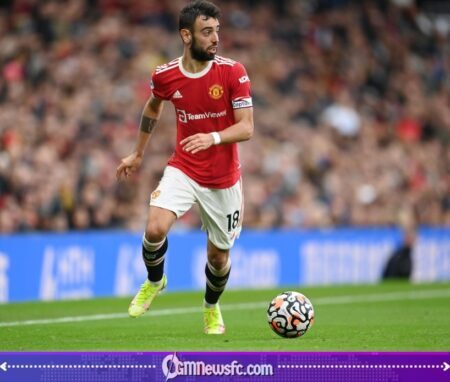
In a season shaped by transition and renewed uncertainty at Manchester United, one constant has stood firm: Bruno Fernandes performing at the highest level. Amid managerial upheaval, tactical experimentation and lingering frustration at Old Trafford, the Portuguese playmaker has once again underlined his value by thriving in his natural attacking midfield role.
At 32, Fernandes is not merely maintaining standards; he is elevating them. Restored to the position that best suits his instincts and creativity, he looks sharper, freer and more decisive. In a campaign where clarity has often been elusive, his return to the No. 10 role has provided both structure and inspiration.
Fernandes Consistency Amid Chaos
Since the departure of Alex Ferguson in 2013, instability has defined much of United’s trajectory. Ten managers have attempted to restore former glories, yet last season’s 15th-place finish — the club’s lowest since relegation in 1974 — represented a sobering milestone. Through it all, Fernandes has remained a beacon of reliability.
Signed from Sporting CP in January 2020, Fernandes has delivered remarkable output. Across six years and 315 appearances, he has amassed 104 goals and 96 assists, reaching 200 goal contributions faster than several club legends. His milestone came 25 games sooner than Cristiano Ronaldo managed in his United career, and quicker than icons such as Paul Scholes, Ryan Giggs and David Beckham.
Such figures would be impressive in a settled environment. That Fernandes has achieved them amid managerial turnover and tactical flux underscores his resilience.
Chasing Premier League History
Fernandes’ goal in the recent 2-0 victory over Tottenham Hotspur marked his 200th goal involvement for the club — a landmark that reflects both durability and decisive influence. Yet he is pursuing another benchmark that would elevate his season into historic territory.
The Premier League single-season assist record of 20, set by Thierry Henry in 2002–03 and matched by Kevin De Bruyne in 2019–20, remains within sight. Fernandes currently has 12 assists with 14 matches remaining. While challenging, the target is not unrealistic given his creative dominance.
He has created 78 chances this season — 27 more than Declan Rice in second place and 46 more than any other United player, including Amad Diallo. The statistics reinforce what has long been evident: when Fernandes is positioned close to goal, United’s attacking rhythm improves significantly.
The Tactical Misstep
The impact of tactical structure on Fernandes’ effectiveness became particularly clear under Ruben Amorim. His insistence on a three-man defensive system required Fernandes to operate deeper in midfield, increasing his defensive responsibilities while limiting his attacking freedom.
This approach constrained his natural tendencies. Fernandes thrives on unpredictability — drifting between lines, taking calculated risks and arriving late in the box. Positioned further from goal, he became easier to contain and less capable of dictating the tempo in advanced areas.
A 3-0 defeat to Manchester City in September illustrated the problem. Tasked with tracking runners and screening space, Fernandes struggled against rotations involving Phil Foden and Jeremy Doku. Guardiola’s midfield exploited central overloads, and United’s most creative player spent much of the match unable to influence proceedings in the final third.
Despite registering five goals and seven assists during that period, his productivity reflected individual quality rather than systemic optimisation.
Restoration and Revival
The appointment of Michael Carrick in January brought a subtle but decisive correction. Fernandes was reinstated as an advanced playmaker, liberated from excessive defensive duties and encouraged to take responsibility in attacking spaces.
The contrast was immediate. In a 2-0 victory over Manchester City, Fernandes had a goal and assist ruled out for offside before eventually setting up the opener. Operating closer to goal, he appeared energised and decisive. Former United defender Gary Neville described his display as “Cantona-esque,” a reference to the creative freedom once embodied by Eric Cantona.
The performance felt symbolic. Beyond securing three points against title challengers, it suggested a rediscovery of identity — a reminder that United’s most cohesive moments often revolve around a dynamic No. 10.
Loyalty and Leadership
In November, Fernandes revealed that the club had been open to his departure to Saudi Arabia. “The club wanted me to leave,” he admitted, acknowledging that the prospect was considered. He ultimately chose to remain, citing both personal conviction and affection for the club.
His decision has proved pivotal. At a time when experience and character are required, Fernandes provides both. He has delivered double figures in goals and assists every season since arriving, regardless of managerial philosophy or squad reshuffle.
As United seek stability, one lesson appears clear: structure should enhance talent, not suppress it. With Fernandes restored to his natural domain, Old Trafford has once again glimpsed what the team can be when its most influential player is allowed to lead from the front.