










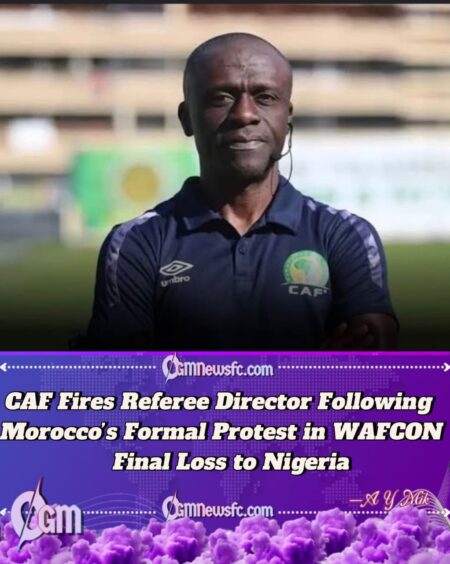
The Confederation of African Football (CAF) has reportedly sacked its Director of Refereeing, Désiré Noumandiez Doué, in the wake of a heated protest from Morocco’s Football Federation (FRMF) over officiating decisions in the WAFCON 2025 final. The match, which saw Nigeria’s Super Falcons complete a dramatic 3–2 comeback against host nation Morocco, has since sparked a firestorm of criticism over alleged refereeing errors.
Though Doué was not directly involved in officiating the match, his role as CAF’s refereeing chief put him in charge of selecting and overseeing match officials. The federation’s silence regarding his removal has only intensified speculation that his dismissal was a response to mounting pressure from Moroccan football authorities and growing public scrutiny.
The final, held in Rabat, ended with Nigeria lifting their 10th Women’s Africa Cup of Nations title, but it has been overshadowed by a string of contentious officiating decisions that Morocco believes unfairly altered the course of the match.
Morocco Lodges Official Protest After WAFCON Final Loss
Immediately after the final whistle, the Royal Moroccan Football Federation (FRMF) filed a formal complaint to CAF, alleging that “critical officiating errors” had a direct impact on the match’s outcome. According to the FRMF, several calls—especially those related to penalty decisions—were inconsistent, unjustified, and decisive in shifting momentum in Nigeria’s favor.
Morocco had gone ahead 2–0 in the first half before Nigeria mounted a stunning second-half comeback. However, FRMF’s protest focused on a denied penalty appeal for Morocco and a controversial penalty awarded to Nigeria, both of which were reviewed by VAR. The protest included a video dossier highlighting specific incidents that the federation believes were incorrectly adjudicated.
The match referee was Antsino Twanyanyukwa from Namibia, supported by assistants from Rwanda and Senegal, while VAR was operated by Rwanda’s Salima Mukansanga. The diversity of the officiating team has since been both applauded and questioned, with critics calling for higher standards and consistency in high-stakes matches.
Coach Jorge Vilda Blasts Officiating: “It Was a Psychological Blow”
Morocco’s head coach, Jorge Vilda, did not mince words in his post-match comments. Speaking to ESPN, he expressed his frustration with the match officials, stating that the controversial decisions left a lasting impact on his team’s morale.
“We saw images that showed clear contact, but the referee overturned her own call,” Vilda said. “It impacted our players psychologically. It was a massive blow.” The Spanish-born coach, who previously led Spain to international success before taking over Morocco’s women’s team, noted that his squad struggled to recover mentally after the contentious calls.
He also emphasized the importance of transparency and accountability at the continental level, adding that the growth of women’s football in Africa cannot continue without credible officiating in major tournaments like WAFCON.
Désiré Doué’s Dismissal: A Scapegoat or Step Forward?
While CAF has not released an official statement confirming Désiré Doué’s dismissal, several reputable sources within the football community have reported the decision as a direct response to the WAFCON final backlash. As Director of Refereeing, Doué was responsible for referee appointments and training, meaning he carried ultimate accountability for the team selected for the final.
Critics are divided on whether his removal is a genuine attempt by CAF to improve officiating standards or simply an effort to appease angry stakeholders. Supporters of the decision argue that the lack of consistency and transparency in African refereeing has been a long-standing issue that must be addressed with firm action.
On the other hand, some observers feel Doué has become a scapegoat, with deeper structural issues in officiating remaining unaddressed. These include inadequate VAR infrastructure, inconsistent training standards across regions, and limited match exposure for African referees at elite levels.
VAR in African Football: Boon or Burden?
The role of VAR (Video Assistant Referee) in the final has also come under serious scrutiny. While introduced to enhance fairness, VAR’s implementation in the WAFCON final only deepened the controversy. Moroccan players and coaching staff reportedly felt that VAR reviews were selective and inconsistently applied, leading to confusion and resentment on the pitch.
Salima Mukansanga, a respected Rwandan referee who has officiated at the FIFA Women’s World Cup, led the VAR team. However, questions remain over whether officials were adequately trained to operate under the intense pressure of a major final. Fans and analysts alike have called for CAF to review its VAR policies, including clearer communication protocols and more consistent application.
VAR was meant to be a leveler, but in the eyes of many, it became a source of deeper division during the WAFCON final—a moment when technology should have served clarity but instead introduced chaos.
What Next for CAF and the Integrity of African Women’s Football?
The fallout from the WAFCON final has broader implications for the integrity of women’s football in Africa. With CAF under pressure to restore public trust, Doué’s dismissal may be just the first step in a series of reforms aimed at rebuilding confidence in officiating systems.
Analysts believe CAF must now initiate a comprehensive review of referee selection processes, implement more rigorous training programs, and establish an independent panel to oversee officiating standards. The stakes are high, particularly as women’s football continues to grow in visibility, support, and competitiveness across the continent.
As Morocco regroups and Nigeria celebrates a record-breaking 10th title, the question remains: Will CAF use this moment as a catalyst for reform, or will history repeat itself in the next tournament? Either way, the credibility of African football’s governing body is on the line.