








For all the blood and thunder at Stamford Bridge, the table barely flinched. Arsenal walk away still top of the Premier League, five points clear of Manchester City and six ahead of Chelsea after 13 games, and that in itself may prove the most important statistic of the night. What could have been a momentum-swinging defeat became, instead, a mildly deflating but ultimately manageable draw.
Arsenal will nonetheless leave west London with mixed feelings. Against 10 men for more than a half, a side harbouring serious title ambitions would have hoped to turn the screw and make a statement. Beating their London rivals on their own patch would have sent a loud message, not only to Chelsea but to City and the rest: this is a team that punishes vulnerability. Instead, Mikel Arteta’s players struggled to sustain pressure, allowed the pace to drift, and came nowhere near pinning Chelsea inside their own penalty area.
Chelsea, by contrast, might consider this a point that says plenty about their trajectory if not yet their league position. Enzo Maresca’s side were the better team before the dismissal and, even after Moises Caicedo’s red card, they created more shots and continued to look dangerous on the counter. In a season framed as a two- or three-horse title race, Chelsea’s draw here may prove less definitive in the standings than in belief: proof that they can live with the leaders, and sometimes outplay them.
Was Caicedo’s Red Card Always Coming?
From the opening whistle, this felt like a throwback Premier League dust-up. Strong challenges flew in, tempers flared and Anthony Taylor’s notebook filled rapidly. Three yellow cards were flashed inside the first 13 minutes: Martin Zubimendi for scything down Reece James, Marc Cucurella for crashing into Bukayo Saka, and Cristhian Mosquera for halting a Joao Pedro break. The tone was set: this would not be an elegant chess match but a bare-knuckle brawl with the ball.
Within that chaos, Caicedo looked like a man hovering on the edge. The Ecuadorian was everywhere, snapping into duels, shoving over Jurrien Timber, and playing on the ragged boundary between committed and reckless. In a game where both sides seemed intent on “letting them know you’re there”, he pushed one step too far. His late lunge on Mikel Merino – studs up, over the top of the ankle – left him in pain on the turf and initially drew only a yellow card. VAR, however, saw what everyone in slow motion could: excessive force, high danger. Yellow turned to red, and the match turned with it.
In truth, the dismissal felt like a culmination of the opening half hour rather than an isolated moment. Taylor had already been forced into multiple decisions and, once the physicality crossed a certain threshold, a red card almost felt inevitable. Piero Hincapie’s swinging arm on Trevoh Chalobah soon brought another booking, while Enzo Fernandez finished the half by barging into Mosquera. That Arsenal ended the first period with four defenders either booked or substituted to avoid further trouble said everything about the temperature of the contest.
By the second half, particularly after Arsenal’s equaliser, the game’s bite dulled somewhat. Fatigue, substitutions and the shift in scoreline conspired to lower the flames. The damage, though, was done: Caicedo’s rush of blood not only reshaped the tactical landscape but will cost Chelsea his presence in upcoming league fixtures.
Maresca and the Art of Playing With Ten Men
If there is one tactical scenario Maresca would happily never rehearse again, it is how to survive with 10 men. Caicedo’s red was Chelsea’s sixth of the season, and earlier experiences against Manchester United and Brighton had ended in defeat and self-reflection. The head coach openly admitted his side had to handle such situations more intelligently. At Stamford Bridge, there were at least encouraging signs that the message is finally sinking in.
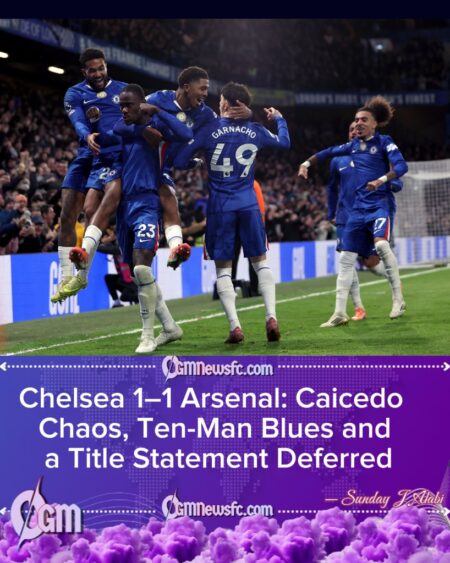
Maresca’s key call came at half-time. Once again, he withdrew Estevao Willian, just as he had in previous red-card matches. The Brazilian youngster had sparkled in Chelsea’s early attacking moves, offering incision and unpredictability, but his manager clearly doesn’t yet trust him to shoulder the defensive responsibility of a 10-man rearguard. Alejandro Garnacho’s introduction was a nod to discipline and tactical structure over improvisation and flair. Any murmurs of discontent in the stands about perceived conservatism were snuffed out when Trevoh Chalobah promptly rose from a corner to head Chelsea into a surprise 1-0 lead.
The next shift underlined Maresca’s growing pragmatism. With Joao Pedro ineffective through the middle, Liam Delap was summoned to lead the line. On paper, the more adventurous option would have been to keep Pedro as a No 10 behind Delap, preserving a double threat. Instead, Chelsea sank deeper, used Delap as a release valve for long clearances and accepted long spells without the ball. The consequence was a disciplined, compact shape that allowed Arsenal few clear chances, even once Merino had headed the equaliser.
In earlier red-card collapses, Chelsea had folded under pressure, representation of a fragile mentality as much as any tactical flaw. Here, although they will rue the soft defending that allowed Merino to score, the performance was notably more resilient. The back line held, the midfield shuffled intelligently and the forwards still posed the odd counter-attacking threat. Maresca will privately lament two points dropped from a winning position; publicly, he can point to a group that is finally learning how to suffer and survive.
James, Arsenal’s Blunt Edge, and the Centre-Back Shuffle
On a night that demanded leadership and clarity, Reece James provided both. Starting in a double pivot with Caicedo, the Chelsea captain anchored his side’s play and produced one of his most complete all-round performances in a blue shirt. His primary brief was to neutralise Declan Rice, and he did so impressively, jockeying, intercepting and blocking passing lanes to ensure Arsenal’s key midfielder rarely dictated from deep.
James’ composure drew fouls and bookings from frustrated opponents: Zubimendi, Riccardo Calafiori and Myles Lewis-Skelly all earned yellows for challenges on him as he continually used his body to shield the ball and invite contact. After Caicedo’s dismissal, his influence only grew. He covered ground tirelessly, filled spaces in front of an increasingly stretched defence and ensured Chelsea’s transitions remained as clean as possible in the circumstances. With the armband on and the odds stacked against them, James set the tone for Chelsea’s grit.
Arsenal, by contrast, never quite found their attacking rhythm. The numbers told a bleak story at half-time: just two touches in Chelsea’s box, their lowest tally of the season, and only one successful dribble. The explosive runs and rotations that eviscerated Tottenham a week ago were absent; movement was predictable, the tempo flat. Saka, usually Arsenal’s cutting edge on the right, was double-teamed and harried by Cucurella and Pedro Neto, and for long spells looked a peripheral figure until his superb cross for Merino’s leveller.
Defensively, Arsenal’s reshuffled centre-back pairing of Mosquera and Hincapie was serviceable rather than spectacular. With Gabriel already missing and William Saliba a late absentee due to discomfort, Arteta was forced to trust a duo who had previously only started together in the Carabao Cup. Hincapie survived a nervy first half, nearly punished for a heavy touch that gifted Pedro a sight of goal, before producing a superb one-on-one recovery tackle on Neto after the break – celebrated in typically demonstrative fashion. Neither he nor Mosquera can be accused of directly costing the goal, but the absence of Gabriel’s aerial dominance and Saliba’s calm distribution was obvious at both ends of the pitch.
For all the talk of Arsenal’s squad depth, this was a reminder that their title hopes remain intertwined with the fitness of their first-choice central defenders and the sharpness of their front line. When both lines are weakened or below par, even a 10-man Chelsea can hold them at arm’s length.
Where Do They Go From Here?
The fixture list offers no time to dwell. Chelsea now turn their attention to a tricky trip to Leeds United on Wednesday, December 3. Maresca will have to re-jig his midfield once more without Caicedo, and that could mean an extended run in the pivot for James or a reshuffle that brings another ball-winner into the side. What matters most is that Chelsea carry the defensive resilience and collective commitment from this performance into Elland Road, a ground that rarely offers visiting teams a quiet evening.
For Arsenal, a home clash with Brentford on the same Wednesday presents an opportunity for an immediate reset. Arteta will hope to restore at least one of Gabriel or Saliba to reinforce his back line and, just as importantly, to reignite the fluid attacking patterns that have driven their best displays this season. He will demand more urgency, sharper movement and greater ruthlessness, particularly if Arsenal find themselves in another situation with numerical superiority.
In the broader arc of the season, this 1-1 draw may ultimately be remembered less as a turning point and more as a test passed at half-strength by both sides. Arsenal preserved their lead in the title race without hitting top gear; Chelsea proved they can go toe-to-toe with the leaders and remain competitive even amid adversity.
Whether this night goes down as a missed chance for Arsenal or a statement of progress for Chelsea will depend on what happens next. If Arteta’s side hold their nerve and sustain their lead into spring, a point at Stamford Bridge may feel like part of a champions’ grind. If Chelsea kick on from here and turn resilience into results, this bruising draw might just be the night they started to believe they belong in the conversation again.